In this episode, the Mystery Inc. Gang visit a Native American reservation to see Velma's Uncle Dave, who seems to have gone missing (Velma's relatives have a tendency to do that). While searching for what happened to him, Scooby finds a monstrously giant owl. At first the gang doesn't believe him but then they see him too. Before you can say "Jinkies" the gang has another mystery on their hands.
Like many of the Scooby episodes from the 1970's, this episode benefits from a wonderful sense of atmosphere. From the woods that the reservation is in the middle of to a creepy cave to a ship out in the middle of the sea, this mystery is full of spooky locations. Each of the locations features wonderful background art, that is incredibly detailed and simply wonderful to look at. This background art also gives the episode a real sense of spookiness. The humor in this episode is also quite good and much of the slapstick with Shaggy and Scooby is simply delightful. The mystery element is also excellent as there are multiple suspects (one named Red Herron (yes, this episode predates A Pup Named Scooby-Doo!)), all of whom would make perfect sense.
The only real problem with this episode is the giant owls themselves. Giant owls make for quite bland Scooby villains. Here they never feel really creepy, threatening or memorable.
Once you get past the monsters being kind of boring, this episode is a lot of fun with a good sense of atmosphere, humor and mystery.
Abbott and Costello Go to Mars has often been looked at as the nadir of the duo's career by many comedy fans. To be fair this film shows the major change in Abbott and Costello plots from the 1940's (when their most popular movies were made) to their later days and often less respected films. There are none of the verbal routines that played a major role in the duo's earlier movies but instead this movie relies more on physical slapstick and outlandish situations for its humor. While I fully understand why many Abbott and Costello fans may hate this movie, I admit to having a soft spot for it. Then again, I first saw it as a kid, when I would have loved anything with Abbott and Costello, so I have a bit of nostalgia for it.
Despite the title Abbott and Costello never actually go to Mars in this movie. When Hideaway Orphans Home's oldest orphan, Orville (Lou Costello), hides away in a truck that is headed for a top-secret lab, he finds himself helping Lester (Bud Abbott), a lab worker load supplies on rocket ship. Naturally through being the lead characters in a slapstick comedy find themselves alone in the ship and cause it take off with them in it. This leads to them flying across the country in this ship and eventually landing in New Orleans. When they land there, they believe they are on Mars and with people being in costumes for Mardi Gras, they believe those people to be aliens. There they also have trouble when two crooks find the rocket ship and two space suits. This causes our heroes to be mistaken for the two crooks. Later in the film the duo as well as the crooks blast off in the rocket ship. They land in Venus, which is completely populated by beautiful women (played by contestants in the Miss Universe pageant). The queen there has a crush on Orville and he is safe with her as long as he stays true to her.
Though this movie does not have a great reputation, I personally find it to be quite a bit of fun. The film moves at a fast pace and the time goes by really quick. Though this is a feature film, it feels like a short because of how quickly it goes by. Though there is no Who's on First level routine here there are some pretty good comedic set pieces here. I especially like the conversation between Orville and the professor, he is mistaken for and our heroes' mistaking people in costumes for aliens gets some pretty good laughs. This film is also one of the duo's silliest movies and I love that the storyline is so unabashedly corny and silly. There is a real charm to a movie that is proud of its own silliness and that is definitely the case here.
I admit though that there are parts of this movie that don't reach the comedic heights they should. This is especially true of the scenes on Venus and our two heroes being in the runaway rocket. There is nothing bad about these scenes but they simply feel like they should funnier. I also admit that the two crooks are not as funny or memorable as they should be.
This film was directed by Charles Lamont, who is too often overlooked by comedy fans. His career began in the silent era when he directed shorts for Mack Sennett and Educational Pictures. At Educational Pictures he directed many of the Juvenile Comedies, a comedy series starring Malcolm "Big Boy" Sebastian. This looks forward to probably his biggest claim to fame, he is often credited with being the one to discover Shirley Temple, and he directed here in some of the talkie Baby Burlesk comedies, a series of short films starring kids. At the same time he was making these he directed some of Buster Keaton's talkie shorts at Educational. After the closing of Educational Pictures, he briefly worked at Columbia studios where he directed Charley Chase in The Wrong Miss Wright (1937) and Calling All Doctors (1937) and The Three Stooges in Playing the Ponies (1937). For Universal Charles Lamount, would become one of the studios best comedy directors. There he directed some of the best Ma and Pa Kettle films and The Francis the Talking Mule movie, Francis in the Haunted House (1956, Lamount's last film). His work with Abbott and Costello marked some of their best later day efforts. Though he mostly directed Abbott and Costello's later films, he did direct one movie with them in their early years, Hit the Ice (1943). His 1950's work with Abbott and Costello including Abbott and Costello in the Foreign Legion (1950), Comin' Round the Mountain (1951), Abbott and Costello Meet the Invisible Man (1951), Abbott and Costello Meet Captain Kidd (1952, for Warner Brothers), Abbott and Costello Meet Dr. Jekyll and Mr. Hyde (1953), Abbott and Costello Meet the Keystone Kops (1955, which featured a cameo by Lamount's former employer, Mack Sennett) and Abbott and Costello Meet the Mummy (1955). Lamount also did some TV work for Disney directed some episodes of Annette (1958), Zorro (1957-1959) and the original The Mickey Mouse Club (1955-1958).
The following is from a 1952 issue of The Independent Film Journal.
"Denver. - A 'date party' contest at a local Air Force base and personal appearances of starlets from the film highlighted the promotional campaign accorded to the promotional campaign accorded the premiere engagement Universal-International's 'Abbott and Costello Go to Mars' at the Paramount Theatre.
"Contest developed by Jack Wodell, Paramount manager, and Velma Bulkely, of Wolfberg Denver Theatres, tied in with a local paper to invite airmen to send in letters of 25 words or less on why they would like a date with a U-I star on Mars.
"Winners were awarded dates with Mari Blanchard, featured in the film, and two of the 'Miss Universe' girls. Airmen met the girls at the airport. In addition, a specular rocket ship theme was provided the Paramount. A large model of a spaceship carrying the film's title was suspended above the marquee above a gala arrangement of flags."
The following is from a 1953 issue of the Motion Picture Herald,
"Universal will send four of the winners in their 'Miss Universe' contest as exploitation for 'Abbott and Costello Go to Mars' - and not a bad tieup with a very reasonable association of ideas. These 'heavenly bodies' are Mari Blanchard, who is featured in the picture, plus Anita Eckberg (Miss Sweden); Judy Hatula (Miss Michigan) and Renate Hoy (Miss Germany). From advance reports, they will take separate trails, so if you see all four 'heavenly bodies' you'll have to hit the road yourself. Gala premiere at the Melba Theatre, Birmingham and the Paramount Theatre, Denver, will start the migration."
Run Time: 20 minutes. Studio: Hal Roach Studios. Director: Fred Guiol. Main Cast: Charley Chase, Edna Marion, Viola Richard, Edgar Kennedy, Bull Montana. Producer: Hal Roach. Cinematographer: Len Powers. Editor: Richard C. Currier.
That Charley Chase is one of the great movie comedians is fortunately becoming more and more accepting among film buff in recent years. However for those still not very familiar with his work, I feel Limousine Love would be the ultimate convincer. This short is an example of silent film comedy at its best as well as simply a very funny movie.
The storyline of this short is simply wonderful and is quite funny in and of itself. Charley is on the way to his wedding, when the limousine, he is riding in, gets into an accident. Charley's chauffeur then gets into a fight with the other driver involved in the accident. The chauffeur loses this fight and Charley is left having to drive the limo himself. This actually goes fairly well until he runs out of gas. Meanwhile a woman (Viola Davis) is learning how to drive and has an accident, that results in her clothes getting very wet and dirty. Seeing Charley's limousine and nobody around, she hangs her clothes up to dry on a tree and pulls down the blinds, while she waits for them to dry. Unfortunately for her Charley comes back and starts the limousine and drives away. He does not know he has a nude woman in the back, and she is now far away from her clothes. When he notices her in the mirror he drives back to retrieve her clothes but ruins them in the process. This is made even worse when the woman's husband (Edgar Kennedy) asks for a ride. When Charley gets to the church, he has to find a way to park without his bride to be (Edna Marion), whom he has already kept waiting for a long time, discovering he has a naked woman in the back.
This is a truly top-notch comedy short and can hold its own among the best works of Charlie Chaplin, Buster Keaton or Laurel and Hardy. Many movie buffs argue that Charley Chase is an overlooked genius of classic movie comedy and you can find no better argument for that than this short. This may in fact be one of my favorite silent comedy shorts. What makes this film so great is it knows perfectly how to set up and pay off a comedic situation. This film starts with a typical situation with some nice little slapstick gags. However as the movie progresses the situation continues to progress to something much sillier and outlandish in a way that feels perfectly natural. As such this is a comedy that just gets funnier and funnier as it goes along. This is simply wonderful comedic filmmaking that not only doesn't call attention to itself but that makes it seem easy and natural.
The following is a review from The Motion Picture Herald (by E.G. Johnson), "Charley Chase can generally be depended on to come through with what this writer considers the best in two-reel comedy making of the present day - and this one is not an exception. Fred Guiol can also be credited with the good direction. As in certain other two reelers to his credit. Charley is on his way to meet his bride. It is their wedding day. From the time his crashes into another the story and action swiftly develops, being built around the fact that a married woman, drenched from a spill in a roadside pool by auto, has invaded the rear of his limousine in order to dry her clothing. Her husband comes along and begs a ride from Charley. Her clothing vanishes down a stream when its rescue is attempted. Suspense, as to the discovery of the wife by the husband, is admirably kept up - right up to the time of the ceremony. The cast includes Edna Marion, Viola Richard, Edgar Kennedy and Bull Montana. An excellent two reeler."
Exhibitors Herald, 1927
Moving Picture World, 1925
Fred Guiol, the director of this film began his career as a prop boy for D.W. Griffith. He joined Hal Roach Studios in 1919 as a camera man. Come 1923 he was directing shorts there. This began with the often-forgotten Spat Family shorts. He went on to direct films starring some of the studio's other stars of that time including Max Davidson and Glen Tryon. He is probably best known today for directing some of the early silent shorts with Laurel and Hardy including Duck Soup (1927), the first film where the duo truly worked as a team. He stayed with Hal Roach into the early talkie era, even directing some of the talkie shorts that Harry Langdon made there. After leaving Roach, he would direct The Wheeler and Woolsey movies, The Rainmakers (1935) and Mummy's Boys (1936). As a writer he would work on such established classics as Gunga Din (1939) and Giant (1956). Both of those films were directed by George Stevens who has also previously been a cameraman for Hal Roach.
Charley's bride to be, Edna Marion had begun her career in the often forgotten Century Comedies around 1924. However she is best known for her work at Hal Roach Studios. There she costarred with Charley Chase in a good number of films including Now I'll Tell One (1927), Assistant Wives (1927), The Sting of Stings (1927), The Way of All Pants (1927), Never the Dames Shall Meet (1927), All for Nothing (1928), The Family Group (1928), Aching Youths (1928) and The Fight Pest (1928). She also worked with Laurel and Hardy in Sugar Daddies (1927), From Soup to Nuts (1928) and Should Married Men Go Home? (1928). Viola Richard, the nude woman, was a regular in Roach shorts during this era. She also appeared with Charley Chase in What Women Did for Me (1927) and Never the Dames Shall Meet (1927). She is best remembered for appearing with Laurel and Hardy in such films as Sailors Beware! (1927), Why Girls Love Sailors (1927), Do Detectives Think? (1927), Flying Elephants (1928) and Should Married Men Go Home? (1928).
The video below talks about the filming locations for this film.
/
Robert Youngston used this short in his feature length compilation film, 4 Clowns (1970). You can watch that movie below.
Hello my friends and happy Saturday morning. Once again it is time for some classic cartoons.
Today's cartoon selection begins with a classic early Merrie Melody, The Queen was in the Parlor (1932). This cartoon features the character Goopy Geer. This was one of Rudolph Ising's attempts to come up with a reoccurring character for the Merrie Melodies cartoons (earlier attempts had been Foxy and Piggy). Goopy only appeared in three short films, Goopy Geer (1932), Moonlight for Two (1932), and this movie. He would much later appear in the Tiny Toon Adventures episode, Two-Tone Town (1992).
Next we join Mickey Mouse, Donald Duck and Goofy in Moose Hunters (1937). This film was not the first time Mickey had hunted a moose. In The Moose Hunt (1931), Mickey and Pluto had hunted a moose. However these two cartoons are very different despite a similar idea. This movie made its TV debut with the Disneyland TV show episode, The Goofy Success Story (1955). The following is a review from The Film Daily, "Plenty of action and fun stud this highly entertaining short with Mickey cast in the role of a hunter. On stilts and enshrouded with foliage, the renowned rodent is camouflaged as a tree. For his two companions, the Goof and Donald Duck, disguise themselves as an alluring female of the moose family so as to attract the majestic Mr. Moose to the spot marked for the kill. Literally ladening the air with the scent of perfume, the plotters succeed not only one but two romantically inclined gentlemen moose to the woodland clearing, where in keeping with classical male tradition, they fight over the lady fair. But when they discover that that the lovely maiden moose is the mean machination of Donald Duck and the Goof they charge to the attack. Mickey and his allies fortunately escape in a canoe. Young and old will love this top-notch reel."
Next is the Fleischer Brothers Superman cartoon, Billion Dollar Limited (1942). Paramount (the distributors of the Fleischer cartoons) brought the screen rights to the famous superhero in 1940, and gave it to the Fleischers to make a cartoon series out of. The studio was not quite sure about this venture after all animated cartoons had not yet done anything similar to a pure action film. They tried to dissuade Paramount by asking for four times the usual budget for one of the studio's cartoon shorts ($100,000) thinking Paramount would refuse. Shockingly they accepted and the series began production. Voicing Superman himself was Bud Collyer, who was already the character's voice on radio. The famous lines "Look up in the sky- it's a bird - no, it's a plane - no its superman" made their first appearance in Superman lore with these cartoons. The following are some exhibitor's reviews from the Motion Picture Herald, "Billion Dollar Limited: Okay. Too bad the animation is so jerky, however. - Palace Theatre, Penacook, N.H." "BILLION DOLLAR LIMITED: Superman Color Cartoons — Poorest of this series so far. Even the kids didn't like this one. Too extreme to get by. The other two we have shown got by pretty well. - S.L. George, Mountain Home Theatre, Mountain Home, Idaho. Small town patronage." "SUPERMAN IN THE BILLION DOLLAR LIMITED: Superman Color Cartoons — We hardly know how to rate these cartoons. Played with a Gene Autry western and the program brought in a lot of kids. Maybe it was the cartoon. - Horn and Morgan Inc., Star Theatres, Hay Springs, Neb. Small Town Patronage." The following is a review from The Motion Picture Daily, "This version of The Great Train Robbery is quite a departure from the original. It involves a billion dollar train shipment. Bandits in an armored car attempt to take over with dynimite, machine guns and other implements of persuasion. Superman speeds to the scene. When the bridge is blown up and train goes toppling over, he dives down, gets a firm grip on it, and brings it back to the tracks. With bullets bouncing off his chest, he then tows it back into the station. The bandits retreat. Apart from the short's obvious value as children's fare, it is so fantastic that adults too should go for it. Running time, 8 mins. Release Jan. 9, 1942."
Now for a Fleischer Brothers Talkartoon, Up to Mars (1930).
Now for a commercial break.
Now for the Pink Panther in Psst Pink (1971). This is the TV version of the short, which unlike the theatrical version contains a laugh track. I chose this version because I really enjoy the little bumpers this show had between the cartoons and this video includes one of those.
Motion Picture Exhibitor, 1966
The Exhibitor, 1964
Now for a Terry Toons short starring Little Roquefort and Percy the Cat, Playful Puss (1953). These shorts may never reach the heights of MGM's very similar Tom and Jerry, but they are quite fun in their own right, even if they continue to go overlooked. This movie in particular has some delightful moments and a fun premise.
Today's cartoon selection ends with Bugs Bunny in Bewitched Bunny (1954). This cartoon marked the first appearance of Witch Hazel in a Looney Tunes cartoon. Rather than being voiced by June Foray (who would take over the voice in the next film, Broomstick Bunny (1956)), here the character is voiced by Bea Benaderet, who would later voice Betty Rubble on The Flintstones. As some of you probably know Disney made a Donald Duck cartoon featuring a witch named Witch Hazel, before this film (that character was voiced by June Foray). Bewitched Bunny would later be used in the feature length compilation film, Bugs Bunny's 3rd Movie: 1001 Rabbit Tales (1982).
Thanks for joining me. Come back next week for another selection of classic cartoons. Until then may all your tunes be looney and your melodies merry.
Though his name may not be known to a lot of you, if you are a Charlie Chaplin fan you have probably seen Loyal Underwood. He was briefly a member of Charlie Chaplin's stock company and appeared in numerous of the great comedian's silent films, including The Count (1916), Easy Street (1917), The Cure (1917), The Immigrant (1917), Shoulder Arms (1918), Sunnyside (1919), Pay Day (1922), The Pilgrim (1923). He would later return to Charlie Chaplin to play a brief role in Charlie's talkie feature film, Limelight (1952). After his original stint with Charlie Chaplin, he would work for the radio station, KNX. This following article fills in some other parts of his career. If you have any trouble reading it click on the page below and use your touch screen to zoom in. Also, his favorite movie actor in the talkies was Rin-Tin-Tin, of course. It is of course always worth noting that magazine articles like these should be taken with a grain of salt.
Radio Doings, 1930
The following article tells a love story involving Loyal Underwood. Again things you read in these articles should be taken with a grain of salt. Also I disagree heavily with the author's view that even the serious films of the silent era were laughable. Click on the pages and use your touch screen to zoom in, if you have trouble reading.
Radio Doings, 1931
The following article about silent film comedian Harry Langdon, mentions a Loyal Underwood from KNX. HMMMM....
Exhibitors Herald, 1926
Here is an example of Loyal Underwood in a Charlie Chaplin film. Loyal has a dual role in this picture. He plays the small father of the big brood and one of the policemen.
This movie begins with Fred getting an email from his Mexican pen-pal, who invites them over to Veracruz, Mexico for a Day of the Dead celebration. Fred excited for the trip invites the rest of the Mystery Inc. Gang. When they get there, they stay at Fred's friend's house. They are enjoying a relaxing vacation, but then they find out that there is a monster on the loose, the legendary, El Chupacabra. Before you can say Jinkies, the gang has another mystery on their hands.
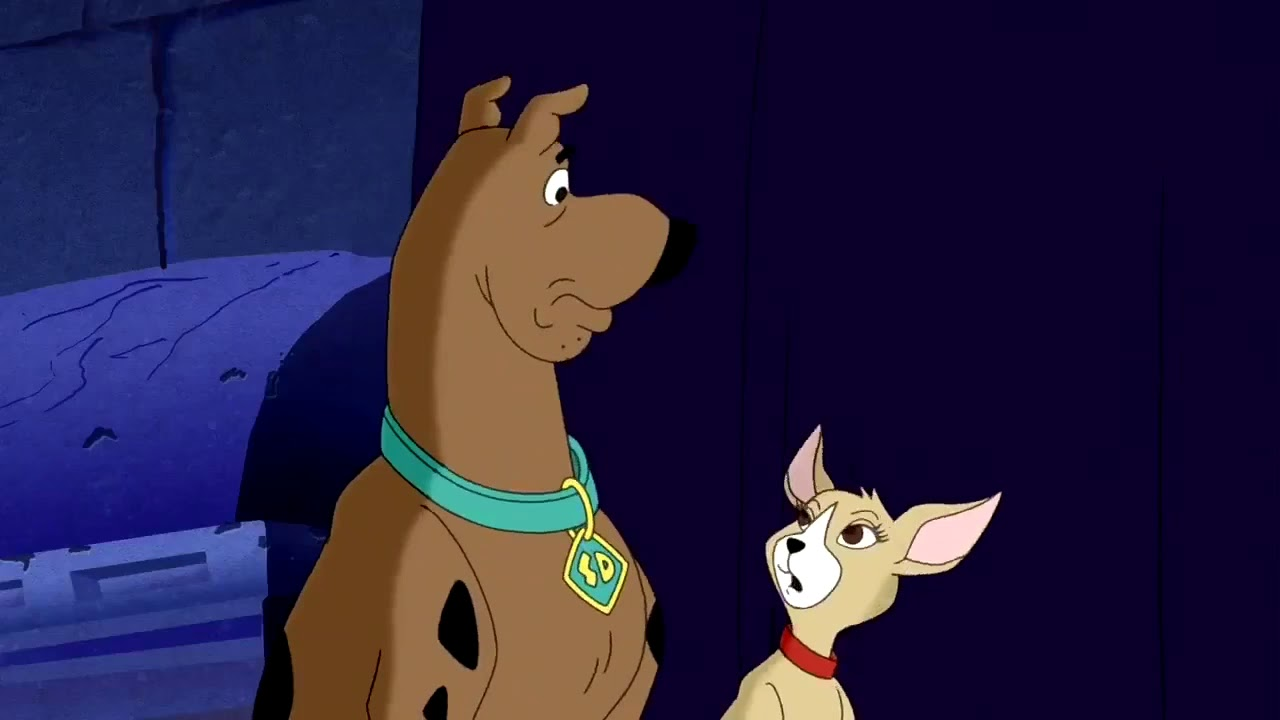
There is a lot to enjoy about this film. The humor is often excellent. I really enjoyed a lot of the slapstick with Scooby, which offers some wonderful cartoony comedy. This is especially true with the scenes where he tries to impress a female chihuahua. The chase scenes are a lot of fun and full of delightful gags. Fred's difficultly with the Spanish language also gives us some pretty good laughs. The mystery is also quite well realized with some very good plot twists. Yet all the clues add up and make perfect sense when the villain is revealed. This film also has quite a bit of the wonderful looking artwork and atmospheric feel that makes this franchise so wonderful. With a completely different type of setting this film can also stand out among the many other Scooby mysteries. The scene in the museum is also delightfully creepy. El Chupacabra is a lot of fun and I really enjoy his design.
However this movie does have its problems. The main monster does not actually appear onscreen as often as other Scooby villains do. Many of the new characters are not that interesting as they don't have much in the way of personality. Also while it may be a matter of personal taste, I did not find the songs all that memorable.
This film marked the last time that Nicole Jaffe voiced Velma and Heather North voiced Daphne. Nicole Jaffe was the original voice of Velma and perfromed the role from 1969 to 1974, only to return to it for two direct to video movies, this one and Scooby-Doo! and the Legend of the Vampire (2003). Heather North was the second voice of Daphne and began voicing the character in the second season of the original series. She continued to voice the character through 1997, when Mary Kay Bergman took over voicing the character starting with the movie Scooby-Doo! on Zombie Island (1998). She return to voice the characters for the same two movies as Nicole Jaffe.
All in all this may not be the best Scooby movie, but it is still a lot of fun.
In this episode the Mystery Inc. Gang takes a trip to Alcatraz Prison. There an old lady warns them of a lady vampire that haunts the area. Naturally Scooby, Scrappy and Shaggy run into this vampire. The vampire looks suspiciously like Daphne, who never seems to be around at the same time as the vampire.
This is one of the best episodes of Scooby-Doo! and Scrappy-Doo! One of the main reasons for this is the villain. This is a villain that is so good, she would have felt right at home in Scooby-Doo! Where Are You? Her design and voice are delightfully creepy, yet never too scary to take away from the show's lighthearted feel. Having Daphne as a suspect also gives this villain a really interesting edge that sets her apart from any similar monsters the gang has faced. This also makes this a more complicated and well thought out mystery than usual. This episode also typically has wonderfully detailed and atmospheric background art that is simply lovely to look at. There is also a pure mastery of lighting that gives the episode the similar type of eerie feel as the old Universal monster movies. While the episode is not laugh out loud funny, there are definitely a few comedic moments that made me smile.
All in all for Scooby fans, this is a wonderful episode. It is also an episode that could hold its own with any episode of Scooby-Doo! Where Are You?
Cartoon and comic book writer (as well as historian) Mark Evanier (who had previously wrote the first episode of this series and some Gold Key comics starring Scooby), turns in an above average script for this episode that helps make this a standout of this series. The Mystery Inc. Gang travels to Tokyo to see a major baseball game between an American and a Japanese team. However the game may not take place due to a dragon demon supposedly haunting the baseball field. Before you can say "Jinkies", the gang has another mystery on their hands.
While many Scooby mysteries of the 1960's and 70's have too few suspects to make the mystery need any thinking to solve, that flaw is not seen in this episode. While there are not many suspects, you could truly buy if one of the other suspects did it. When we find out who done it, the reasoning behind why this person tried to scare everybody is very well thought out. As is the way the gang deduces who the culprit is. The humor in this episode is also quite good. This episode has one of my favorite dialogue exchanges from this series. Shaggy asks, "You mean we traveled all the way to Japan just to chase down another ghost?" Velma bluntly responds, "Let me put it this way... yes." This is perfect and in character for both of them. This episode has some other well-done gags, including Scooby's way of stealing Shaggy's food and the payoff afterwards, Scrappy trying to get the gang's luggage and the ending gag, which is a great cartoony moment. The background work here is excellent as always, with great uses of lighting and shadows, that really bring an atmosphere to this mystery. The actual character animation is above average here and makes the characters come to life.
This episode is a great example of everything I love about Scooby-Doo!
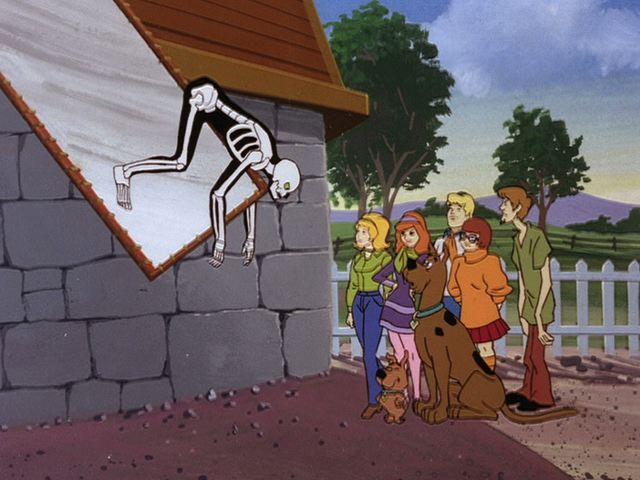
In this episode Daphne is looking forward to visiting her childhood friend, Wendy, who is now a stunt pilot. However when the gang gets near where her airshow is going to be, they find an airfield that is haunted by an evil skeleton who flies a plane and calls himself, The Sky Skeleton.
This episode is just what a Scooby mystery should be. The Sky Skeleton is a great villain. Both his design and voice are perfectly creepy, while not being too scary to take away from the lighthearted feel of the show. The mystery is pretty good, even if again it suffers from a lack of suspects. Our main characters are as likable as ever. Scooby and Shaggy truly get to shine here in some of the episode's best slapstick scenes. The chase scenes are especially good here and are simply just a lot of fun. Once again the background art is fantastic, as is true of all the Scooby mysteries of the 1960's and 70's. With this the episode is just a joy to look at.
I do however wish more time was spent with Daphne's friend, who, while likable, we never get to know very well.
Marla Frumkin, who voices Wendy, would later become the voice of Velma later this season.
A surprisingly funny modern-day update of the Fletch character.
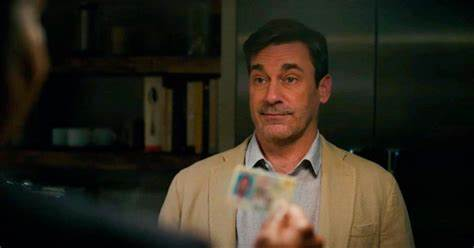
Fletch was not a franchise that I personally excepted to ever come back with a new movie. When I heard there was going to be a new Fletch film, I had very low expectations thinking this would be a cheap cash in on people who have nostalgia for the Chevy Chase films. I was definitely pleasantly surprised to find that this is actually a pretty funny movie. This movie has a different take on the Fletch character than the Chevy Chase films (in fact Fletch doesn't use any disguises in this movie) and that is the perfect way to approach this film. As talented as Jon Hamm (who both stars in and produced this movie) is no one could do what Chevy Chase always did so well. This movie is instead constructed very well to Hamm. He truly shines in this role and is simply a delight to watch. He delivers all the great Fletch wise cracks perfectly and when the film calls for physical slapstick he certainly delivers. He may not be Chevy Chase, but he still shows that he was perfectly cast. The wild antics in this film may be toned down from the previous movies in the franchise, but there is still a lot of great humor. The one liners are wonderful here as are the great running jokes such as Fletch's "mastery" of the Italian language. The physical slapstick is also often fantastic and the scene in the tunnel as well as the fireworks scene cracked me up. The mystery element is also pretty good. While this may not be one of the great movie mysteries, it does its job quite well and has enough good twists and turns to be involving.
Unfortunately as great as Fletch is, pretty much all the supporting players are simply one note caricatures for Fletch to play against or to move along the mystery. None of them are that memorable and often times when they get their own comic moments, they can fall flat.
Studio: Essanay. Director: Charlie Chaplin. Writer: Charlie Chaplin. Cast: Charlie Chaplin, Edna Purviance. Leo White, Jack Henderson, John Rand, May White, Ben Turpin, Wesley Ruggles. Cinematographer: Harry Ensign.
In my opinion, A Burlesque on Carmen is one of Charlie Chaplin's most underrated films.
AS you can probably tell by the title, this film is a parody of Carmen (both the novella and the Cecil B. DeMille movie). Charlie stars as Darn Hosiery (instead of Don Jose), an honest guard, who is lead astray by the seductive gypsy Carmen (Edna Purviance, Chaplin's main female co-star at this time, starring in over 30 films with him).
Charlie had made this short and intended it to be a two-reel comedy. This two-reel version is a fast moving and funny short that also shows Charlie's growth as a filmmaker and how he could have been a serious actor. This version was screened briefly in December of 1915 for critics. The Essanay Studio quickly withdrew the film not long afterwards. When Charlie left the Essanay studio, he had left behind cut footage from this movie. The studio decided to take this footage and create a four-reel version of the picture, so that they could still make money off the Charlie Chaplin name. This version of the movie would not only use footage cut out from Chaplin's version but also new footage featuring cross-eyed comedian Ben Turpin. Charlie hated this new version stating, "I was so impressed with [Cecil B. DeMille’s movie version of] Carmen that I made a two-reel burlesque of it, my last film with Essanay. After I had left, they put in all the cut-outs and extended it to four reels, which prostrated me and sent me to bed for two days. Although this was a dishonest act, it rendered a service for thereafter I had it stipulated in ever contract that there should be no mutilating, extending or interfering with my finished work." Charlie even tried to sue over this but lost the case.
Unfortunately, after this four-reel version was released the studio found little use for the two-reel version. For decades no one was able to see what Chaplin's version might have been like. Because of this many movie fans, have dismissed this film due to the messiness of the longer version. However in 1999, film preservationist David Shepard worked to help create the closest thing to Charlie's original intent. Shepard would say about restoring this movie, "The version I prepared in 1999 attempts to reconstruct the two-reel version of A Burlesque on Carmen, based upon an affidavit from the lawsuit provided by the Chaplin archives in which Charlie details his intended two-reel version. It was impossible to be guided exactly by Chaplin’s testimony. Some of Chaplin’s original shots were removed in the process of editing the four-reel expansion, which now seems to survive only with reissue intertitles from 1928. A few 1916 shots are retained for continuity in this version and most of the intertitles derive from DeMille, but we hope it captures Chaplin’s intention. For those familiar with DeMille’s production, the two-reel A Burlesque on Carmen is actually one of the better Essanay-Chaplin comedies."
The Moving Picture World, 1920
Moving Picture News, 1920
Motion Picture News, 1919
While the Ben Turpin material added for the four-reel version is terrible (and I am saying this as someone who normally likes Ben Turpin), everything featuring Charlie Chaplin is truly wonderful.
At the time he made this film, Charlie Chaplin had not yet evolved into the artist, who would comedy and drama. Nor had he shed off the type of pure slapstick that he had done at Keystone a year earlier. Here is Charlie Chaplin the pure slapstick comedian who would kick someone in the pants just because he could. Yet that does not mean that the humor here is crude or primitive. By this time, he had refined the execution of this humor to near perfection. Each gag is timed perfectly and delivered in such a way to give the greatest comedic effect. Because of this, even with how much I love Charlie's Keystone films, I must admit these very similar jokes are definitely funnier here.
As this film parodies a very elaborate movie, it required more elaborate filmmaking than the average slapstick comedy short. As such this short not only shows Charlie's growth as a comedian but also as a filmmaker. Never before had Charlie made a film that looked as wonderful as this. The attention to detail and the more sophisticated filmmaking makes this truly stand out among the other films he made for Essany. If you find a good restoration of this short, you can see how wonderful this film truly looks. Anyone familiar with the Cecil B. DeMille film will especially love the care that went into capturing the feel of that movie for this parody. While much of the elaborate look of this film comes from the material the short is parodying, this short feels like a look ahead at the even more elaborate and daring feature films, Charlie would later make.
Below are two versions of this wonderful film. The first is closer to Charlie's original plan for the film and the second features the Ben Turpin subplot.
Like how today movies get made based off TV Shows, back in the 1930's there were movies based off of radio shows. Meet the Baron was based off a comedy radio show about the fictional Baron Munchausen. Jack Pearl, the radio actor for the character was hired here to play the Baron (or at least someone who is believed to be the Baron) for the screen.
This film would be directed by Walter Lang. Walter Lang is a director who is mostly associated with musical films like State Fair (1945), The King and I (1956) There is No Business Like Show Business (1954). One of the writers for this film was Herman Mankiewicz, who is known by film fans today for co-writing Citizen Kane. One interesting thing in here is that there is a mule named Rosebud in this. I am not saying this film would have inspired any of Citizen Kane, but it is still an interesting tidbit. On top of this the film has a great cast including Jimmy Durante, Edna May Oliver and Zasu Pitts.
However, what this film is most watched today for is that it includes a group soon to be known as The Three Stooges. At this time they were known as Ted Healy and his Stooges. Ted Healy was originally the boss and leader of the group, yet after some personal problems between them they would separate, and the group would become The Three Stooges. Meet the Baron was the first feature film to feature Curly (although he had appeared in some shorts with this team before). Earlier Shemp would appear in these films with Moe, Larry and Ted. However, Shemp was not happy with Ted and left the group. Shemp was replaced by his and Moe's younger brother, Curly. However, when in 1946 Curly would have a stroke, he would be replaced again by Shemp, who now was willing to be part of the team since they were no longer working with Ted. In this film Curly was credited as Jerry Howard, as his real name was Jerome Howard. This is one of the very few times he would be credited as such. Walter Lang would later direct the Stooges again in the feature film, Snow White and the Three Stooges (1961).
Curly wasn't the only star to have Meet The Baron as a feature film debut. This was the film debut (not just feature) of Lynn Bari, who would star in quite a few B-movies including Return of the Cisco Kid and Hotel For Women.
The story begins with the real Baron (Henry Koller) and his two assistants (Jack Pearl and Jimmy Durante) traveling through the jungle. The Baron discovers they are low on supplies and leaves his assistants out to die. At this time some explorers find the two assistants and mistake one for the Baron (Jack Pearl) and take him and his friend to the U.SA. The phony Baron must keep up the facade and not be found out.
This film is very entertaining, it has a good sense of humor, a great cast and even a great musical number. Most of all though this film is just good corny, silly fun.
Resources Used
The Three Stooges: An Illustrated History, From Amalgamated Morons to American Icons by Michael Fleming
Hello my friends and happy Saturday morning. It is time to get yourself ready for another round of classic cartoons.
Today's cartoon selection begins with a classic Mickey Mouse film, The Delivery Boy (1931). This short film, like all of the 1930's Mickeys, features a wonderful cast of animators. Johnny Cannon animates the opening scene with Mickey riding the delivery wagon and the scene with the dog playing the accordion. Rudy Zamora, who would later direct many of the Hanna-Barbera TV cartoons of the 1980's, animates Minnie washing her clothes. Jack Cutting animates the underwear washing itself. Norm Ferguson (who as an animator helped define the character of Pluto) animates the first scene of Mickey and Minnie's dance, Pluto getting his feet caught in the tar and doing his little dance and the two workers with the dynamite. Frenchy de Trémaudan animates the gag with the goat. David Hand, who would later be the supervising director on the feature films Snow White and the Seven Dwarfs (1937)and Bambi (1942) animates Mickey climbing into the pants, the scene with the hornets and the birds whistling and dancing. Future Donald Duck, Woody Woodpecker and Barney Bear director, Dick Lundy animates the second scene of Mickey and Minnie's dance. George Lane animates the instruments nearly falling on the animals and them running away. Tom Palmer, who would later direct a few cartoons for Warner Brothers and Van Beuren, animates Mickey and Minnie on the Piano. Les Clark, one of the best Mickey Mouse animators, animates Mickey and Minnie playing the trombone, trumpet and drum as well as the gag with the turtle and the mule. Future Looney Tunes and Donald Duck director, Jack King animates the ending sequence from when Pluto picks up the dynamite to the end.
Movie buffs know Jack Hannah best for directing Donald Duck cartoons and Jack Kinney best for directing Goofy cartoons. However, there were times when Hannah would direct Goofy and Kinney would direct Donald. They're Off (1948) has Hannah directing an excellent Goofy short. This film is still very much in the style of Kinney's Goofy cartoons though.
Next up is the 1st Hoot Kloot film, Kloot's Kounty (1973).
Next comes a classic Porky Pig cartoon, Injun Trouble (1938). This short film would later be remade in color as Wagon Heels (1945). The title would later be reused as the name of another Looney Tunes cartoon, a 1969 Cool Cat short that would mark the last of the original Looney Tunes shorts.
Now it is time for a commercial break.
Next comes one of the wonderful Fleischer Superman cartoons, The Artic Giant (1942).
Boxoffice, 1940
Now for a silent movie starring Mutt and Jeff, A Kick For Cinderella (1925).
Next comes a wonderful later Looney Tunes cartoon, Daffy's Rhapsody (2015). Despite this movie being made after Mel Blanc's death, Daffy's voice is still obviously Mel. This is because Daffy's song comes from a 1950 children's record Mel Blanc made that was also entitled Daffy's Rhapsody. This short film was released in movie theaters before the feature film, Journey 2: The Mysterious Island (2012).
Today's cartoon selection ends with some Saturday Morning Minions.
Thanks for joining me, come back next week for more animated treasures. Until then may all your tunes be looney and your melodies merry.
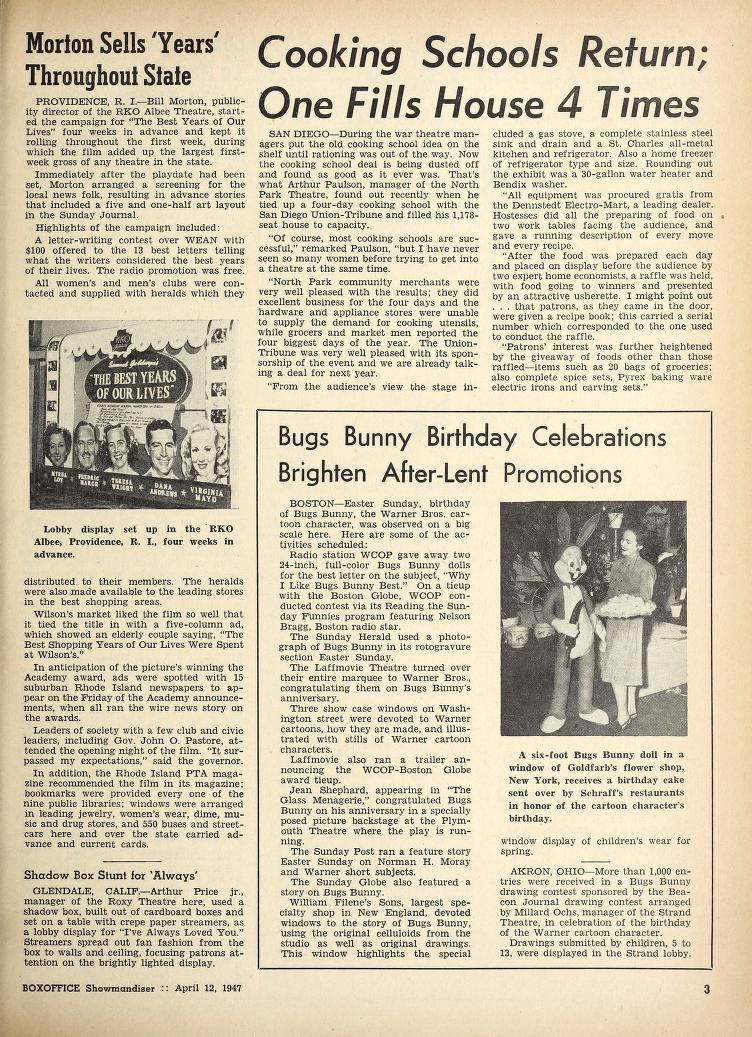
Today marks the 82nd Birthday of everybody's favorite wascally wabbit, Bugs Bunny. Bugs' first officially appearance was Tex Avery's A Wild Hare (1940), which first played in movie theaters on July 27th, 1940. To be fair the point as to whether this was the first Bugs cartoon has been argued. A wacky rabbit character first appeared in a Looney Tunes film with the Porky cartoon, Porky's Hare Hunt (1938). Some cartoon fans believe that to be the first Bugs cartoon, while others veiw it as a diffrent character. Never the less, Bugs first appeared fully formed as the character we know today in A Wild Hare.
Like many cartoon stars of the day old movie magazines never got Bugs' birthday right. Neither July 27th or the day Porky's Hare Hunt was released, April 30th, where given as Bugs' birthday. Often times being a rabbit, his birthday was given as Easter Sunday, whatever day that happened to be on. These following articles should give you an idea what I mean. If you have trouble reading either of them click on the pages and use your touch screen to zoom in.
Box Office, 1947
Boxoffice, 1948
My favorite of these articles is the following one from 1961 which lists Bugs as being 25 years old. I'll let you do the math to figure out what is wrong with that.
Boxoffice, 1961
I love that on Easter Sunday, a movie theater would have a special Bugs Bunny day as evidenced by the below page.
Showman's Trade Review, 1946
Film Daily, 1948
Like many movie fans, I have been a fan of Bugs since as far back as I can remember and my fondness for him has not died down in any way. His best films are timeless and will never lose any of their charm. If you have ever seen a Bugs cartoon in a movie theater, than you know just the effect Bugs still has on audiences. Bugs has never stopped staring in cartoons, whether for movie theaters, TV or streaming services, Bugs will always be up to something new because audiences will never stop wanting more Bugs Bunny. Just recently there Bugs Bunny show, Bugs Bunny Builders.
A movie I am going to watch today to celebrate Bugs' birthday is the wonderful feature-length compilation movie, The Bugs Bunny/ Roadrunner Movie (1979). This was the first (and best) of three feature length compilation films starring Bugs Bunny and I watch the movie every year on Bugs' Birthday.
Let us end this birthday celebration with a classic Bugs short film.







.jpg)

