A 1930 issue of Exhibitors Hearld dedicated a large section to promotion for upcoming films for MGM. Here is part of that section, which is dedicated to the short subjects that MGM would be making a distributing (including the films from Hal Roach Studios) in 1930 and 1931. It states, "The Greatest Short Product Line Up MGM Has Ever Offered." While this is obviously just publicity, it is hard to argue with a lineup that includes Laurel and Hardy, Our Gang (AKA The Little Rascals), The Boy Friends, Charley Chase and Ub Iwerks' bizarre Flip the Frog cartoons.
Now enjoy some shorts from 1930 and 1931.
You have seen Burton Holmes in the article. This is a name that you may not be familiar with. So here is a short video about him and his films.
Run Time: 82 minutes. Studio: Keystone. Director: Mack Sennett. Writer: Hampton Del Ruth. Based off of the stage play Tillie's Nightmare by Edgar Smith and A. Baldwin Sloane. Producer: Mack Sennett. Cast: Marie Dressler, Charlie Chaplin, Mabel Normand, Mack Swain, Charles Bennett, Douglas Banks, Chester Conklin, Edgar Kennedy, Charles Parrott, Glen Cavender, Harry McCoy, Phyllis Allen, Gordon Griffith, Rube Miller, Billie Bennett, Frank Opperman, Nick Cogley, Fritz Shade, Morgan Wallace, Charlie Murray, Minta Durfee, Hampton Del Ruth, Hugh Saxon, Fred Fishback, Ted Edwards, Hank Mann, George "Slim" Summervillie, Al St. John, Edwin Frazee, Bill Hauber, Dan Albert, Billy Gilbert, Robert Kerr, Alice Howell, Eva Nelson, Dixie Chene, Wallace McDonald, Alice Davenport, Eddie Nolan, Grover Ligon, Josef Swickward, Frankie Dolan, Dick Smith, Meiklejohn and Hazel Allen, Helen Carruthers.
Often referred to as the first feature length comedy, Tillie's Punctured Romance is far from an obscure film. Yet at the same time, I often feel that it gets too overlooked. Many tend to just view it as a footnote in film history. Even with Charlie Chaplin in it, dedicated Chaplin fans tend to not discuss this movie and instead prefer to look at Chaplin's later features that he directed and wrote. This may not be on the same level as such masterpieces as The Gold Rush (1925) or City Lights (1931). However, it is a comedy that is over a century old and is still quite entertaining. That definitely accounts for something.
In this film, a con man (Charlie Chaplin) from the city tricks a naïve country woman (Marie Dressler) to flee to the city with him. As soon as the con man gets her money, he leaves her flat. When he discovers that the woman is heir to a large fortune, he comes back to her having had "a change of heart."
The storyline for this film is pure melodramatic hokum. This is not by accident nor is this lazy writing. From its very start the Keystone studio made short films that were parodies of melodramas, using these familiar storylines that were often taken seriously and use them as an excuse for slapstick comedy. It is no wonder that the studio's first feature length movie would also parody melodramas. Adapting the stage play Tillie's Nightmare was a perfect idea for the studio's first feature length movie as the stage play didn't take these melodramatic conventions very serious either.
For fans of silent comedy, this movie is a delight. Of course, one of the treats is to see so many silent comedy greats in one film. Cinephiles can have a great time seeing just how many silent comedy stars, they can catch and name. Another delight is to see Charlie Chaplin play against type. He is wonderful as the villainous conman here. His performance is a bit more over the top than he often is as his famous Tramp character. However, this is just what the movie calls for, and he does a great job. He commands the screen every time he appears.
While most of the gags here may not be as laugh out loud funny as some later silent comedies, many of them do get some good chuckles and there is a great sense of comic momentum that lasts through the whole movie. Many of these gags may be simplistic and crude but they are delivered with such dedication, and zest that they actually work. There is such a lighthearted playful spirit here, that even when you don't laugh at a gag, you still enjoy it. The comedic highlight however is the whole climatic chase with the Keystone Kops getting involved. This chase is silent comedy making as its finest. There are so many slapstick gags in this finale and many of them are quite funny and creative. This climatic scene alone would make this movie essential watching for silent comedy fans.
Another creative and charming scene involves Charlie Chaplin and Mabel Normand's characters sitting in a movie theater watching a film that greatly resembles what has been happening in their lives. This scene is not especially funny, but it is still delightful. I have always been a sucker for a well-used film in a film, and this is an early example of just that. Not only is the film in a film quite entertaining in its own right but it is a delightfully fun and creative way to express what is going on the characters' minds. For cinephiles, it is also a delight to get a glimpse into what the movie going experience was like in the 1910's.
The play, Tillie's Nightmare, itself was very popular. At the Herald Square Theatre (1331 Broadway (29 W. 35th St.), New York, NY), it ran from May 05, 1910, to Jul 09, 1910. At the Manhattan Opera House (30 Lincoln Center Plaza, New York, NY) (now Manhattan Center), it ran from Dec 18, 1911, to Dec 23, 1911. Director, producer and studio head, Mack Sennett stated in his autobiography, King of Comedy, that scenario editor Craig Hutchinson had suggested to make an adaption of the play. The play was a musical, well-known at the time for the song Heaven Help the Working Girl, and naturally a lot had to be changed from stage to screen. Sennett recalled that Hampton Del Ruth and a team of other writers used only the play's story as a loose guideline.
The star of stage play was Marie Dressler. Dressler was a very popular stage actress, and Tillie's Nightmare had been her greatest stage success. Mack Sennett mostly planned to fill the movie's cast with Keystone regulars, but he did want Dressler to reprise her role on screen. This had not been Sennett's first interaction with Dressler. When Sennett was a young novice in the entertainment industry, Dressler had helped the young man. She wrote him a letter of introduction to David Belasco (a popular theatre producer and playwright). Later Sennett would claim that Dressler moved to California to make this movie. Dressler however denied such claims, stating that she moved to California because of her nerves after a recent failure in her stage career.
Sennett would meet Marie Dressler outside a movie theater. They agreed to meet a hotel to discuss the film project. During the hotel meeting Marie Dressler agreed to work for $2,500 a week (for comparison Charlie Chaplin was being paid $200 a week). During this meeting there seemed to be a verbal agreement that Dressler would own half the film and her husband, James Dalton, would distribute it. This is not how things worked out. Though Sennett was in charge of the studio's production, the Keystone company was actually created and owned by Adam Kessel and Charles Bauman from the New York Film Company. Kessel and Bauman would sell the distribution rights to the Alco Film Corporation. Because of this, Dressler took legal action against the Keystone Studio, but this was ultimately unsuccessful.
Filming began in late April 1914 and wrapped up late July of the same year. There would be some delays in filming. Of these delays Glenn Mitchell writes in The Chaplin Encyclopedia, "The main difficulty lay in Miss Dressler's memory of him [Sennett] as an unknown, rather than as the boss of a studio, and consequent unwillingness to take direction until baffled by the techniques of filmmaking."
Much of this movie was filmed on location in Hollywood. Anyone has been to Hollywood recently will find it unrecognizable watching this film. At the time, Hollywood was not the major city that it is today. However certain buildings can still be seen today.
One of these is The C.E. Toberman Building (6410-6146, Hollywood Boulevard), which can be seen when two cops meet Tillie in the middle of the street after Tillie gets drunk as well as when Charlie falls in the middle of the street and Tillie picks him up. The same building can be seen in the classic Harold Lloyd feature, Why Worry (1923), when Harold announces to his giant friend that he is going to be a father. A shot of the back of this building can be seen in Buster Keaton's classic comedy short, The Goat (1921).
When Tillie waves to a cop flirtatiously, she is standing on the porch of the Hollywood Hotel. This hotel was located on the northwest corner of Hollywood and Highland. At one time this hotel was a center for the social life in Hollywood. However, it would be demolished in 1956. There today is the Hollywood & Highland Retail and Entertainment Center.
When two cops are escorting a drunk Tillie into the police station, they are actually taking her to the entrance door for the Keystone Studio. This was also used as an entrance to a police station in the Roscoe "Fatty" Arbuckle short, Fatty's Plucky Pup (1915). It even appeared as the entrance to a dentist's office in the Charlie Chaplin short, Laughing Gas (1914).
When Tillie flirts with a cop after being released from jail, she is on Duane Street by the back corner of the wall for the Selig studio (the first permeant movie studio in Los Angeles). You can also see two homes in these shots. The homes were 2212 and 2216 Duane Street, both of which are now apartment buildings.
The entrance to Tillie's wealthy uncle's place is Castle Sans Souci, which had formerly been located at 1901 Argyle. It was torn down in 1928 and the Castle Argyle Apartments, which are still standing today.
During the climax, you can see in the background the original Los Angeles Fire Engine Co. No. 20, which was located at 2144 Sunset. You can also see this in the background of the Charlie Chaplin short, Cruel, Cruel Love (1914).
Comedian Milton Berle often times claimed to be a newsboy in a brief scene. This has been greatly disputed with many historians crediting the role to child actor Gordon Griffith. Later Griffith approached Charlie Chaplin and described the scene he claimed they made together, while Chaplin was filming A Countess from Hong Kong (1968). Chaplin just unenthusiastically stated, "oh I see ... exposition" and then went back to work.
Moving Picture World, 1915
Moving Picture World, 1915
This film was reissued to theaters in 1920. The following is an article about this reissue from an issue of The Moving Picture World (dated January 17, 1920).
"From W.H. Productions comes information that 'Tillie's Punctured Romance' is being revived by Tower Film Corporation. This Mack Sennett favorite, featuring Charlie Chaplin, Marie Dressler, Mabel Normand, Mack Swain and Chester Conklin, has a great reputation to be revived with the showings.
"It early accomplished what the 'glooms' argued couldn't be done - that the screen could make people laugh. Yet thousands laughed at 'Tillie's Punctured Romance.' This production mad history for screen comedy and records for exhibitors and exchange men.
"A special exploitation campaign, unique in character and destined to put the picture over in an even bigger way than heretofore is being planned. This will include new advertising material of every description, new posters, lobby photos and displays.
"'Tillie's Punctured Romance' is one of the pictures which serves as sort of a high watermark in box office receipts by which others are measured. 'As big a winner as 'Tillie'' or 'as good as 'Tillie,'' are expressions of motion picture exchange men and exhibitors. Seldom does the independent market get unusual money makers, and when they do, they are not soon forgotten.
"A special exploitation and press sheet is now being prepared for 'Tillie,' containing copies of newspaper cuts, special advertisements, press stories, catch phrases, exploitation ideas, suggestions and special 'stunts.' Every aid that can be given to the exhibitor to put this picture over as provided."
Moving Picture World, 1920
The movie was so popular that it spawned three sequels Tillie's Tomato Surprise (1915), Tillie Wakes Up (1917), and The Scrub Lady (1917), all of which featured Dressler reprising her role. The film would also be remade in 1928 with the same title. That remake would star Louise Fazenda, W.C. Feilds and Chester Conklin. Unfortunately, that remake is considered lost.
You can watch this movie on YouTube below.
Resources Used
The Chaplin Encyclopedia by Glenn Mitchell.
A-Z of Silent Film Comedy by Glenn Mitchell
Chase! A Tribute to the Keystone Cops edited by Lon and Debra Davis
Run Time: 20 minutes. Studio: Hal Roach Studios. Director: James Parrott. Titles: Reed Heustis. Producer: Hal Roach. Main Cast: Charley Chase, Lupe Velez, Eric Mayne, May Wallace, Gale Henry. Cinematographer: Len Powers. Editor: Richard C. Currier.
Though never achieving the same popularity as Charlie Chaplin, Buster Keaton, Harold Lloyd or Laurel and Hardy, Charley Chase is a fan favorite among many classic comedy lovers. Though his talkies are often delightful comedic treats, I often times find Charley's silent films to be his best work (I am also a fan of the Three Stooges shorts he would direct later). Some of his silent films are true comedy classics that deserve the same masterpiece status as the work of the best silent comedians. I have written about some of my favorite of his silent shorts on this blog before and this month I would like to call attention to another. What Women Did for Me is a classic that deserves to be better known.
In this short film, a botany professor, who is terrified of women finds himself teaching at an all-girls college. This proves to be too much for him to handle and when he decides to take a little getaway, his female students follow him.
This is a true comedy classic and one of my favorite Charley Chase shorts. The film moves at a fast pace and offers gag after gag. There is not a single gag that falls flat here and the comedic energy makes it a joy to watch. What also helps is that the gags build upon each other. There is a real structure to each gag that makes each one funnier than the last. This type of structure is one of the hardest things for filmmakers to do when making a comedy. However here it feels so natural and easy. Charley is great in the main role, perfectly getting over the sense of being terrified of women without making the reactions too over the top to be believable. His female co-stars however often steal the show, getting just as many laughs, if not more, than Charley himself. In most comedies these young women would just be pretty faces, while the comedy is left to the male star. Yet each of these young women were very talented comedians in their own right. However, what makes this film a must watch is the ending. True to the format of making each gag funnier than the last, this ending is laugh out loud funny and truly brilliant in how it subverts our expatiations.
One reason this film will stand out to current movie buffs is that it features one of the earliest film appearances by Lupe Velez. Sadly, for many Velez's life and career have been overshadowed by her tragic death. She was found dead on the toilet after having an overdose with a suicide note nearby. Many believe that she killed herself because she was about to have a child out of wedlock. However, her movie career is well worth remembering. She appeared in such classic films as The Gaucho (1927), Where East Is East (1929), The Squaw Man (1931), Palooka (1934) and Stardust (1937). In the 1940's she starred in the very popular B-movie series of Mexican Spitfire films. These films work almost solely because of her larger-than-life personality and charisma. Comedy lovers may also know her for playing against Laurel and Hardy in a delightful scene in the movie Hollywood Party (1934).
Gale Henry, though forgotten today had quite a comedy career herself. She was the first woman to headline a series of short comedies. She spent much of the 1910's starring in comedies by independent producer Pat Powers and Universal's Joker comedies. In early 1915 she co-starred (with Max Asher) in a series of 11 one-reelers for Pat Powers entitled Lady Baffles and Detective Duck. By the mid-1920's she was mostly working in supporting roles for comedies starring other comedians. These films include the Charley Chase short, Mighty Like a Moose (1926) and the Laurel and Hardy comedy, Love 'em and Weep (1927).
Director James Parrott was the brother of Charley Chase. As well as his directing career he had starred in 75 silent short comedies (as well as supporting Harold Lloyd in some films) for Hal Roach Studios (for which this film was made). In some of these films he was credited as Paul Parrott and some of these shorts have been mistakenly identified as early credits for Charley Chase. However, he had success behind the camera. He began directing in 1924 and would direct 89 films from 1924 to 1935. He is probably best known today for the Laurel and Hardy shorts he directed. Those include some of the duo's best films including Two Tars (1928), Habeas Corpus (1928), Blotto (1930), Pardon Us (1931), Helpmates (1932) and the comedy team's most famous film, The Music Box (1932) (you know the one where they push the piano up the flight of stairs). Outside of Hal Roach Studios, he also worked as an uncredited writer on a true comedy classic, Duck Soup (1933) with the Marx Brothers. Born on August 2, 1897, in Baltimore, Maryland, James passed away at the age of 42 on May 10, 1939. His death was reported as a heart attack.
Motion Picture News, 1927
Two more Hal Roach regulars who worked on this film were cinematographer Len Powers and editor Richard C. Currier.
Len Powers was born on December 12, 1892, in Rodney Iowa. Before his time in the movies, Powers had been a professional boxer. He began his film career in 1914 at the Reliance studios. Two pre-Roach credits for Powers included Blue Blood and Red (1916) directed by Raoul Walsh and Headin' South (1918) starring Douglas Fairbanks and directed by Allan Dawn. The first film he worked on for the Hal Roach Studio was the Our Gang (AKA Little Rascals) short, Young Sherlocks (1922). As well as working as a cameraman, Powers also directed or co-directed 14 of Roach's Dippy Doo-Dad shorts. These live action shorts featured animals in human type roles. Because of this, he was assigned to film the rooster that crows in the Pathe logo. After his time with Roach, he would work at Universal in the early 1940's. By the end of the 1940's he would be a camera operator on Johnny Mack Brown B-westerns. His last known credit is for shooting stills for the Best Picture winner, Around the World in Eighty Days (1956). He passed away on January 25, 1965, from a heart attack.
Richard Currier was born on August 26, 1892, in Denver, Colorado. He began editing films in 1911 for the Selig Company. He started working for Hal Roach around 1921 under Thomas J. Crizer, head of the studio's editorial department. Crizer left in 1925 and Currier was promoted to the new head of the editorial department. Currier received sole editorial credit for on every Hal Roach film from then until mid-1933. However, he was the first to acknowledge that his role was more as a supervisor than anything else. Later in the 1930's he would work at Paramount on films featuring W.C. Feilds as well as Burns and Allen. He would go on to work on such TV shows as The Adventures of Wild Bill Hickok and The Whistler. He would run his own Hollywood editorial service until his retirement. He died on December 14, 1984 at the ripe old age of 92.
Motion Picture News, 1925
You can watch this film below on YouTube in quite poor picture quality. To see it in better quality get the Blu-ray set Charley Chase at Hal Roach: The Late Silents: 1927. You won't regret it.
Resources Used
Laurel and Hardy: The Magic Behind the Movies by Randy Skredvedt
For those of us who love classic comedy, Hal Roach is a legendary name. He produced many classic films starring the likes of Laurel and Hardy, Harold Lloyd, the Our Gang kids (also known as The Little Rascals), Charley Chase and plenty more. All these years later these films stand as some of the greatest comedies of all time. So of course, for us any book about Hal Roach makes for essential reading. However, this book stands as one of the best books about the subject. This is because it not only gives us a historical overview of one of the best comedy studios of all time, but it also gives us the most vivid portrait of Hal Roach as a person available.
Author Craig Calman is a comedy filmmaker himself who discovered the work of Hal Roach at a very young age becoming enamored with the films of Laurel and Hardy. Little did he dream as that young kid that one day he would meet the producer of those classic Laurel and Hardy films. At the age of twenty he went out on a limb and tried to contact Hal Roach, when working on a term paper. This resulted in a decades long friendship. This book is the result of that friendship. Much of the book is filled with quotes from Hal Roach. Because of this we not only get a view of how films were made at the Hal Roach Studio but also insights into Hal Roach viewed comedy and filmmaking. His views on comedy are quite revealing from him speaking about taking children into consideration but never making films only for them to him talking about how he believed that comedies should not exceed forty-five minutes (though he would make feature length comedies out of necessity). He even speaks about others in the comedy field from Mack Sennett to Benny Hill. While I may not agree on some of those comments, they do say a lot about his approach to comedy and how it differed from others. Even the times when Roach's memory proved to be faulty, what he remembers about his own work says a lot about the way he viewed his career and the various films he worked on.
Though by design this book cannot go into as much detail about individual films as Randy Skretvedt's Laurel and Hardy books or Leonard Maltin and Richard W. Bann's book about Our Gang, it still gives a very nice historical overview of the work from this movie studio. Probably most valuable is that for each year of the studio's existence, Calman provides a list of how many films were made with each of the studio's comedy stars as well as how many dramatic features or special productions were made for each year. Calman as well as using his personal experience with Hal Roach also digs into studio documentation and old movie magazines to create an even greater dig into the history of these films.
Also unlike many histories of the Hal Roach Studio, this book does not neglect the studio's later involvement in TV. This includes both TV shows made by the studio and those that used the studio's resources for filming (did you know The Abbott and Costello Show was filmed there?).
This book is a must have for any fan of classic comedy.
Leonard Maltin's The Great Movie Shorts is a seminal book on classic short subjects. While this book is still incredibly enjoyable and informative today, to truly appreciate it, you must put into the context of the time it was written. At this time most writings about movie focused on "important" films, nearly all of which were feature length. A whole book long study of the live action short subject of the 1930's and 40's was something virtually unheard of. Today there have been many books written about classic short subjects (Leonard Maltin would even co-write another on (with Richard W. Bann), The Little Rascals: The Life and Times of Our Gang). As such this could have been a very basic history and still been an important book. That this is such a well-researched and incredibly informative (even today) book at this time makes it all the more impressive.
This book is broken up into multiple different sections. The first of these is brief history of each major (and some not so major) Hollywood studio and their output in the short subject field. The second is a survey of many of the classic short subject series. This section makes up the bulk of the book and as well as the surveys each series gets a filmography giving you a list of each film, acting and directing credits and a plot summary. This section includes the most popular and famous series such as Laurel and Hardy, The Three Stooges, Our Gang (AKA The Little Rascals), Joe McDoakes, Pete Smith (whose shorts play on TCM regularly) and Charley Chase. Also included are the sound shorts of the beloved silent comedians Buster Keaton and Harry Langdon (the talkie work of legendary silent comedy producer Mack Sennett is even chronicled in this book). Here you get a great picture of an overlooked part of the work of some true Hollywood legends. There are also many series here that even the most avid cinephiles will not have seen or maybe even heard of. Not all the series listed here are comedies as we also get a look at such series as Crime Does Not Pay, John Nesbit's Passing Parade and Screen Snapshots. After this comes surveys of various genres that were not talked about in depth elsewhere in this book (newsreels, travelogues, musicals and sports).
With all this the book marks a perfect introduction to those who wish to get further into classic short subjects, letting you know all aspects of the classic live action short subject, so that whatever your interests may be, you will know when to start. Maltin's writing also often fully reflects his passion for the subject and will make you want to seek out many of the films he has written about. Yet this book is equally essential to seasoned movie buffs. It's in-depth filmographies, look at obscure films (as well as the better-known ones), surprisingly in-depth histories and especially its quotes from many of those who worked on these films (many of whom Maltin talked to firsthand) make this just as essential reading for true cinephiles. Beyond this the book is simply a lot of fun to read.
This book would be reissued and updated in 2015, when it would be retitled Selected Short Subjects" From Spanky to the Three Stooges.
This book should have a treasured place in every movie buff's library. It certainly has a very cherished place in mine.
Guess what my friends, today is my birthday. I am officially 33 years old.
I celebrated my birthday yesterday with a small group of good friends. We all went to my personal favorite place in the world, Old Town Music Hall to see the classic silent Alfred Hitchcock film, The Lodger (1927). Though this was Hitch's third film as a director, it is the movie that the master of suspense would refer to as the first real Hitchcock film. Not only is it his first suspense movie but it is the film that would introduce many of the themes that would play a major role in his most popular work. The film was accompanied live on the Mighty Wurlitzer Pipe Organ, which was being played by the wonderfully talented musician, Robert York. Some of my friends had never seen a silent movie before and I am very happy to report that they very much enjoyed it.
Of course, I have long been a fan of Hitch's British films, many of which hold their own with his more famous Hollywood work.
As someone who is passionate about both movies and country music, I love that I share my birthday with both Turner Classic Movies and Loretta Lynn.
On the topic of Loretta Lynn, I still consider Coal Miner's Daughter (1980) to be the best musical biopic.
Also mentioning TCM, I am extremely excited about the TCM Film Festival, later this month. The schedule is already up and there are tons if great films lined up. /
Though TCM is still my favorite TV channel. However, METV Toons is now running a close second. This new channel is truly a godsend for cartoon fans everywhere. This is the type of cartoon channel; I have wanted to exist for my whole life. Rather than being aimed at kids, this channel is aimed at an audience that I fall perfectly into. This is the audience of film buffs who love cartoons. It is filled with cartoons that range from beloved classics to compete obscurities.
On the subject of animation, lately I have also been on a real Disney kick, especially old school Disney.
I am of course always on a silent comedy kick.
/
/
What is a better way to end this post than with one of the greatest short comedies ever?
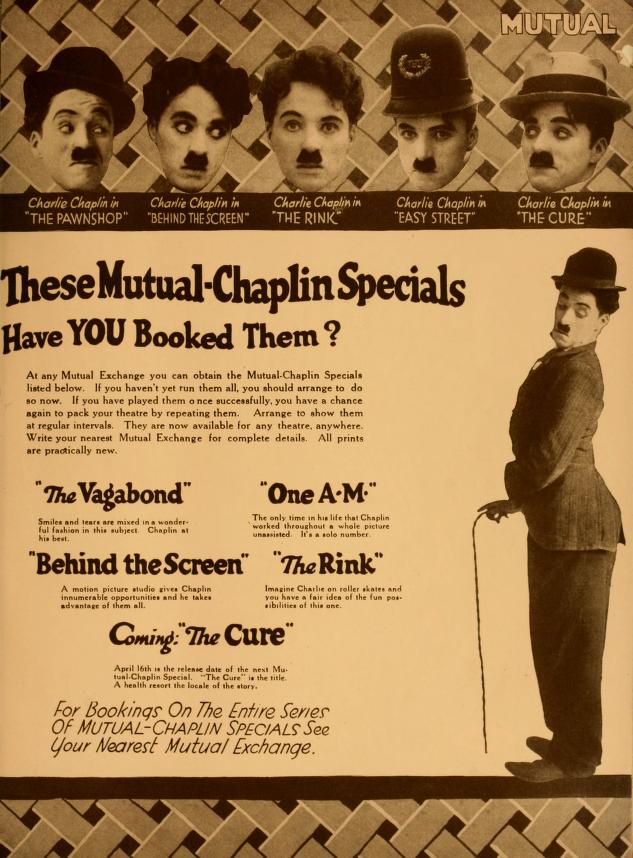
Hello my friends. I think it is a good time to take another look at the short films of my personal favorite filmmaker Charlie Chaplin.
Let us start with one of Chaplin's most beautiful films, The Vagabond (1916). Around this time, Charlie had been working on combining his slapstick comedy with real drama and pathos. Though he had already made some good films in this vein, this short shows him taking it to a new level with incredible results. In reality the plot is something that had already been done many times in movies, but Charlie does it with such sincerity that it remains incredibly touching. There has long been a rumor that this film's (SPOILERS) happy ending had been added to appeal to a wider audience, who did not want a comedy with a sad ending. Supposedly the original ending would have had Charlie jump into the water after the girl leaves. To end with a joke, he would be rescued by a woman but discovering this woman is incredibly ugly he would have jumped back in. Chaplin supposedly filmed this scene and kept it for himself. However, this rumor has never been proven true. There is however a wonder outtake that was done as a practical joke with the girl walking in on her long-lost mother much too early during the art gallery scene. (END SPOILERS) This film also benefits from a fine supporting cast that includes Enda Purviance, Eric Campbell, Lloyd Bacon (who would go on to become a director of such movies as 42nd Street (1933), Footlight Parade (1933) and Marked Woman (1937)), Charlotte Mineau, Leo White (in a dual role as a gypsy woman and a Jewish customer) and Frank J. Coleman. The band of musicians outside the bar would be played by Chaplin regulars John Rand, Albert Austin and James T. Kelly.
Moving Picture World, 1917
It is a shame that Charlie Chaplin and Roscoe "Fatty" Arbuckle didn't work together more. They simply made a perfect comedy team in today's next short, The Rounders (1914). While the story is slight and the gags are predictable, this film is a must watch for silent comedy fans simply for how well these two greats work together. Here the two feel like a well-established well into their teaming, rather than two comedians who were simply making a film together. Roscoe regretted that they did not make more films together and stated, "I have always regretted not having been his partner in a longer film than these one-reelers we made so rapidly. He is a complete comic genius, undoubtedly the only one of our times and he will be the only one who will still be talked about a century from now." Arbuckle's wife is played by his real-life wife Minta Durfee and Charlie's wife is played by Phyllis Allen. Al St. John platys a bellboy here. Al was Roscoe's nephew and would work in many films with his uncle. In a brief role as another dinner is a future great film comedian Charley Chase.
By the Sea (1915) is a Chaplin short they I think deserves more attention. This film is often viewed as quick little one reel comedy that Charlie churned out while more attention was paid to his more ambitious films of the time. In some ones this might be true. The whole picture was shot simply in one day and stylistically this film resembles his earliest work at the Keystone Studio (this film was done for Essanay after he left Keystone). There is little to no story here but simply a bunch of slapstick gags revolving around a simple setting. Many of his early comedies for Keystone would simply be little slapstick gags around a bunch of characters with romantic misunderstandings in a park. Because of the similarity but different setting, this film has often times been called a park comedy without a park. As is common with nearly all Chaplin shorts, this film benefits from a wonderful supporting cast. The big burly man is played by Bud Jamison, who would later become a regular foil for The Three Stooges. Billy Armstrong played the man that Charlie is fighting with. He would also appear in other Chaplin Essanay films including The Tramp, Work, A Woman, The Bank and Shanghaied (all 1915). Billy's wife is played by Margie Reiger and Bud Jamison's wife would be played by Charlie's main leading lady at this time, Edna Purviance. Snub Pollard can be seen briefly as the ice cream vendor, though he is nearly unrecognizable due to not having his famous moustache. Snub would go on to have his own series of short comedies in the 1920's at Hal Roach Studios. Also at Hal Roach, he had been a regular presence in Harold Lloyd's short comedies. Snub would much later appear as one of the street musicians in Chaplin's talkie feature, Limelight (1952). This picture was shot along Ocean Front Walk and Abbott Kinney Pier in Venice, California.
Moving Picture World, 1920
Laughing Gas (1914) is another pure knockabout Chaplin comedy. Like many of Charlie's early films for Keystone, there is no effort to make his character, the slightest bit likable here. In fact, many of the gags make him seem pretty much sadistic. However, since the whole film is played for laughs this is not a problem at all. It has been said that this comedy is based off the Fred Karno sketch (Charlie worked as part of Karno's traveling troupe), The Dentist. Whether or not this is true, this comedy features some truly funny moments as Charlie pretends to be a dentist.
In my opinion Police (1916) is the best film Charlie made for Essanay. Not only is this short often very funny, but it also does an incredible job of combining slapstick comedy and real drama. This film very much looks forward to the mature films, he would later make for Mutual as well as his great feature length movies. This film seems to be a perfect combination of everything that Chaplin learned during his first couple years of movie making. Once again, the cast is full of Chaplin regulars like Edna Purviance, Wesley Ruggles, James T. Kelly, John Rand, Leo White, Bud Jamison and Fred Goodwins. Once again, they all add a lot to this film.
Thanks for joining me. Be sure to come back in the future for more Charlie Chaplin Carnivals.
Resources Used
The Chaplin Encyclopedia by Glenn Mitchell
Liner notes for the DVD/Blu-Ray set Chaplin's Essanay Comedies by Jeffery Vance
Liner Notes for the DVD set Chaplin at Keystone by Jeffery Vance
Run Time: 20 minutes. Studio: Hal Roach Studios. Director: Fred Guiol. Main Cast: Charley Chase, Edna Marion, Viola Richard, Edgar Kennedy, Bull Montana. Producer: Hal Roach. Cinematographer: Len Powers. Editor: Richard C. Currier.
That Charley Chase is one of the great movie comedians is fortunately becoming more and more accepting among film buff in recent years. However for those still not very familiar with his work, I feel Limousine Love would be the ultimate convincer. This short is an example of silent film comedy at its best as well as simply a very funny movie.
The storyline of this short is simply wonderful and is quite funny in and of itself. Charley is on the way to his wedding, when the limousine, he is riding in, gets into an accident. Charley's chauffeur then gets into a fight with the other driver involved in the accident. The chauffeur loses this fight and Charley is left having to drive the limo himself. This actually goes fairly well until he runs out of gas. Meanwhile a woman (Viola Davis) is learning how to drive and has an accident, that results in her clothes getting very wet and dirty. Seeing Charley's limousine and nobody around, she hangs her clothes up to dry on a tree and pulls down the blinds, while she waits for them to dry. Unfortunately for her Charley comes back and starts the limousine and drives away. He does not know he has a nude woman in the back, and she is now far away from her clothes. When he notices her in the mirror he drives back to retrieve her clothes but ruins them in the process. This is made even worse when the woman's husband (Edgar Kennedy) asks for a ride. When Charley gets to the church, he has to find a way to park without his bride to be (Edna Marion), whom he has already kept waiting for a long time, discovering he has a naked woman in the back.
This is a truly top-notch comedy short and can hold its own among the best works of Charlie Chaplin, Buster Keaton or Laurel and Hardy. Many movie buffs argue that Charley Chase is an overlooked genius of classic movie comedy and you can find no better argument for that than this short. This may in fact be one of my favorite silent comedy shorts. What makes this film so great is it knows perfectly how to set up and pay off a comedic situation. This film starts with a typical situation with some nice little slapstick gags. However as the movie progresses the situation continues to progress to something much sillier and outlandish in a way that feels perfectly natural. As such this is a comedy that just gets funnier and funnier as it goes along. This is simply wonderful comedic filmmaking that not only doesn't call attention to itself but that makes it seem easy and natural.
The following is a review from The Motion Picture Herald (by E.G. Johnson), "Charley Chase can generally be depended on to come through with what this writer considers the best in two-reel comedy making of the present day - and this one is not an exception. Fred Guiol can also be credited with the good direction. As in certain other two reelers to his credit. Charley is on his way to meet his bride. It is their wedding day. From the time his crashes into another the story and action swiftly develops, being built around the fact that a married woman, drenched from a spill in a roadside pool by auto, has invaded the rear of his limousine in order to dry her clothing. Her husband comes along and begs a ride from Charley. Her clothing vanishes down a stream when its rescue is attempted. Suspense, as to the discovery of the wife by the husband, is admirably kept up - right up to the time of the ceremony. The cast includes Edna Marion, Viola Richard, Edgar Kennedy and Bull Montana. An excellent two reeler."
Exhibitors Herald, 1927
Moving Picture World, 1925
Fred Guiol, the director of this film began his career as a prop boy for D.W. Griffith. He joined Hal Roach Studios in 1919 as a camera man. Come 1923 he was directing shorts there. This began with the often-forgotten Spat Family shorts. He went on to direct films starring some of the studio's other stars of that time including Max Davidson and Glen Tryon. He is probably best known today for directing some of the early silent shorts with Laurel and Hardy including Duck Soup (1927), the first film where the duo truly worked as a team. He stayed with Hal Roach into the early talkie era, even directing some of the talkie shorts that Harry Langdon made there. After leaving Roach, he would direct The Wheeler and Woolsey movies, The Rainmakers (1935) and Mummy's Boys (1936). As a writer he would work on such established classics as Gunga Din (1939) and Giant (1956). Both of those films were directed by George Stevens who has also previously been a cameraman for Hal Roach.
Charley's bride to be, Edna Marion had begun her career in the often forgotten Century Comedies around 1924. However she is best known for her work at Hal Roach Studios. There she costarred with Charley Chase in a good number of films including Now I'll Tell One (1927), Assistant Wives (1927), The Sting of Stings (1927), The Way of All Pants (1927), Never the Dames Shall Meet (1927), All for Nothing (1928), The Family Group (1928), Aching Youths (1928) and The Fight Pest (1928). She also worked with Laurel and Hardy in Sugar Daddies (1927), From Soup to Nuts (1928) and Should Married Men Go Home? (1928). Viola Richard, the nude woman, was a regular in Roach shorts during this era. She also appeared with Charley Chase in What Women Did for Me (1927) and Never the Dames Shall Meet (1927). She is best remembered for appearing with Laurel and Hardy in such films as Sailors Beware! (1927), Why Girls Love Sailors (1927), Do Detectives Think? (1927), Flying Elephants (1928) and Should Married Men Go Home? (1928).
The video below talks about the filming locations for this film.
/
Robert Youngston used this short in his feature length compilation film, 4 Clowns (1970). You can watch that movie below.
Runtime: 17 Minutes. Studio: Hal Roach Studios. Director: Clyde Bruckman. Supervising Director: Leo McCarey. Titles: H.M. Walker. Producer: Hal Roach. Cast: Max Davidson, Lillian Elliot, Spec O' Donnell, James Finlayson, Stan Laurel, Oliver Hardy, Charley Chase, Charlie Hall, Frank Brownlee, Charles Meakin, Leo Willis, Lyle Tayo, Edgar Dearing, Fay Holderness. Cinematographer: Floyd Jackman. Editor: Richard Currier.
While I love Charlie Chaplin, Buster Keaton and Harold Lloyd, sometimes it is nice to talk about the silent movie comedians who don't get the same amount of attention. One of these is the great Max Davidson. Part of the reason he is probably so overlooked is that his character clearly belongs to another time period. He is Jewish and retains quite a bit of the stereotypes that populated Jewish characters of this time period. However, if this character was just a stereotype and nothing else than there would be little sense of talking about or recommending his films today. Luckily there is much more than this. His character is someone we would be glad to know or call our friend. This is because there is a warmth and humanity behind this character that makes him feel real. Film curator, Paolo Cherchi Usai once said of Max's movies, “That his films parody ethnic particularities without even a tinge of racism is what bestows Davidson with greatness. As is the case with all truly intelligent film comedies, the parody also mocks cultural and ethnic prejudices.” One could debate whether or not this excuses the obvious stereotypes, but it is hard to deny that his films are still very entertaining and charming today. In fact, in 1997 the London Jewish Film Festival ended with quite a few of his classic comedies and they were meant with almost unanimous praise. In his time Max was incredibly popular with movie audiences and Hal Roach gave him his own series of short films. These shorts, entitled "Max Davidson Dialect Comedies" were some of the popular films coming from the studio at that time. Call of the Cuckoo is a perfect example of why this is.
Exhibitor's Herald, 1927
In this movie Max is having trouble with his neighbors (Stan Laurel, Oliver Hardy, James Finlayson, Charley Chase, Charlie Hall), who are driving him crazy with their zany attempts at radio announcing. This eventually gets so bad that Max decides he and his family have to move, but that seems to cause even more trouble. From this simple story idea comes a wealth of top-notch silent comedy. The slapstick involving Max is not only very clever but downright hilarious and you can easily see that he delivers slapstick comedy right up with the best of them. While the idea of the neighbors training to be radio announcers is a bit odd for a silent film, it works remarkably well, heavily due to a cast of comedy greats playing these characters. The film also moves at a fast pace quickly going from one great gag to another without missing a beat. The story is very zany, but in the most charming and irresistible way. Max is as likable as ever and while he is the butt of many of the slapstick gags, there is no doubt that we really get to care for him in this short.
If this film is remembered or talked about at all today, it is for having Laurel and Hardy in supporting roles. By the time of this movie, the two had only been officially teamed for a short time. They had first appeared together in The Lucky Dog (1921), but they were clearly not team and certainly did not play the familiar Stan and Ollie characters at this time. They would not appear in the same film again until 45 Minutes to Hollywood (1926). As they started to appear in films together regularly in 1927, their characters and their relationship with each other would change from movie to movie. They would sometimes work together as a team, while other times they would work against each other and other times they would hardly interact at all. The first official film in the Laurel and Hardy series would be The Second Hundred Years (1927), which finished shooting right before the duo's scenes in this picture were shot. The Second Hundred Years had been a prison picture and because of that the boys still had shaved heads here. George Stevens (who was working at the Hal Roach studios) at this time later stated, "The were so tremendous in the convict picture that the studio grew impatient for their hair to grow in. Finally, it was decided that there was no use in waiting. The boys were too good to be kept inactive, so they were put almost right away into the next picture brush cut and all."
Exhibitors Herald and Moving Picture World, 1928
This marked the first time Clyde Bruckman directed Laurel and Hardy. He would later direct the duo in two of their most famous silent shorts Putting Pants on Phillip (1927) and The Battle of the Century (1927). He is best known today for his work with such comedy greats as Buster Keaton, Harold Lloyd, W.C. Feilds and The Three Stooges. Max's son is played by Specs O' Donnell who was a regular in Max Davidson films around this time, often playing his son. Disney fans may know him for appearing in multiple Alice Comedies.
If you wish to watch this film, it is on YouTube.
Also be sure to listen to Patrick (from the Laurel and Hardy blog) and entertainment historian Randy Skretvedt talk about this movie below.


.jpg)