Thursday, September 22, 2022

Wednesday, July 27, 2022
Happy 82nd Birthday Bugs Bunny
Today marks the 82nd Birthday of everybody's favorite wascally wabbit, Bugs Bunny. Bugs' first officially appearance was Tex Avery's A Wild Hare (1940), which first played in movie theaters on July 27th, 1940. To be fair the point as to whether this was the first Bugs cartoon has been argued. A wacky rabbit character first appeared in a Looney Tunes film with the Porky cartoon, Porky's Hare Hunt (1938). Some cartoon fans believe that to be the first Bugs cartoon, while others veiw it as a diffrent character. Never the less, Bugs first appeared fully formed as the character we know today in A Wild Hare.
Like many cartoon stars of the day old movie magazines never got Bugs' birthday right. Neither July 27th or the day Porky's Hare Hunt was released, April 30th, where given as Bugs' birthday. Often times being a rabbit, his birthday was given as Easter Sunday, whatever day that happened to be on. These following articles should give you an idea what I mean. If you have trouble reading either of them click on the pages and use your touch screen to zoom in.
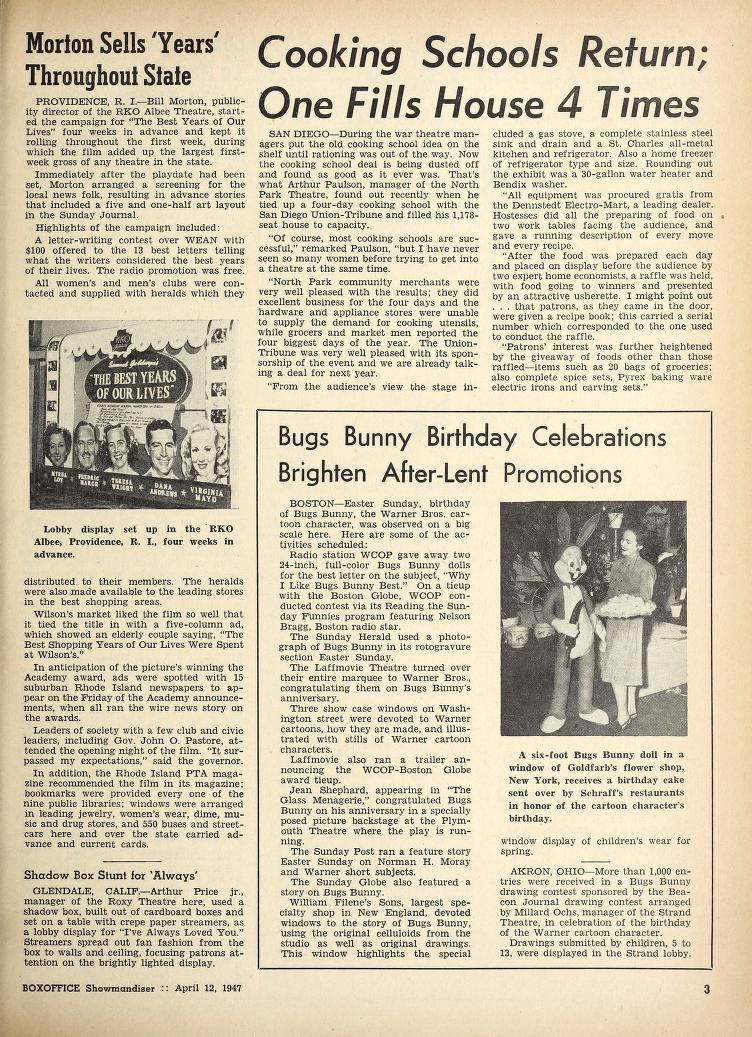
Box Office, 1947

Boxoffice, 1948
My favorite of these articles is the following one from 1961 which lists Bugs as being 25 years old. I'll let you do the math to figure out what is wrong with that.
.jpg)
Boxoffice, 1961
I love that on Easter Sunday, a movie theater would have a special Bugs Bunny day as evidenced by the below page.

Showman's Trade Review, 1946

Film Daily, 1948
Like many movie fans, I have been a fan of Bugs since as far back as I can remember and my fondness for him has not died down in any way. His best films are timeless and will never lose any of their charm. If you have ever seen a Bugs cartoon in a movie theater, than you know just the effect Bugs still has on audiences. Bugs has never stopped staring in cartoons, whether for movie theaters, TV or streaming services, Bugs will always be up to something new because audiences will never stop wanting more Bugs Bunny. Just recently there Bugs Bunny show, Bugs Bunny Builders.
Let us end this birthday celebration with a classic Bugs short film.
Saturday, June 25, 2022
Some Cartoons For Saturday Morning #181
Hello my friends and welcome back for another selection of classic cartoons.
Today's cartoon selection begins with Sylvester in Peck Up Your Troubles (1945). This short film is certainly a forerunner to the later Tweety and Sylvester cartoons, the first of which would be released in 1947. However instead of Tweety there is a little woodpecker and dialogue is kept to a minimum. This movie was in fact only Sylvester's second cartoon, the first of which was Life With Feathers (1945). Peck Up Your Troubles was directed by Friz Freleng who would later direct nearly all of the Sylvester and Tweety shorts. Friz would later say about Sylvester, "I designed Sylvester to look subtly like a clown. I gave him a big red nose and a very low crotch which was supposed to look like he was wearing baggy pants. But gradually he changed because the construction restricted his animation."
Up next comes Goofy in The Big Wash (1948). Rather than being directed by Jack Kinney, this short film was directed by Clyde Geronimi, who by this time was mostly working on Disney's feature films. This often causes his work as a director of shorts to get overlooked. Yet his work in shorts was often incredibly delightful and this movie is no exception. This may not be as wild as the Goofy cartoons, Jack Kinney directed, but in its own way it is just as fun. This movie relies heavily on character-based humor and it has really been done better. In this cartoon Goofy washes an elephant named Dolres. This elephant would later appear in the Donald Duck cartoon, Working for Peanuts (1953) and in that film Donald would sing the same song as Goofy does here.
Next we join Mutt and Jeff in Westward Whoa (1926). This movie was directed by Charles Bowers who also had an unjustly forgotten career staring in live action silent comedy shorts.
The Betty Boop cartoons from the early 1930's were some of the most risqué cartoons from the golden age of American animation. Anyone who thinks of old cartoons as sweet, innocent and squeaky clean may be surprised to see scenes in these cartoons. One of the most risqué images from one of these cartoons comes from Red Hot Mama (1934), where we are given a look through Betty's dress. Though admittedly the rest of this cartoon is not exactly innocent either. The setting for this film is Hell, where Betty's sexiness excites the various demons. Not everyone back then was fine with what happens in this film as the following exhibitor's review from Motion Picture Herald shows. "Red Hot Mama: Betty Boop - I can remember several years ago after sound had been established that a great cry arose within the industry that the youngsters of that day ( and the show patron of tomorrow) were unable to find any entertainment in the movie palaces because the biz had gone high hat and no entertainment for them. I screened 'Red Hot Mama,' a cartoon yesterday on my Sunday matinee hence this letter. I have always felt that in booking these cartoons the youngsters were getting a treat. I enjoy their hearty laughs and suppressed excitement when their favorite cartoon is on the screen. However 'Red Hot Mama' must have been drawn when the guy was drunk. Betty Boop starts out sweetly, is suddenly transported to Hell and pursued and tortured by all sorts of fire devils, imps and what have you. One variety, the ability to bound in the air and come down on a spear studded tail stabbed in the floor. A grand subject for your juvenile trade? Naturally my Sunday matinee was without a cartoon. The only recommendation I have for this is that the one responsible for it be compelled to sit through a screening every time he has a pink elephant fantasy. Some exhibitor's have said they hesitate to report on products through the Herald for fear of getting in bad with the local exchange. My opinion is that the people who are sincere in this business welcome constructive criticism. Report fairly on pictures with merit and likewise that class of product which is detrimental to our investments. I'm not a crank but it is cartoons such as the Symphonies and 'Jack and the Beanstalk' and 'Little Red Hen' that are in demand and not such a thing as 'Red Hot Mama'. -E.A. Reynolds, Strand Theatre, Princeton, Minn. Small Town and Country Patronage." With the praise of the Silly Symphonies, I am wondering what this exhibitor would have to say about the Silly Symphony, Hell's Bells (1929). The following is a much more positive exhibitor's review from the Motion Picture Herald, "Red Hot Mama: Betty Boop - This is a great cartoon comedy that will please everyone. It is full of good clean entertainment and much better than the average comedy. More time should be given to shorts in order to fill in a poor feature and everything would be better. Running Time eight minutes. -J.J. Medford, Orpheum Theatre, N.C. General patronage."
Now for a commercial break.

Motion Picture News, 1913
Next we join Popeye in I Don't Scare (1956). This was towards the end of Popeye's career in theatrical cartoon shorts. The last of these shorts was released only a year later in 1957.
Now for Colonel Heeza Lair in Knighthood (1924). The Colonel's cartoon career began in 1913. After 1917 he briefly vanished from movie screens. Yet in 1922 the series returned. New cartoons with the character would be made through 1924. This cartoon coms from the later run of films. These later shorts would combine live action and animation (something the earlier shorts did not do) in way that resembled the Fleischer Brothers' Out of the Inkwell shorts.

Film Daily, 1924
Up next is the Pixar short film, For the Birds (2000). This cartoon premiered at the Annecy International Animated Film Festival in 2000, but most movie lovers first saw it play before the Pixar feature film, Monsters Inc. (2001).
Now to end with a song.
Resources Used
I Tawt I Taw a Puddy Tat: Fifty Years of Sylvester and Tweety by Jerry Beck.
https://mediahistoryproject.org/
Saturday, June 18, 2022
Some Cartoons For Saturday Morning #180
Hello my friends. Happy Saturday morning and welcome back for another selection of classic cartoons.
Today's cartoon selection begins with Hop, Look and Listen (1948). This is the first cartoon to pair Sylvester and Hippety Hopper (it is also his debut appearance). After this cartoon the two worked together in 12 more short films. Each of those cartoons followed the formula set by this film, where Sylvester mistakes Hippety for a giant mouse instead of a baby kangaroo. This cartoon was reissued to theaters in 1955.
Casper the Friendly Ghost was created by Seymour Reit and Joe Oriolo. The character was created with the intention of staring him in a 1939 children's book. However there was little interest in this idea. During World War 2, Oriolo sold the rights to the book to Famous Studios, the animation studio which was making the Popeye cartoons at this time. The studio originally viewed this as a one shot cartoon, but Sam Buchwald liked the idea and by 1950, Casper cartoons would officially become a series. Animator Myron Waldman worked on the majority of the Casper films would later state, "The boys at the studio used to kid me when we were doing the Caspers; they'd call them the 'ooh-ahh' pictures, but I always felt those pictures would last much longer than a picture that was just based on gags, because nobody can remember the gags. When they go to see it again, or talk about it, I think they like a story - kids especially." Up next is the first Casper cartoon and one that was also an adaption of the book. So enjoy The Friendly Ghost (1945).


Broadcasting, 1957
The cartoons continue with The Grocery Boy (1932) starring Mickey Mouse. This is a sweet simple little cartoon of the type that the Disney studio excelled at. The movie is helped by some truly excellent character animation and a great cast of animators. David Hand (who would be the supervising director for Snow White (1937) and Bambi (1942)) animates the film's opening. Tom Palmer animates Mickey and Minnie on the phone, a long sequence that begins with Mickey and Pluto entering the house and ends with Minnie kissing a bump on Mickey's head and the closing moment. Ben Sharpsteen (who would be the supervising director for Pinocchio (1940) and Fantasia (1940)) animates Pluto pulling at the table as well as the statue falling on Mickey. Rudy Zamora animates Mickey and Pluto running to Minnie's house. Future Donald Duck director, Jack King animates Minnie stirring and Mickey shelling the peas. Les Clark (one of Walt's Nine Old Men and one of the studio's top Mickey animators) animates Mickey getting the stuffing out of the turkey. A review in Variety stated, "Nothing outstanding in this one, but a good example of the Disney product." The climatic ending of this cartoon would later be adapted for the Mickey Mouse newspaper comic strip.
Now for a delightful early Terrytoon, Spring is Here (1932).
Now for a commercial break.
Now comes a delightful short film from Pixar, Lifted (2006). This cartoon premiered at the 42nd Chicago International Film Festival. However most moviegoers first saw it play alongside the Pixar feature Ratatouille (2007) in movie theaters.
Have you every wondered "What makes the moon shine." Well after watching Felix Finds Out (1924), you won't have to wonder anymore.
Let us close with a song.
Thanks for joining me, come back next week for more animated treasures. Until then may all your tunes be looney and your melodies merry.
Resources Used
Of Mice and Magic: A History of American Animated Cartoons by Leonard Maltin
Walt Disney's Mickey Mouse: The Ultimate History by J.B. Kaufman and David Gerstein
http://afilmla.blogspot.com/
https://mediahistoryproject.org/
Thursday, May 26, 2022
Classic Comedy Shorts on MeTV-Plus

Hello fellow movie lovers, I have wonderful news. I have recently found out that some of the wonderful old movie comedy shorts are back on TV at a regularly scheduled time. On the TV channel, ME-TV plus there is a two-hour block of these classic films called Comedy Classics. Unfortunately, it airs late at night. It airs all weekdays at 10pm Pacific and 1am Eastern. This time is far from ideal, I would certainly prefer an earlier time, when kids could watch, and I never have to record if I work early the next day. However, I also can't argue that this is a huge step in the right direction towards what many of us movie fans having been asking for, for quite a while now. The program only consists of three of the classic short subject series, The Three Stooges, Our Gang (also known as The Little Rascals) and Laurel and Hardy. However, as a huge fan of all three of these series, this is a fantastic selection and it makes me smile to watch TV and hear the Laurel and Hardy theme playing. If you can stay up late enough or don't mind recording, these two hours are a real treat for movie fans.
Saturday, March 26, 2022
Some Cartoons For Saturday Morning #167
Hello my friends and happy Saturday morning. Once again it is time for some classic cartoons.
Today's cartoon selection begins with the classic Goofy film, Two Weeks Vacation (1952). As I mentioned before on this blog, director Jack Kinney's Goofy short films are some of my all time favorite cartoons. Kinney was simply a great comic mind and Goofy was simply a perfect character for him. Though Kinney's humor appears in its purest form in short films, he did work on some of Disney's animated feature films. He was a sequence director on such features as Pinocchio (1940), Dumbo (1941), Saldos Amigos (1942), The Three Caballeros (1944), Melody Time (1948) and The Adventures of Ichabod and Mr. Toad (1949).
Hop and Go (1943) is a fantastic late black and white Looney Tunes cartoons. This film was towards the very end of Looney Tunes appearing in black and white. The first color Looney Tune had been released the year before with The Hep Cat (1942) and the last black and white Looney Tune, Puss n' Booty (1943) would be released later the same year. This short film was directed by Norm McCabe. Though McCabe's Looney Tunes shorts have not been a staple of TV, due to being in black and white and having many direct references to World War 2 (when these films were made), many cartoon fans (including myself) have a real fondness for his Looney Tunes, which have a fun and unique style all their own. His work in the world of Looney Tunes hardly ended with the theatrical shorts though. He was the timing director on the Looney Tunes TV shows, Tiny Toons Adventures, Taz-Mania and Sylvester and Tweety Mysteries. He was also an animator on the feature length movie Daffy Duck's Quackbusters (1988). If the voice of Claude sounds familiar in the cartoon you are about to watch that is because it is provided by Pinto Colvig, who was also the voice of Goofy.
Up next is the Terry Toon cartoon, Club Life in the Stone Age (1940). The following are a couple of exhibitor's reviews from The Motion Picture Herald, "CLUB LIFE IN THE STONE AGE: Terry-Toons— A very good black and white cartoon. Was afraid of this after the colored cartoons but it went over very well. - Gladys E. McArdle, Owl Theatre, Lebanon, Kansas. Small Town Patronage." "CLUB LIFE IN THE STONE AGE: Terry-Toons— Just an ordinary cartoon. Running time, 7 Minutes. E.M. Freiburger, Paramount Theatre, Dewey, Okla. Small Town Patronage."

Boxoffice, 1937
Now we join Pink Panther in The Pink Pro (1976).
Now it is time for a commercial break.
Up next is the Roland and Rattfink cartoon, A Taste of Money (1970). This short film is the only cartoon in the series to not feature Roland. Instead, this is fully a Rattfink cartoon. This film is also a remake of the Yosemite Sam cartoon, Honey's Money (1962), which in turn is a remake of the Daffy Duck film His Bitter Half (1950).
Up next is one of Disney's early Silly Symphonies, Monkey Melodies (1930). Like many of the Silly Symphonies of this era, this film has a very loose storyline that is simply meant to establish a mood and be a framework for a succession of gags. Also like most of the Silly Symphonies of this time the film includes an all star cast of animators. David Hand, who would later be the supervising director for the Disney features Snow White and the Seven Dwarfs (1937) and Bambi (1942), animated the opening scene, the alligators surfacing and the underwater chase with the alligators. Jack King, who would go on to direct some great Donald Duck cartoons, animated the ape in the vines, the monkey couple kissing on the log and the closing scene. Norm Ferguson, whose animation would help define the character of Pluto, animates the two monkeys scratching and the alligator dance. Dick Lundy, who would become a great Woody Woodpecker director, animates the Aba Daba Honeymoon (the song with nonsense lyrics) musical number. Ben Sharpsteen, who would be the supervising director on the Disney features Pinocchio (1940), Fantasia (1940) and Dumbo (1941), animates the parrotts as well as the alligator triping the monkeys off the log. LEs Clark, one of the foremost Mickey Mouse animators and one of Walt's Nine Old Men, animates the Monkey's swinging on each other's tails and the introduction of the film's hero. Wilfred Jackson, who would be the co-director of such Disney features as Cinderella (1950), Alice in Wonderland (1951) and Peter Pan (1953), animates the boy monkey giving the girl flowers and the romantic dance. Tom Palmer, who would direct cartoons for both Warner Brothers and Van Bueren animated the boy offering the girl a banana and the monkeys meeting the hippo. Johnny Cannon, who animated on many Disney shorts of the 1930's, animates the boy monkey chasing the girl monkey through the vines.
Let us close by singing one we all know.
Thanks for joining me. Come back next week for more animated treasures. Until then may all your tunes be looney and your melodies merry.
Resources Used
Walt Disney's Silly Symphonies: A Companion to the Classic Cartoon Series by Russell Merritt and J.B. Kaufman
https://mediahistoryproject.org/
Monday, March 21, 2022
Saturday, March 19, 2022
Some Cartoons For Saturday Morning #166
Hello my friends and happy Saturday morning. Once again it is time for some classic cartoons.
Despite Taz's extreme popularity with Looney Tunes fans today, he only appeared in 5 of the original short films. My favorite of these cartoons is Ducking the Devil (1957). This movie marks the only time during the golden age of Looney Tunes that Taz was paired against Daffy Duck. In the other four films, Taz had worked against Bugs Bunny. This movie like the other Taz cartoons is directed by Robert McKimson.
Next Little Lulu tries to break into the movies, despite her cartoons already playing in movie theaters, in Lulu on Hollywood (1944). The storyline of this cartoon however is very appropriate as Little Lulu had been a star of cartoons that appeared in The Saturday Evening Post before Hollywood called on her to be a movie star. Not everyone was impressed with her animated screen antics though as is evidenced by a review of this cartoon in The Showman's Trade Review, which stated, "This promising little cartoon character is suffering from faulty scripting. In her mischievous nature rests on her popular following, but on the screen her antics are falling short of their protentional laugh punch." Still the range of emotions in her acting, during the screen test scene always puts a smile on my face.

Motion Picture Herald, 1943
Next comes an early Merrie Melody cartoon that I really love, You're Too Careless with Your Kisses (1932). Like many of the Merrie Melodies of this time this short film very much resembles Disney's early Silly Symphonies. However this cartoon does not come off as a pale imitation of Disney but as a fun little movie that is very charming. There are some really clever gags here (such as one involving a couch) and the villain is a lot of fun. The themes of drunkenness and infidelity remind one that these cartoons were not made only for children but all movie audiences.
Next comes an early Disney Silly Symphonies cartoon, Playful Pan (1930). One thing that separates Disney from other cartoon studios of the time is that they would sometimes completely throw away work that the filmmakers weren't happy with to make them work better. This costs time and money, something other studios held too dear to do such a thing. Though animation began on October 24, 1930, in early November of the same year. the film's opening scenes were completely redone. This redone animation lasts from the opening to when the tree is sawed in half with lightning. Because of this, the opening scenes of this short film were the last ones animated. Speaking of animators this cartoon features an all star cast of Disney animators. The beautiful opening is animated by Tom Palmer, a great animator who was also briefly a director for Warner Brothers. The scenes involving the daisies dancing, the fire attacking the tree and the squirrels were all animated by Les Clark. Les Clark is a true Disney legend and would become one of Walt's Nine Old Men and is often recognized as one of Mickey Mouse's best animators. Future Donald Duck director Jack King animates the great scene where Pan causes the flames to follow him. The flames actually jumping into the water was animated by Norm Ferguson, another Disney legend who played a huge role in developing Pluto's personality. Wilfred Jackson (who would become one of the best Silly Symphonies directors) animated the worms dancing. Johnny Cannon, who animated on many of Disney's best films from the 1930's would animate the scenes with the birds in the fire. Dave Hand, who would be the supervising director for the Disney features, Snow White and the Seven Dwarfs (1937) and Bambi (1942), animated the trees and clouds dancing. Ben Sharpsteen, who would be the supervising director for the Disney features Pinocchio (1940) and Dumbo (1941) animates the lightning and the flames leaving the trees. Frenchy De Tremaudan, another great animator who worked on a lot of Disney's best shorts at this time, animates the animals squirting water. Dick Lundy, who animated Donald's first tantrum and would become a director of some great Woody Woodpecker cartoons at Walt Lantz studio, animates the animals running and the raccoon alerting Pan. Jack Cutting, who would later direct a couple of Silly Symphonies animates the fox whose tail is on fire.

National Board of Review Magazine, 1931
Now it is time for a commercial break.
Now we join The Pink Panther in Tickled Pink (1968).
Up next is one of The Van Beuren Studio's Aesop's Sound Fables cartoons, Good Old Schooldays (1930). Notice two mice in this movie who look a lot like Mickey and Minnie. In 1931, Walt Disney would sue the Van Beuren Studio for making cartoons with characters too much like Mickey and Minnie for his comfort.
Today's cartoon selection ends with our friend Goofy in Father's Weekend (1953). By the 1950's Goofy had turned from Mickey's silly friend to an everyman, who had to endure the little problems in life that pretty much every moviegoer could relate to. Much of this change occurred under the direction of Jack Kinney. I feel that too often Jack Kinney is overlooked when the great cartoon directors are listed. However his hilarious short films for Disney, perfectly show why he deserves to be listed with other greats like Tex Avery or Chuck Jones. This movie is a perfect example of his true gift with comedic cartoons and it never fails to make me laugh.
Thanks for joining me come back next week for more animated treasures. Until then may all your tunes be looney and all your melodies merry.
Resources Used
The Disney Films by Leonard Maltin
https://mediahistoryproject.org/
Friday, March 11, 2022
Laurel and Hardy - Those Two Goofy Guys
The following is a 1930 article from Photoplay magazine. If you have trouble reading, click on the pages and use your touch screen to zoom in.


Thursday, March 3, 2022
Stop! Look! and Laugh! (1960)
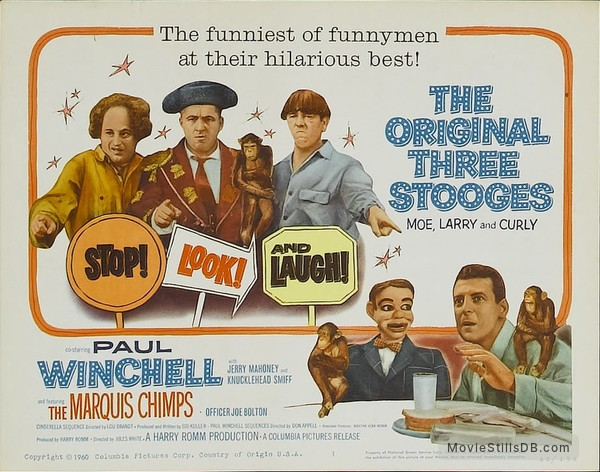
After the box office success of Have Rocket Will Travel (1959), that movie's producer Harry Romm quickly wanted to make another feature film starring The Three Stooges. However, since The Stooges were experiencing a major resurgence in popularity, they felt comfortable in asking for 75% of the profits. While Romm wanted to make a new Stooge feature film, he still wanted his usual 50% of the profits. Stop! Look! and Laugh! was his way of having his cake and eating it too. By going directly to Columbia, Romm took footage from old Stooge short films and connected them together with new footage that didn't feature the Stooges.
The new footage would star ventriloquist Paul Winchell and his dummies, Jerry Mahoney and Knucklehead Smiff. Paul Winchell had briefly had a radio show in 1943, but the show did not last long, and its popularity was clearly overshadowed by Edgar Bergan's show. However by the time this film was made, Winchell was best known for his children's TV show, The Paul Winchell and Jerry Mahoney Show (1950-1956). This show would feature a lot of corny comedy with him and Jerry Mahoney and Knucklehead Smiff, as well as a lot of advertising for the show's sponsor, Tootsie Roll. This show has an important place in TV history as it featured the TV debut of Carol Burnett. Today however Paul Winchell will mainly be remembered by animation buffs for his voice work on Hanna-Barbera's TV cartoons. He voiced the villainous Dick Dastardly (Wacky Races (1968-1970) and Dastardly and Muttley in their Flying Machines (1969-1970)) and the evil Gargamel (The Smurfs (1981-1989)). Disney fans will best know him as the original voice of Tigger for the Disney Winnie the Pooh films. Stop! Look! and Laugh! was not Winchell's only Three Stooges connection. He had voiced Moe in The Three Stooges episodes of The New Scooby-Doo! Movies (1972-1973) and the TV cartoon, The Robotic Stooges (1978).

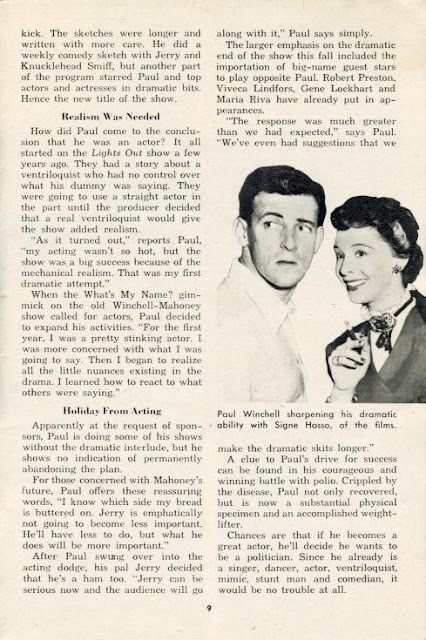
TV Guide, 1954
This movie also features The Marquis Chimps, these were a trio of comedic chimps owned and trained by Gene Detroy. Detroy was born into a family of circus performers. In the late 1940's he began raising and training chimps, which he would do for 30 years. In the early years of him raising chimps, one of his chimps was named Marquis. Because of this someone suggested he call the act, The Marquis Chimps. Detroy liked this idea and the name stuck. Starting in the mid-1950's, the chimps started appearing on TV shows. Over their career the chimps made appearances on such shows as The Colgate Comedy Hour (1950-1955), The Ed Sullivan Show (1948-1971), The Jack Benny Program (1950-1965) and The Lucy Show (1962-1968). The Marquis Chimps also starred in their own TV show, The Hathaways (1961-1962). This was a typical sitcom about the typical American family, a husband, a wife and their three chimps. Stop! Look! and Laugh! is one of the only two feature films that The Marquis Chimps appeared in. The other is a delightful live action Disney movie, Toby Tyler or Ten Weeks with a Circus (1960). In Stop! Look! and Laugh!, the chimps perform their own version of the classic fairytale Cinderella. Since chimps don't talk, the voices were provided by real life people. One voice in this section of the film will sound quite familiar to many cartoon fans. This voice is the one and only June Foray. June Foray is a voice acting legend and is best remembered today for providing many female voices for Looney Tunes and Merrie Melodies (including Granny), as well as being the voice of TV's Rocky the flying squirrel.

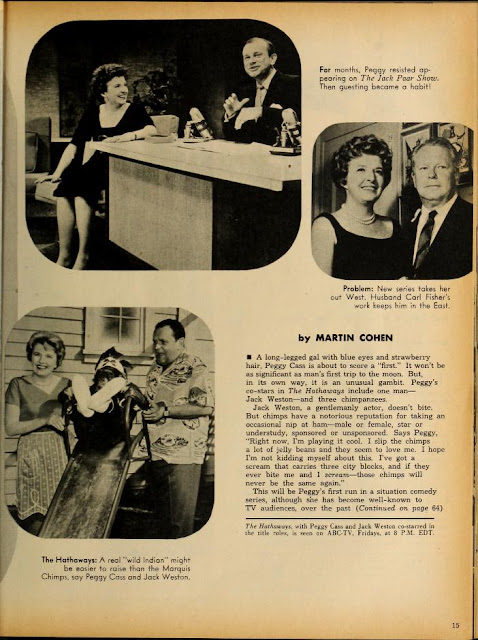


Radio TV Mirror, 1961.
This movie doesn't have much in the way of an actual story. This is just an average day in the life of Paul Winchell and his dummies, mostly told through a series of brief comedy skits that are designed to transition to the next clip of The Stooges.
I must say the clips of The Three Stooges used here are fantastic. This may at first seem like an obvious e statement, but it really isn't. Too many of these feature length compilations of a comedian's or group of comedians' work fail to show them at their best and instead just show random clips from their career instead. This movie though actual shows The Stooges at their best and therefore there will be plenty of real laughs for any Stooge fans who watch this film. The clips all come from the Curly era of the Stooges output. Though many Stooge fans have divisive feelings about some eras in The Stooges' history (especially the Joe and Curly Joe eras), pretty much every Stooge fan agrees that the Curly era is where some of the boy's best work came from. Not only does this movie show clips of the Stooges in their prime, but it shows some of the funniest moments from this era. The shorts used here include How High is Up (1940, directed by Del Lord), Violent is the Word for Curly (1938, directed by Charley Chase), Sock a Bye Baby (1942, directed by Jules White), Higher Than a Kite (1943, directed by Del Lord), What's the Matador? (1942, directed by Jules White), Calling All Curs (1939, directed by Jules White), Goofs and Saddles (1937, directed by Del Lord), Micro-Phonies (1945, directed by Edward Bernds), A Pluming We Will Go (1940, directed by Del Lord) and Half Wits Holiday (1947, directed by Jules White and featuring Curly's last starring appearance with The Stooges). As a Stooge fan, I certainly can't argue with a line up like that. It even includes Curly's personal favorite Stooge short, A Plumbing We Will Go. While I would recommend anyone new to the Stooges starts with the classic Stooge shorts in their entirety, I can see someone new to the Stooges becoming a fan after seeing this movie with how good the clips are.
The Paul Winchell skits may not be masterpieces, but they work well enough. While the original Stooge shorts were aimed at all ages, these Paul Winchell shorts are clearly aimed at kids. Because of this adult movie fans will probably not laugh at these skits as much as the clips from the Stooges shorts. Still there is nothing truly bad about these skits and taken as children's entertainment they are pretty good actually. I will admit I even got a few chuckles from a couple of these skits. So, while I understand why some Stooge fans will find the inclusion of these skits, I personally find them charming for what they are.
Now the Marquis Chimps version of Cinderella on the other hand is quite bad. I can't even see myself as a little kid enjoying this. And you know a skit is bad when even June Foray can't save it. The main problem is that this scene doesn't have any real jokes. The filmmakers just simply think the idea that we are seeing Cinderella performed by monkeys is funny enough on its own. In reality it isn't even slightly amusing. I really wish that instead of this sequence the movie including more Three Stooges clips, but this skit is the price you will have to face for watching an otherwise fun movie.
James B. Meyers Jr. of the Bluebird Theatre in Petersburg, Virgina went all out when this movie played at his theater.
"Playing the double bill of Columbia's 'My Dog Buddy' and 'Stop! Look! and Laugh!' recently in our 473-seat house we tried our hand at some selling that was well within our small budget.
"An idea occurred to me that might help the sales of concessions while at the same time tying in with one of the features. Accordingly I made up three octagon shapes for each left hand door entering the orchestra. The top sign was lettered STOP. This was on red cardboard. The second sign was lettered LOOK and this was on white cardboard, while the third sign was lettered AND LAUGH and was on blue cardboard. On the right hand doors, another sign was lettered 'DO NOT ENTER.' This was opposite the red sign. Another read 'UNTIL YOU HAVE LOOKED OVER OUR FINE ASSORTMANT OF CANDIES AND TASTED OUR DELICIOUS HOT BUTTERED POPCORN.' Opposite the blue sign another was lettered 'NOW ENTER! AND LAUGH TO YOUR HEARTS CONTENT WITH THE THREE STOOGES IN STOP, LOOK AND LAUGH.'
"Being mindful of the fact that nearly every person will observe a stop sign, it was no surprise to me that everyone DID stop and read this display from top to bottom before entering the orchestra. I might add that our concession stand is located exactly in the center of the two sets of lobby doors.
"The art work was done by myself with the cost of the signs $1.97 for the cardboard and 35 cents for a magic marker.
"To promote interest in the other feature, 'My Dog Buddy' and also to get some outside advertising away from the theatre I enlisted the services of a young lad who owned a German shepherd dog, with his parents' permission to walk around town in the main business section. A small sign was placed on either side of the small dog, lettered 'Don't miss 'My Dog Buddy,' Now Showing Bluebird.' The local boy and his dog resembled the boy and the dog starring in the picture. This little stunt attracted a lot of street attention. This cost me a trifle over $5."
The Stooges themselves were not very amused with the idea of this movie and sued Harry Romm and Columbia over the picture feeling that it was illegal to use their comedies without their permission. This ended up being settled out of court. The Stooges received a cash settlement and a contract to make another feature film for $50,000. Though they would receive 50 percent of the profits, Moe's son in law and the team's manager (as well as writer of The Three Stooges comic books) Norman Maurer would become the film's producer.
Resources Used
The Three Stooges Scrapbook by Jeff Lenburg, Jean Howard Maurer and Greg Lenburg.
https://mediahistoryproject.org/
https://www.paulwinchell.com/bio.html
https://books.google.co.uk/books?id=VKS1-aBvXawC&pg=PT170&lpg=PT170&dq=The+Marquis+Chimps+were+owned+and+shown+by+Gene+Detroy&source=bl&ots=0jV-nXjXW7&sig=ACfU3U3eZ2E6E-iwLoqE-0vENMDYd3RgoA&hl=en&sa=X&ved=2ahUKEwim2OjXkv7sAhXAQUEAHYj8CeI4FBDoATADegQIAhAC#v=onepage&q=Marquis%20Chimps&f=false
https://www.imdb.com/?ref_=nv_home
Tuesday, January 18, 2022
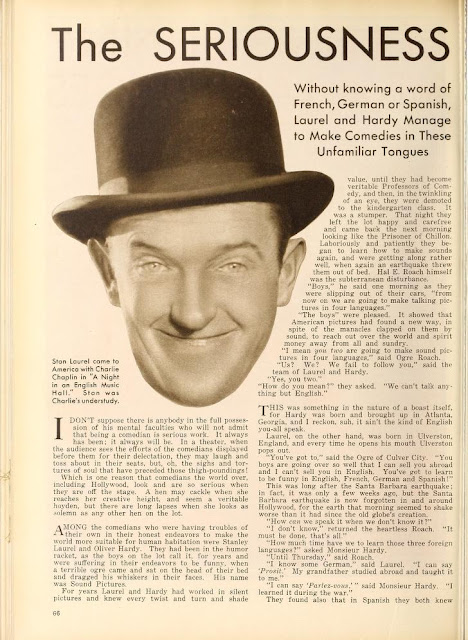
Laurel and Hardy in Foreign Languages
The following is an article from a 1930 issue of The New Movie Magazine. If you have trouble reading, click on the pages and use your touch screen to zoom in. If that still doesn't work, click here.


Tuesday, October 5, 2021
Mickey Mouse in "Giantland" (1933)

This cartoon understands how completely familiar this story was to movie audiences. The film wastes no time with the story before the beanstalk grew. After the opening where Mickey is reading the story of Jack and the Beanstalk to his nephews (their first animated appearance, though they had appeared in Floyd Gottfredson's Mickey Mouse comic strip a year earlier), the cartoon immediately cuts to Mickey (as Jack) climbing the beanstalk. Since anyone watching this cartoon already knew the story, the filmmakers could jump directly into the action with no trouble. Since this was a short film (meaning there is only so much time to tell the story), this makes room for more action and gags.
The following is a review of this cartoon in The Film Daily.
"Fertile in invention and full of amusing situations, Mickey's adventures with a giant after climbing Jack's famous Beanstalk is an ace addition to the series. Especially amusing are Mickey's antics in the giant's mouth where he is pelted by peas, nearly drowned by water, almost crushed in mastication. Mickey's escape from this cell, his chase by the giant and the flight down the beanstalk wind up in this very entertaining subject."
A review in the Motion Picture Daily, stated "Here Walt Disney makes Jack and the Beanstalk live again in the person of his versatile Mickey Mouse."
A working title for this short was Mickey and the Giant. It was released on 11/25/1933.
Much of the animation of the famous mouse was handled by two of the studio's Mickey Mouse experts, Les Clark and Fred Moore. The cartoon’s director was Burt Gillett, one of the studio's main Mickey Mouse directors at this time.
Animation
Terminology: L.S. - Long Shot; Dis. - Dissolve; C.U. - Close Up; O.S.
Les Clark (L.S. Camera moves down -- Story starts; C.U. Mickey starts story; L.S. Kids cheer and applaud; C.U. Mickey continues story; L.S. Kids all whistle; Mickey says "Up and Up", etc., and dis. to: (Pan of Mickey climbing beanstalk (animated by CY Young)); L.S. Mickey and kids - he talks; C.U. kid in high chair - razz; L.S. Mickey and kids laugh)
Cy Young (Pan of Mickey climbing beanstalk. Top of beanstalk - Mickey gets on butterfly; L.S. Castle door -- Butterfly in)
Johnny Cannon (C.U. Door handle and key hole - Mickey hears O.S. voice; C.U. outside keyhole -- Mickey jumps in it; C.U. Mickey on end of pipe; Pan - Mickey whirls around in a spiral; Bottom of stalk - Mickey starts fire)
Dick Huemer (L.S. giant coming over hill - Pan up to head)
Ham Luske (Giant pouring coffee - picks up spoon; C.U. Bowl - hands put cube on spoon - second time Mickey is picked up on it. Puts him in coffee; C.U. Giant reads and stirs coffee; C.U. cup whirlpool effect - gets out - runs with pant full of coffee; Rides in cheese; C.U. Giants drinks coffee - picks up knife; L.S. castle - sneeze blows side of castle out - Mickey lands - Mickey slides down beanstalk - giant starts down (split with Dick Williams (the only scene he worked on)); Giant climbing down - still scene; Stalk burns around giant - he falls)
Bill Roberts (C.U. Knife cuts out slice - picks it up; S.C.U. Giant puts cheese on bread - reaches for mustard; C.U. Mickey in cheese on bread on hand -mustard gag; S.C.U. Giant cats -throws last piece in mouth (head on shot)… X-Dis. to; Inside mouth - rock crusher effect. (head on shot))
Fred Moore (Outside - Giant eats peas; Inside - peas coming down; Outside - Hiccoughs, Inside - Hiccoughs (tossed in blanket effect); Outside: Giant Drinks; Inside - Smoke Entering - Mickey puts hands over end; Outside - Giant looks at pipe - draws on it; Inside - Mickey Blows; S.L.S. Outside - sparks pipe out - Mickey on end)
Gerry Geronimi (S.L.S. Mickey Drops - runs - butter gag; Mickey jumps in pickle jar - bites finger; S.L.S. Giant hits bottle - Mickey flies out - giant looking for him; S.C.U. Giant looks around; Mickey jumps on fork- pepper goes in giant's face - short sneezes; S.C.U. Giant ready for big sneeze)
"Frenchy" de Trémaudan (C.U. Mickey peeks out - prepares spoon and pepper - whistles)
Ben Sharpsteen (C.U. Mickey's expression - laughs)
Ugo D'Orsy (Giant falls in - Mickey looks down hole - x. dis. to (use 6 ft., w. dis))
Story: Mickey is reading the story of Jack and the Beanstalk to some kids. Mickey places himself in the story and soon we dissolve to Mickey climbing the beanstalk. When he reaches the top he hops aboard a butterfly who takes him to the giant's front door. Soon Mickey sees the giant coming home singing a song about how he is the king of Giantland. Mickey jumps in the keyhole to hide but when the giant puts in his key Mickey goes flying onto the table where a meal is prepared for the giant. As the giants heads inside Mickey quickly hides in the sugar bowl. The giant picks up his newspaper, which say "Giants win." He then prepares a cup of coffee for himself. Unfortunately the giant takes sugar in his coffee and Mickey is soon in the giant's coffee. Mickey escapes while the giant is stirring and hides in the swiss cheese. Naturally the giant wants some cheese next. The giant puts some cheese on his sandwich and it looks like Mickey is eaten. Mickey is trapped in the giant's mouth and tries to escape but the giant keeps eating slippery peas. The giant get the hiccups and takes a drink to stop them. Mickey must swim fast to keep from going down the giant's throat. As soon as Mickey is safe from the water, the giant decides to smoke a pipe. When the giant takes the pipe out Mickey is holding onto it. Our hero is now spotted. Mickey says "hi big boy," but instead of returning his greeting the giant tries to squish our hero. After a chase our hero is trapped in a bottle. The giant sticks his hand in and Mickey bites it. When Mickey gets out of the bottle, he gets a brilliant idea and sends a spoonful of pepper heading the giant's way. The giant lets out a big sneeze that destroys his whole house. The chase continues. They both slide down the beanstalk. Mickey gets to the bottom first and lights the beanstalk on fire. The giant takes a huge fall and leaves a large hole in the ground. When transition back to Mickey telling this story to the kids. Mickey informs them, "he came out in China." Mickey asks "what do you think of that?" One of the kids responds with a raspberry and everyone laughs hardily at that.
http://afilmla.blogspot.com/search/label/Shorts_UA
Walt Disney's Mickey Mouse: The Ultimate History by J.B. Kaufman and David Gerstein
The Making of Fun and Fancy Free by J.B. Kaufman
Disney A to Z: The Official Encyclopedia 5th Edition by Dave Smith.
Saturday, August 14, 2021
Some Cartoons For Saturday Morning #136
Hello my friends and happy Saturday morning. Once again it is time for some classic cartoons.
Next comes The Inspector in Cock-A-Doodle Deux Deux (1966).