Showing posts with label Disney Breakdowns. Show all posts

Friday, February 6, 2026

Mickey Mouse in "Two Gun Mickey" (1934)


Two Gun Mickey marked the directorial debut of Ben Sharpsteen. About Sharpsteen Walt would write, “Concerning Ben Sharpsteen and his contributions to the development of the Disney organization, I want to say he played a very important part.” Sharpsteen was born in Tacoma, Washington, on November 4, 1895, although he was raised in Alameda, California. He studied agriculture at the University of California at Davis. In 1917 he joined the marines serving in World War 1. After the war he went into animation working for the Hearst International Film Service. Later he came to work at the Max Fleischer Studio. A mutual friend introduced Ben to Walt. Walt valued Sharpsteen so much that he hired the artist at $125 a week. This salary was higher than even Walt's. It was also higher than Walt's head animator at the time, UB Iwerks who was only making $90 a week. In 1933, Ben would establish an in-house animation training program. He would also supervisor new animators. In this he was assisted by his cousin in law George Drake. Few people at the Disney studio were as hated by the artists as Drake, who was known for firing people for no good reason. Ben's opinion on some of these new artists was not much higher. Ben once told an inbetweener, "Listen, you artists are a dime a dozen and don't you forget it." Starting with this short, Ben would direct 21 cartoon shorts for Disney. He would then move on to features as soon as the studio started making them, first as a sequence director then a supervising director then a production supervisor. He would even get involved with the studio's live action output, producing the True-Life Adventure nature documentaries then the anthology Disneyland TV series. Ben retired in 1962. He would pass away on December 20, 1980, in Calistoga, California. 

Though today, Mickey Mouse is known as a company mascot and a straight man to the more comedic characters of Donald and Goofy, in the 1920's and early 1930's Mickey was often cast as a fun-loving adventurer and a Fairbanks-ian action hero. One of his earliest screen appearances was The Galloping Gaucho (1928), where he swoops in and saves Minnie from Pete in a true Fairbanks inspired role. He is a tough character in that film with a fearless devil-may-care attitude, even drinking, smoking and being quite forward with Minnie. That cartoon would be remade as The Catus Kid (1930) with Mickey fully in the guise of an American cowboy. With the early Mickey being a rugged adventurer, it was only natural that he would play a cowboy again in Two Gun Mickey. This film would also follow the basic premise of The Galloping Gaucho with Mickey saving Minnie from the villainous Pete. 

Though Pete is best known today as Mickey's nemesis, he actually dates back further than Mickey, first appearing in Walt Disney's silent Alice Comedy, Alice Solves the Puzzle (1925). Walt and co. would continue to use the character as an adversary for Oswald the Lucky Rabbit in that character's silent cartoons.  

Walt Disney provides the voice of Mickey here as he does in most of the Mickey cartoons of this era. Marcellite Garner voices Minnie. The voice of Pete is by Billy Bletcher. Billy Bletcher is one of the main voices for cartoon villains in the 1930's. Most famously he provided the voice for the Big Bad Wolf for Disney's Three Little Pigs (1933). As well as his work at Disney, he also provided the voice of Papa Bear from Chuck Jones' Three Bears cartoons at Warner Brothers. Before his cartoon work, Bletcher appeared in many live action comedy shorts during the silent era.  

In true cowboy fashion, this film uses traditional folk songs on its soundtrack. These include She'll be Coming Around the Mountain and Bury Me Not on the Lone Prairie. She'll be Coming Around the Mountain is a folk song based off the Christian Hymn When the Chariot Comes. Two of the earliest known recordings of the song are Henry Whitter in 1924 and Vernon Dalhart in 1925. The earliest known written version of Bury Me Not on the Lone Prairie appeared in John Lomax's Cowboy Songs and Other Frontier Ballads in 1910. The earliest known recording was by singing cowboy Carl T. Sprague in 1926.


The following is an exhibitors' review from an issue of the Motion Picture Herald (Dated December 7, 1936).

"Two Gun Mickey: Mickey Mouse - The Mickey and Silly seem to go over well second-run. Would advise everyone to pick them up. - C.L. Niles, Niles Theatre, Anamosa, Iowa, General Patronage."

This cartoon was released to theaters on December 15, 1934. It would be reissued to theaters in 1936. The film would make its TV debut with an episode of The Mickey Mouse Club that aired on October 7, 1955. It would later appear again on an episode that aired on March 27, 1958. It is available on the DVD set Walt Disney Treasures: Mickey Mouse in Black and White. 


Animation

Leonard Sebring (Minnie in at iris; horses stop at puddle of water; C.U. horses-Minnie falls into water; Mickey and horse laugh-talk; Minnie sitting in puddle)

Archie Robin (Mickey's horse drinks- let's water out; Mickey and Minnie on horse)

George Drake (L.S. Minnie into town; Lasso pans to limb)

Nick George (M.C.U. Pete - Minnie "hello keed" C.U. poster; Pete sees Minnie coming; Pete accosts Minnie)

Jack Kinney (Minnie in bank; Mickey on mt. - sees smoke; L.S. Mickey sees chase; Shadow truck back to Mickey; Mickey throws lasso)

Wolfgang "Woolie" Reitherman (Minnie on to the wagon; Pete on horse-whistles; Pete Pursuing; Minnie on springs out -reins shot away; Minnie across log - Pete follows; L.S. Mickey and Minnie towing Pete)

Don Towsley (Bandits leave town; C.U. Cellar Door; Pete and gang)

Ugo D'Orsy (Minnie startled - dips down around bend - gang follows; Minnie-wheels are shot off wagon; Minnie ono bridge-bridge shot away; L.S. bridge shot away- bandits reconnoiter)

Louie Schimdt (Horse and Mickey into action)

Paul Allen (Mickey to rescue on inclined pan; Mickey downhill; Horse skids to stop; Mickey firing)

Earl Hurd (Minnie in chariot)

Cy Young (Last of wagon torn away wheel spins; Bandit cactus deflated hole reamed in ledge - bandits fall through; Bandits around catus - mushroom gag; Bandits firing from pinnacle; Bandits down pinnacle X-Dix; Mickey across chasm - horse bites Pete) 

Art Babbitt (Minnie escapes Pete - rec Posses logs; Pete tilts log; Pete shakes leg; Pete catches Minnie - bites gun muzzle; Pete in air; Mickey catches Pete in pistol - shoot; Pete in air - shoe; Pete lands on Mickey - fight; Mickey puts on hat; Mickey into clothes - Mickey kicks him over chasm; Mickey and Pete fight on ledge; C.U. Pete pulls knife; Mickey eludes Pete - hangs onto root; Pete gets cactus on fanny. Ledge breaks)

Ed Love (Minnie running on log)

Ed Smith (Minnie grabs top of log; Minnie falls; Pete falls past Mickey; Pete onto cactus X-Dis) 

Frank Oreb (L.S. Bandits)

Roy Williams (Mickey fires a la artillery; bandit sneaking; Bandit shot in fanny - leaps off cliff; Mickey fires like machine gun)

Eric Larson (Mickey sees shadow - throws gun on lasso)

Story: Minnie is out west and wishes to take care of herself. Pete tries to tell her to let him help her, but she refuses. When it turns out the Pete is a bandit and he pursues Minnie, Mickey rushes to her rescue.  


  Here is the original version of this film.


And here is the colorized version.


Resources Used

Walt Disney’s Mickey Mouse: The Ultimate History by David Gerstein and J.B. Kaufman

Of Mice and Magic: A History of American Animated Cartoons by Leonard Maltin

The Life and Times of Ward Kimball: Maverick of Disney Animation by Todd James Pierce. 

https://disney.fandom.com/wiki/Two-Gun_Mickey

https://web.archive.org/web/20201022084904/https://www.fresnostate.edu/folklore/ballads/San372.html

https://afilmla.blogspot.com/search/label/Shorts_UA?updated-max=2006-12-11T02:00:00-08:00&max-results=20&start=26&by-date=false

https://d23.com/walt-disney-legend/ben-sharpsteen/


Tuesday, May 10, 2022

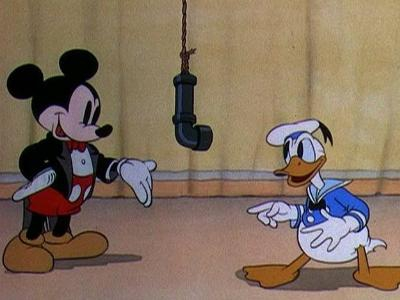
Mickey's Amateurs (1937)


Mickey's Amateurs is a rare directorial effort by Pinto Colvig, who my fellow Disney fans will know best as the voice of Goofy (who appears in this film). He co-directed this cartoon with Erdman Penner and Walt Pfeiffer. Penner spent most of his time at Disney working in the story department. He even worked on such Disney feature films as Pinocchio (1940), Fantasia (1940), The Reluctant Dragon (1941), Victory Through Air Power (1943), Make Mine Music (1946), Melody Time (1948), The Adventures of Ichabod and Mr. Toad (1949), Cinderella (1950), Alice in Wonderland (1951), Peter Pan (1953), Lady and the Tramp (1955) and Sleeping Beauty (1959). Walt Pfeiffer was a childhood friend of Walt Disney and would become manager of Disney's Penthouse Club. None of these men were typically directors of cartoons and to see them in the director's chair is a rare treat. The three also wrote the short, which was a more typical job for them. 

In their book Walt Disney's Mickey Mouse: The Ultimate History, J.B. Kaufman and David Gerstein describe this film as "...an extremely offbeat cartoon, with wild, freewheeling gags and animation that suggest other studios as much as Disney." Animator Al Eugster remembered working on this cartoon with a real fondness stating, "I felt I had more freedom during my assignment on this film." This short would be the last Mickey Mouse cartoon released for United Artists. 

Despite being credited as a Mickey Mouse cartoon and having Mickey's name in the title, Mickey has little to do in this film. This was actually quite usual by this time in his career. Though Mickey's cartoons from the late 1920's and early 1930's clearly had him as the star by this time he was becoming a supporting player in his own films. The reason for this is quite simple. As Mickey was becoming a bigger and bigger movie star, he was also being looked at as a bit of role model for kids. The problem was that Mickey's personality had not always been that of a perfect role model. Instead he was a mischievous character who constantly got himself into trouble with his childlike playfulness. With this complaints started to come up concerning Mickey's questionable behavior. This presented a problem. How do you make a funny Mickey Mouse cartoon without what made him funny in the first place? The answer was quite simple actually. Mickey was given a new role not as the comedian of the pictures but as the straight man. Characters like Donald Duck, Pluto and Goofy were not held up to the same scrutiny if they did not prove to be perfect role models. Therefore they could be the ones to get the laughs, while Mickey would be the master of ceremonies. This is a role Mickey filled out quite well and proved excellent as and a role that in many ways he still fills today (not including those great new Mickey Mouse cartoons on Disney+). 

The following is a review from The Motion Picture Herald.

"Making sport of the current amateur hour craze, the Disney penmen have devised some of the craziest and comic cartoon moments yet to hit the screen. With Mickey Mouse as the master of ceremonies, the talent parade their specific specialties. Donald Duck recites "Twinkle Twinkle Little Star," which is a very coy act for Donald and a good laugh for his audience. The female aspirants are represented by Clara Cluck and Carabelle Cow who offer a song and a piano treat. The highlight of the progamme and the one that would receive this reviewer's vote is 'Bandmaster Goofy and his Fifty Piece Band.' Goofy and his 'Rube Goldberg' invention play 'In The Good Old Summertime' and then going modern, the pace proves too much for the maestro and his machine. The subject must be seen to be appreciated and enjoyed and enjoyed. The fun it offers defies description. Running time, one reel."  

I have always had strong fondness for when Disney fully embraces a spirit of cartoon zaniness. Many favorite Disney shorts are often the ones with the wildest and most cartoony sense of humor. So it should come as no surprise that I love this film. Sentimentality and cuteness have no place in this short, instead this film is full of zany cartoon gags that come at a fast pace without ever letting up. Most importantly though is that the gags are truly funny. Some of the comedic highlights include Donald's recitation (I love that he legitimately has a machine gun) and Goofy's brilliant musical performance. The later benefits from some truly hilarious cartoony animation from the great Art Babbitt. 

According to the Disney Wiki this cartoon made its TV debut on an episode of the Mickey Mouse Club that aired on October 18, 1956. The film would air as part of the Walt Disney Presents episode This is Your Life Donald Duck. This episode aired on March 11, 1960. 


The New York State Exhibitor, 1932

Animation

Terminology: CU= Close Up; MCU= Medium Close Up; LS = Long Shot; MLS = Medium Long Shot; O.S. = Off Screen

Stan Quackenbush (CU Radio playing - smoke curls - set expands and contracts - gong interrupts)

Ralph J. Somerville (CU Gong swinging - hammer hitting it; CU Gong ringing - hand silences it; Audience's heads follow Cluck's actions)

Ed Love (CU to MCU Pete desperate - mechanical hands pull him O.S.; MCU Cluck followed by Belle - enter from left - stops at "mike" - Belle walks O.S. to right - Cluck bows (co-animated with Les Clark); MCU Belle twirls skirt - trips -falls; MCU Belle in awkward position - twitters - snorts; MCU Belle plays opening cords with flourishes; MCU - Belle at piano - blinks eyes in syn. to piano trill; CU Front view - Belle at piano - hands and eyes bump; MLS Bell laughs - points to Cluck - titters snorts; MCU Cluck smooths feathers - Belle bows - both exit - O.S. crash (co-animated with Les Clark))

Marvin Woodward (Back of Mickey at desk; says OKAY OKAY; CU Mickey at the desk - continues OKAY - OUR NEXT AMATUER IS ---- Loud quacking O.S. Mickey looks to the right; MLS Donald enters from right - Polishes apple - hands it to Mickey - Mickey leads him to "mike" - O.S. laughter (co-animated with Al Eugster); MCU Mickey starts to introduce next act - Don grabs apple - Mickey continues - "THE TWO CLARAS - CLUCK AND BELLE" (co-animated with Al Eugster); MCU Mickey is interrupted by "Professor" (Donald in disguise) - recites - shoots machine gun (co-animated with Al Eugster); MCU Duck bouncing - gun shooting - Duck in case - pulls him O.S. - Mickey announces Bandmaster Goofy (co-animated with Al Eugster)) 

Al Eugster (MLS Donald enters from right - Polishes apple - hands it to Mickey - Mickey leads him to "mike" - O.S. laughter (co-animated with Marvin Woodward); CU Donald sore - frowns into camera - mumbles; MLS continues reciting laughs interrupt gets gong - hand comes in - grabs him - Donald races out;  MCU Mickey starts to introduce next act - Don grabs apple - Mickey continues - "THE TWO CLARAS - CLUCK AND BELLE" (co-animated with Marvin Woodward); ); MCU Mickey is interrupted by "Professor" (Donald in disguise) - recites - shoots machine gun (co-animated with Marvin Woodward); MCU Duck bouncing - gun shooting - Duck in case - pulls him O.S. - Mickey announces Bandmaster Goofy (co-animated with Marvin Woodward); C.U. of wreckage - Goof's head pops through drum - Donald out of Goof's busby - iris closes down - gets Donald in neck - pulls it out with hands - he ducks back (co-animated with Art Babbitt))

 Les Clark (MCU Cluck followed by Belle - enter from left - stops at "mike" - Belle walks O.S. to right - Cluck bows (co-animated with Ed Love); MCU Cluck glares at Belle - annoyed; MCU Cluck tries to start; MCU Cluck tries to start - Belle improvises O.S. - Cluck standing on toes glares at Belle; MCU Cluck sings "Il Baccio" - "Mike" swings gently away - opens eyes - sees "mike" swinging; MLS Cluck chases "mike" - runs up and down stage - feet leave floor; MLS Cluck chases "mike" grabs at it - tries to sing into it - springs up and catches it - wire breaks - crashes; MCU Cluck smooths feathers - Belle bows - both exit - O.S. crash (co-animated with Ed Love))

Art Palmer (LS Audience ducks machine gun bullets)

Art Babbitt (LS Goof out from right wing - twirls baton - walks to machine; MCU Goof picks up accordion - snaps on knees - pulls on belt - sings cymbals - sits - nods head - machine starts; CU Goof plays third phrase on flute - flute goes out; MCU Tuba in - plays - clarinet up - tries to get it - plays; CU Hands come down - sticks tongue out - licks thumb - hand turns page - mouth harp in - plays - out - hands down - stretch mouth - all horns in mouths; MCU Goof gets ready to play next number - lever breaks off - starts playing clarinet smacks him; MLS Clarinet - out - harp up - plays - trombone up - plays it. Mouth harp rolls over face; MCU Fanny bouncing and being thrown around on cymbal; MLS Tuba comes up - plays it - harp in - cornet in - misses it; CU mouth harp plays - saws across mouth - hold explosion - cogs wizz in his head: MCU Clarinet whizzes by - misses it - shakes in mouth - in and out of mouth; CU mouth harp saws mouth - hold - explosion, etc.; MCU Inst. whizzes by - Goof dodges - trombone up - socks him in face - pulls face - boinks off - doges inst. - trombone under fanny; L.S. machine jumps around - builds up to big explosion - everything falling into scene wreckage smoking; C.U. of wreckage - Goof's head pops through drum - Donald out of Goof's busby - iris closes down - gets Donald in neck - pulls it out with hands - he ducks back (co-animated with Al Eugster))


Story: The film starts with Pete singing Asleep in the Deep very poorly. Mickey rings a gong and some hands drag Pete off stage. Our master of ceremonies Mickey Mouse introduces the next amateur performer. Before he finishes the introduction Donald Duck walks out gives Mickey an apple then starts his performance. He starts a recitation of Twinkle Twinkle Little Star but bungles it when he forgets the words. The audience laughs at him and this makes Donald lose his temper. Mickey rings the gong and a hand pulls an angry Donald off stage. Donald rushes back on stage and takes his apple back from Mickey. Mickey introduces Clara Cluck and Clarabelle Cow. The two give a musical performance with Cluck singing and Clarabelle playing the piano. However trouble arises when the mike won't stay still for Clara Cluck. Before Mickey can introduce the next amateur Donald comes back on stage in a "professor" disguise. He is carrying a case with him and out of the case he takes a gun and points it at the audience who laughed at him earlier. He then proceeds to give another recitation of Twinkle Twinkle Little Star. He again forgets the words and the audience again laughs at him. At this time the machine gun goes off and goes out of control sending Donald flying all around and the audience ducking. A hand once again appears and puts Donald inside his case and pulls him off screen. Mickey now introduces "Bandmaster Goofy." Goofy has his "fifty-piece band" with him. This band is a big contraption with many musical instruments on it. Not surprisingly this machine malfunctions and explodes. Donald then pops out of Goofy's hat and gives a really quick recitation of Twinkle Twinkle Little Star as the iris closes and Donald's neck gets stuck in it. 


Resources Used

http://afilmla.blogspot.com/search/label/Shorts_UA

https://mediahistoryproject.org/

https://disney.fandom.com/wiki/The_Disney_Wiki

Walt Disney's Mickey Mouse: The Ultimate History by J.B. Kaufman and David Gerstein 


Tuesday, October 5, 2021

Mickey Mouse in "Giantland" (1933)

The Jack and the Beanstalk story was popular among makers of classic cartoons. The reason for this is very understandable, it is a simple story that nearly everyone was already familiar with and one that offered a never ending supply of gag possibilities. Giantland was Mickey Mouse's first foray into the famous fairy tale. He would return to Jack and the Beanstalk in a segment of the feature film Fun and Fancy Free (1947). Giantland was a much smaller scale telling than the mouse's return to the story, but it has more than enough fast paced gags to be an excellent cartoon in its own right. It is worth noting that at the tine this was a big adventure for the mouse, who had begun to move away from the simple barnyard settings and gags he was first known for into more adventurous stories. In their book, Walt Disney's Mickey Mouse: The Ultimate History. J.B. Kaufman and David Gerstein state, "Giantland was the most extravagant yet." 

This cartoon understands how completely familiar this story was to movie audiences. The film wastes no time with the story before the beanstalk grew. After the opening where Mickey is reading the story of Jack and the Beanstalk to his nephews (their first animated appearance, though they had appeared in Floyd Gottfredson's  Mickey Mouse comic strip a year earlier), the cartoon immediately cuts to Mickey (as Jack) climbing the beanstalk. Since anyone watching this cartoon already knew the story, the filmmakers could jump directly into the action with no trouble. Since this was a short film (meaning there is only so much time to tell the story), this makes room for more action and gags.

The following is a review of this cartoon in The Film Daily.

"Fertile in invention and full of amusing situations, Mickey's adventures with a giant after climbing Jack's famous Beanstalk is an ace addition to the series. Especially amusing are Mickey's antics in the giant's mouth where he is pelted by peas, nearly drowned by water, almost crushed in mastication. Mickey's escape from this cell, his chase by the giant and the flight down the beanstalk wind up in this very entertaining subject."

A review in the Motion Picture Daily, stated "Here Walt Disney makes Jack and the Beanstalk live again in the person of his versatile Mickey Mouse."

A working title for this short was Mickey and the Giant. It was released on 11/25/1933.

Much of the animation of the famous mouse was handled by two of the studio's Mickey Mouse experts, Les Clark and Fred Moore. The cartoon’s director was Burt Gillett, one of the studio's main Mickey Mouse directors at this time.

Animation

Terminology: L.S. - Long Shot; Dis. - Dissolve; C.U. - Close Up; O.S.

Les Clark (L.S. Camera moves down -- Story starts; C.U. Mickey starts story; L.S. Kids cheer and applaud; C.U. Mickey continues story; L.S. Kids all whistle; Mickey says "Up and Up", etc., and dis. to: (Pan of Mickey climbing beanstalk (animated by CY Young)); L.S. Mickey and kids - he talks; C.U. kid in high chair - razz; L.S. Mickey and kids laugh)

Cy Young (Pan of Mickey climbing beanstalk. Top of beanstalk - Mickey gets on butterfly; L.S. Castle door -- Butterfly in)

Johnny Cannon (C.U. Door handle and key hole - Mickey hears O.S. voice; C.U. outside keyhole -- Mickey jumps in it; C.U. Mickey on end of pipe; Pan - Mickey whirls around in a spiral; Bottom of stalk - Mickey starts fire)

Dick Huemer (L.S. giant coming over hill - Pan up to head)

Ham Luske (Giant pouring coffee - picks up spoon; C.U. Bowl - hands put cube on spoon - second time Mickey is picked up on it. Puts him in coffee; C.U. Giant reads and stirs coffee; C.U. cup whirlpool effect - gets out - runs with pant full of coffee; Rides in cheese; C.U. Giants drinks coffee - picks up knife; L.S. castle - sneeze blows side of castle out - Mickey lands - Mickey slides down beanstalk - giant starts down (split with Dick Williams (the only scene he worked on)); Giant climbing down - still scene; Stalk burns around giant - he falls)

Bill Roberts (C.U. Knife cuts out slice - picks it up; S.C.U. Giant puts cheese on bread - reaches for mustard; C.U. Mickey in cheese on bread on hand -mustard gag; S.C.U. Giant cats -throws last piece in mouth (head on shot)… X-Dis. to; Inside mouth - rock crusher effect. (head on shot))

Fred Moore (Outside - Giant eats peas; Inside - peas coming down; Outside - Hiccoughs, Inside - Hiccoughs (tossed in blanket effect); Outside: Giant Drinks; Inside - Smoke Entering - Mickey puts hands over end; Outside - Giant looks at pipe - draws on it; Inside - Mickey Blows; S.L.S. Outside - sparks pipe out - Mickey on end)

Gerry Geronimi (S.L.S. Mickey Drops - runs - butter gag; Mickey jumps in pickle jar - bites finger; S.L.S. Giant hits bottle - Mickey flies out - giant looking for him; S.C.U. Giant looks around; Mickey jumps on fork- pepper goes in giant's face - short sneezes; S.C.U. Giant ready for big sneeze)

"Frenchy" de Trémaudan (C.U. Mickey peeks out - prepares spoon and pepper - whistles)

Ben Sharpsteen (C.U. Mickey's expression - laughs)

 Ugo D'Orsy (Giant falls in - Mickey looks down hole - x. dis. to (use 6 ft., w. dis)) 

Story: Mickey is reading the story of Jack and the Beanstalk to some kids. Mickey places himself in the story and soon we dissolve to Mickey climbing the beanstalk. When he reaches the top he hops aboard a butterfly who takes him to the giant's front door. Soon Mickey sees the giant coming home singing a song about how he is the king of Giantland. Mickey jumps in the keyhole to hide but when the giant puts in his key Mickey goes flying onto the table where a meal is prepared for the giant. As the giants heads inside Mickey quickly hides in the sugar bowl. The giant picks up his newspaper, which say "Giants win." He then prepares a cup of coffee for himself. Unfortunately the giant takes sugar in his coffee and Mickey is soon in the giant's coffee. Mickey escapes while the giant is stirring and hides in the swiss cheese. Naturally the giant wants some cheese next. The giant puts some cheese on his sandwich and it looks like Mickey is eaten. Mickey is trapped in the giant's mouth and tries to escape but the giant keeps eating slippery peas. The giant get the hiccups and takes a drink to stop them. Mickey must swim fast to keep from going down the giant's throat. As soon as Mickey is safe from the water, the giant decides to smoke a pipe. When the giant takes the pipe out Mickey is holding onto it. Our hero is now spotted. Mickey says "hi big boy," but instead of returning his greeting the giant tries to squish our hero. After a chase our hero is trapped in a bottle. The giant sticks his hand in and Mickey bites it. When Mickey gets out of the bottle, he gets a brilliant idea and sends a spoonful of pepper heading the giant's way. The giant lets out a big sneeze that destroys his whole house. The chase continues. They both slide down the beanstalk. Mickey gets to the bottom first and lights the beanstalk on fire. The giant takes a huge fall and leaves a large hole in the ground. When transition back to Mickey telling this story to the kids. Mickey informs them, "he came out in China." Mickey asks "what do you think of that?" One of the kids responds with a raspberry and everyone laughs hardily at that. 


                                                                  Resources Used

http://afilmla.blogspot.com/search/label/Shorts_UA

Walt Disney's Mickey Mouse: The Ultimate History by J.B. Kaufman and David Gerstein 

The Making of Fun and Fancy Free by J.B. Kaufman

Disney A to Z: The Official Encyclopedia  5th Edition by Dave Smith.


Saturday, December 15, 2018

Mickey Mouse and Pluto in "Pluto's Christmas Tree" (1952)

Merry Christmas, my friends. Let us celebrate the season with yet another classic Disney cartoon short. This time we jump ahead a few decades to 1953 to bring you Pluto's Christmas Tree.


This is a very late Mickey Mouse short. In fact it is the next to last (the last would be The Simple Things (1953)) Mickey short to be released theatrically until Mickey's Christmas Carol (1983). However the world's most famous mouse would not be dropping out of the entertainment business during that long period without theatrical Mickey shorts. In 1955 Mickey would become a television star with The Mickey Mouse Club (1955-1958) and the host of Walt's latest passion project Disneyland.


Pluto's Christmas Tree was a rare Mickey Mouse cartoon directed by Jack Hannah, who mostly directed Donald Duck cartoons. However this is not too surprising as this cartoon features two of Hannah's creations, Chip and Dale (whom the director most often used as adversaries for Donald). Hannah had directed an earlier Mickey Mouse cartoon that co-starred Chip and Dale with Squatters Rights (1946). Despite Hannah being one of the main directors of Disney shorts during this period, these marked the only two Mickey shorts he actually directed.

Though this was released as a Mickey cartoon, Pluto plays just as large if not a larger role. Not shockingly Mickey and Pluto appeared in quite a few shorts together despite each technically having their separate series. Still these cartoons would technically have to be either listed as a Mickey short or a Pluto short, and Pluto's Christmas Tree was labeled a Mickey short.

At Eitel's Palace in Chicago this cartoon played with the feature film Plymouth Adventure for three weeks. These weeks were the weeks of December 8, 15 & 22, 1952. It played with the feature Million Dollar Mermaid in the Music Hall in New York, the same weeks.


AnimationDan MacManus (Truck in on Christmas card. Snow in falling and girls are humming in b.g., "Deck the Halls with Boughs of Holly")

Fred Moore (Mickey coming out of house, calling out to Pluto: "Okay Pluto lets get our tree." They start out to look for tree (split with George Kreisl); Shot of Mickey chopping tree; Chopping tree jostles chipmunks; Mickey falls tree says "Oh Boy!"; Mickey decorating Christmas tree; Pluto comes in and helps Mickey trim tree; Shot of Mickey's hands hanging candy canes; Mickey hangs ball of twig on tree; Mickey finishes decorating and leaves tree stating "Well Pluto that's it" Pluto starts sniffing; Mickey leaves room (split with George Kreisl); Mickey enters room with packages; Mickey puts balls back on tree says "That's better" (Split with George Kreisl); Pluto watches as ball (on Dale) moves up tree (split with George Kreisl); Mickey looks at tree after all has disappeared; Mickey motions that Pluto is nuts; Mickey enters scene whistling; Pluto tries to tell Mickey about Dale on the mantel but Mickey pulls him away and says "Okay I'll light the candle"; Mickey looks at burnt match, puzzled; Mickey walks away from scene whistling; Mickey grabs Pluto's tail and gets pulled into tree, says "Pluto get out of there, whata think you're..."; foliage falls from tree; Mickey shakes Pluto's neck says "You dumb mutt, you..."; "Look what you've done to your … Pluto" Mickey points up to tree in take; Mickey holds chipmunks says "Pluto, after all it is Christmas"; Pluto and Mickey run to window to watch carolers (Goof, Duck, etc.); Mickey, Pluto and chipmunks looking out window)

George Kreisl (Mickey coming out of the house calling out to Pluto: "Okay Pluto lets get our tree." They start to look for tree (split with Fred Moore); Pluto excitedly runs up slope; Chipmunks picking up nuts are interrupted by Pluto's antics - they throws nuts at him (split with Bill Justice); Pluto gets smacked on fanny but nuts; Pluto chases chipmunks down hill; Pluto plows though drift - pushes out snow in form of "Snow Dog"; Chipmunks run up onto tree; Pluto sniffs snow dog -- it collapses; Mickey calls o.s., "Okay Pluto"; Pluto trotting; Dale sees Pluto and zips from scene; Pluto goes into trot; Pluto sniffs tree; Pluto takes at Dale who has landed on Pluto's nose; Chip, with candy cane, pulls Dale away from Pluto's nose. Pluto barks. Pluto catches Christmas balls with paws - ends up in awkward position; Mickey puts balls back on tree says "That's better" (split with Fred Moore); Pluto watches as ball (on Dale) moves up tree (split with Fred Moore); Pluto madly pointing at tree, trying to tell Mickey about the chipmunks; Pluto hears o.s. rattling of nuts; Pluto sneaks up in front of Christmas tree; Pluto makes menacing grin and growls; Pluto watches Mickey leave room; Chip hops onto Pluto's tail; Chip pulls Pluto's tail; Pluto raises Chip up on tail; Chip says thank you to Pluto; Chip puts out fire on Dale's head; Pluto takes - charges after chipmunks; Pluto chases chipmunks up ladder into Christmas tree; Pluto trying to keep balance on shaking ladder; Star lands on Pluto's tail; Pluto goes into tantrum; Pluto dives into tree after chipmunks; Mickey: "Aw cute little fellows!" Pluto in burn pulls back and barks at chipmunks; Pluto hears o.s. carolers singing "deck the halls with boughs of Ivy"; Pluto into chorus with howl; Dale slaps Christmas tree sticker on Pluto's mouth - Do not open until Christmas)

Bill Justice (Chipmunks picking up nuts are interrupted by Pluto's antics - they throw nuts at him (split with George Kreisl); Chipmunks go into act of mimicking Pluto's barking (split with Volus Jones); Chipmunks say "what was that" as tree is jarred by chopping; Shot of the tree being carried off. Dale's legs appear and reach for ground - he lands on ground and brushes his hands as he turns to walk away; Dale sip back into tree; Chipmunks hiding behind trunk in tree, look out and see decorations - Chip say "Hey wake up!"; Chip and Dale look over decorations; Dale looks over ornaments, say "well whatta you know"; Dale says wow and rips off branch; Dale starts to bite Christmas ball; Dale drops twig in wild take and goes out of scene to hide; Dale runs in on all fours -taps ball and makes face in it; Dale runs with ball on twig, comes into scene and crashes ball into Chips head. Door in ball opens, revealing Chip; Dale turning light globe off and on, mistakes Pluto's nose for globe and twists it - is suddenly zipped down out of tree; Dale in imitation, barks at Pluto and sticks Christmas ball on his nose; Dale throws another ball; Shot of dale getting nuts out of bowl; Dale starts towards tree with pile of nuts; Dale poses as one of the Christmas candles on the mantle. Pluto sniffs at him causing Dale to sneeze; Pluto pushes candles off mantle; Carolers singing; Chipmunks sing carol; Chipmunks hear Pluto - stop singing and cover ears)  

Volus Jones (Chipmunks go into act of mimicking Pluto barking (split with Bill Justice); Chopping of tree jostles chipmunks; Dale takes at Chip as ball disintegrates; Chip clonks Dale on head. Dale shrugs sheepishly; Dale looks at Pluto in sick expression. Pluto goes into vicious growl; Chip zips out of scene with candy cane; Christmas ball hanging on Dale's nose; Dale takes at Pluto - throws nuts in his path and scrambles out of scene; Dale runs up onto mantle - Pluto after him, slips on nuts and crashes into fireplace; Dale takes at Mickey's match and blows it out; Mickey takes hold of Dale - lifts him to other candle and lights his hat; Chip looks out of tree -- sees Dale's situation and makes take; Dale shakes ladder leg; Chip loosens brace on ladder; Dale blows on ladder and ladder crashes to floor; Chip drops star from top of tree; Chipmunks laughing; Chipmunks huddled in Christmas tree. Mickey "We've got chipmunks in our tree")

Blaine Gibson (Lights go on and off on tree)


Story: Mickey and Pluto chop down a Christmas tree. However Chip and Dale are living in this tree and end up in Mickey's house. The chipmunks drop a decoration on Pluto. This gets Pluto angry and he gives chase. This causes much destruction throughout the house. Mickey doesn't see the chipmunks and think Pluto is trying to ruin the house. He scolds Pluto until he sees Chip and Dale. He tells Pluto that it is Christmas and they should be friendly to the little guys. Then they all hear caroling outside. It is Donald, Goofy and Minnie. They all enjoy the music until Pluto tries to sing along, after which Chip and Dale cover the dog's mouth with a sticker.


-Michael J. Ruhland


Sunday, December 2, 2018

Disney's "Santa's Workshop" (1932)

Merry Christmas, my friends. Today we are going to look at a Christmas cartoon that I absolutely love. This is an early color Silly Symphony cartoon (in fact the fourth one) that shows the Disney studio at the height of its powers.


With this being an early color Disney cartoon, there is not a moment in which the filmmakers don't use color to their advantage. They knew not to take color for granted but instead use it to create a pure atmospheric spectacle. In fact this cartoon still stands out today partly for its beautiful use of color.

The following is an Exhibitors Review from the Motion Picture Herald (Dated January 13, 1934)


"Santa's Workshop: This is the greatest one-reeler we have ever had the pleasure of screening in our theatre and did the kids flock in! It is filmed in glorious color and there is only one word that can describe it - beautiful. Just as the name suggests, it shows Santa's workshop where all of the toys are made and just the type of short for this season. We played this three days and many patrons young and old, saw it two or three times. Many thanks to Walt Disney and United Artists for this great short. Running time, eight minutes - J.J. Medford, Orpheum Theatre, Oxford, N.C. General Patronage."


The following are two more Exhibitors Reviews from the Motion Picture Herald (Dated October 28, 1933).

"Santa's Workshop: Silly Symphony - An excellent all color short you will do well to book. They just rave over it. Running time, seven minutes - Wm. A. Crute, Victoria Theatre, Vancouver, B.C. Neighborhood Patronage."


"Santa's Workshop: Silly Symphony - Excellent and drew considerable business. - B.R. Johnson, Orpheum Theatre, Kerrobert, Canada, Rural Patronage."


The following is another Exhibitors Review from the Motion Picture Herald (dated January 3, 1933).


"Santa's Workshop: Silly Symphonies - These cartoons are good but an exhibitor can feed his public up on them by booking too many. Once a week is plenty. Running time, eight minutes. - Edmund M. Burke, Fort Plain Theatre, Fort Plain, N.Y. General Patronage."

The following is another exhibitors review from the Motion Picture Herald (dated February 4, 1933).

"Santa's Workshop: Silly Symphony - Another great color cartoon from Disney. This brought additional business after playing 'Babes in the Wood.' - H.R. Hisey, State Theatre, Nashville, Ill."  

An issue of National Board of Review Magazine (dated January 1933) stated about this cartoon, "Worth being kept permanently available for Christmas programs."

A working title for this film was Santa's Toy Shop. It premiered at the Roxy in New York on December 16, 1932 playing alongside the feature film, Man Against Woman. It played with this movie from the 16th to the 23rd. It would continue to play at the theatre from the 24th to January 1st, 1933 this time playing alongside the feature. Rare for a short cartoon at this time, Santa's Workshop was revived in big name movie theatres in 1933.

This film went through production relatively fast beginning in September 1932 and hitting movie theatres by December of the same year.


Walt himself provided the voice of one of the elves. Walter Geiger provided the voice of Santa and J. Delos Jewkes and Pinto Colvig (the voice of Goofy) provided voices for other elves.

To read two articles from The Film Daily (dated December 9, 1933) about various stores decorating their windows with Disney displays for Christmas (including a picture of one of these displays) and how Santa's Workshop worked its way into this click here.

This cartoon would later receive a sequel, The Night Before Christmas (1933). Perhaps I will write about that sometime. In 1936 an idea for another Silly Symphony cartoon centering around Santa and his helpers at the north pole was proposed. In this cartoon a little boy would have been shrunk to the size of a toy and given a chance to see Santa's workshop. One title for this would have been The North Pole. This idea never came to be.


Animation

Note: Ben Sharpsteen headed a crew of animators. All this animation will appear under Ben Sharpsteen with additional animators listed in prentices. It is interesting to note how many of these animators would go on to become major animators for Disney in their own right. Clyde Geronimi worked with other animators on a couple of scenes and these are handled in the same manner. Also bear in mind that the choice of words are from the original animation draft.


Ben Sharpsteen (Castle (Marvin Woodward); Gnomes grooming reindeer (Art Babbitt); Stables - castle in distance - truck up to castle (Art Babbitt); Factory (Joe D'Igalo); Put heads on horses and saw bodies (Harry Reeves); Put legs and rockers on horses (Harry Reeves); Bore holes in horses (Harry Reeves); Put tails on horses (Ham Luske); Paint horses (Louie Schmitt); Paint department (Dick Williams); Checkered paint (Paul Fennell); Tailors (Chuck Couch); Permanent wave (Fred Moore); Plane knocks toys off the shelf (Ed Love); Toys start to move (Joe D'Igalo); Band and soldiers march (Ed Love); Penguins, tinkertoy, donkey, elephant, jap dolls, Chaplin and cop dolls marching (Fred Moore, Jack Kinney, Jack Cutting, Nick George); Mule kicking wagon - other toys passing (Chuck Couch); Noah's Ark (George Drake); Pan of many toys - Kazotski toy last (Nick George, Jack Kinney, Ed Love); Jack in box (Jack Cutting); Last of toys in bag - pick up bag and start out with it (Clyde Geromini); Santa flies off in distance (Loie Schmitt))
Les Clark (Gnomes working on sleigh - all stop and sing; Bass gnome says "Better hurry up."; Gnomes resume work on sleigh)
Norm Ferguson (Santa and secty. Santa reads Molly's letter; Santa picks up long letter; Santa starts to read long letter; Santa finishes letter; Santa orders soap - follow gnome on pan to factory)
Tom Palmer (Secty looks up Molly in big book; Secty looks up Billy in his book; Secty says "Billy didn't wash his ears.")
Jack King (Santa picks up mama doll; Santa teaches doll to say "mama" and "O.K.s" her; Santa inspects mammy doll and airplane)
Clyde Geronimi (Toys start into bag (truck back); Last of toys in bag - pick up bag and start out with it (Ben Sharpsteen); Outside castle - gnomes cheer as Santa and bag of toys get in sleigh)
Eddie Donnelly (Santa sings goodbye song and starts up on pan - goes up in air)

Story: Santa and his elves (or gnomes) prepare for the big Christmas Eve flight. The elves feed the reindeer, Santa reads his mail, other elves make the toys (whistling while they work before Snow White), Santa tests some toys and after all this they are ready for the big night. Santa sings goodbye and heads into the sky.


     Below is the sequel film.


Thanks to JB Kaufman and Russell Merritt's book, Walt Disney's Silly Symphonies: A Companion Guide to the Classic Cartoon Series, which proved a huge help in writing this article.

-Michael J. Ruhland


Sunday, November 18, 2018

Mickey Mouse in "Mickey's Good Deed" (1932)

With it being Mickey Mouse's 90th Birthday and with Christmas rapidly approaching, I feel it is the perfect time to look at what may be my favorite Mickey Mouse cartoon, Mickey's Good Deed.


Mickey's Good Deed was a shockingly huge departure from what most earlier Mickey Mouse cartoons have been . Most of the earlier cartoons had been non-stop gag fests. There was little to no room for sentimentality as the cartoons tried to cram in as many jokes as possible. In fact The Moose Hunt (1931) unsubtly mocked such sentimentality as seen in this film. In that cartoon Mickey believes he shot Pluto and is crying. Pluto, when Mickey is not looking, literally winks at the audience and then continues to play dead when Mickey looks at him again. Mickey's Good Deed marks the first Mickey cartoon in which we are supposed to take any sentimentality seriously. This was a bold move on the part of the Disney studio. We were now supposed to feel actually sympathy with a character who previously was only meant to be laughed with or at. To ask an audience to emotionally connect with any cartoon character was not a popular thought at the time. It is not only something the Disney studio was not doing at this time, but something no American cartoon studio was trying. The idea that one could emotionally connect with a moving drawing was something animation studios were warry about. It was well known that audiences could laugh at a cartoon character, but the idea of them accepting such a character as real seemed unbelievable.

Around this time many critics referred to Charlie Chaplin and Walt Disney as the two true geniuses of the cinema. This cartoon is probably one of the closet connections that can be found between their films. This came not only from this cartoon's use of sentimentality but also from the depiction of Mickey Mouse here. Mickey like Charlie Chaplin's tramp is an outsider who doesn't truly belong in the world around him. The world of the rich pigs in this movie is completely separate from the world of Mickey and Pluto. Despite this Mickey is a wise character who has his own outlook on life that is much more rich and beautiful than that of those who are finically better off, again this is something that is very similar to Chaplin's little tramp.

In this film, Mickey is poor and happy, while the rich characters are unhappy. With this film being made during the Great Depression, this probably helped audiences of the day relate to and root for Mickey. Audiences of this time did not want to see rich characters go through life on easy street. They wanted to see a poor character make it not by using money but instead by good old American optimism and a can do spirit. This gave them hope and a feeling of pride in who they were.

The following is an exhibitors review from the Motion Picture Herald (dated January 6, 1934).

"Mickey's Good Deed: Mickey Mouse - Christmas cartoon. Kids like Mickey. That's why they come. One Mickey Mouse cartoon on your Saturday's program brings the kiddes out to the matinee. Running time eight minutes. - Edmund M. Burke, Fort Plain Theatre , Fort Plain, N.Y. General Patronage."

The following is another exhibitors review from the Motion Picture Herald (dated December 23, 1933).

"Mickey's Good Deed: Mickey Mouse - This is another good cartoon comedy, if you can play this on Christmas day, it will go over good. This one is not as good as the last one but will please the kiddes. Running time, eight minutes. -JJ Medford, Orpheum Theatre, Oxford, N.C. General Patronage."

The following is yet another exhibitors review from the Motion Picture Herald (dated January 13, 1934).

"Good Deed: Mickey Mouse - One of the best Mickey Mouse cartoons Walt ever made. Running Time eight minutes. Louis Perretta, Crescent Theatre, Maboningtown, Pa. Town and city patronage."

The following is another exhibitors review for the Motion Picture Herald (dated December 2, 1933).

"Mickey's Good Deed: Mickey Mouse - Got a lot of laughs and pleased generally. Something for the kids when the feature isn't too their liking. Mayme P. Musselmann, Princess Theatre, Lincoln, Ka. Small Town Patronage. "


The working title for this film was Mickey's X-mas Picture. This cartoon was directed by Burt Gillett, who was directing most of the Mickey Mouse cartoons of this time as well as a few of the Silly Symphonies. From 1934 to 1936 he would head the Van Bueren animation studio. Afterwards he would work at the Walter Lantz studio. This film featured a great team of animators as well. Les Clark would go on to become one of Walt's Nine Old Men. Norm Ferguson was one of the great personality animators for the studio and helped define the character of Pluto. Ben Sharpsteen would be the supervising director for the Disney features, Pinocchio and Dumbo. Dick Lundy would later join the Walter Lantz studio and become one of Woody Woodpeckers best directors. Tom Palmer would later direct cartoons for both Warner Brothers and Van Bueren.


Animation
Johnny Cannon (Mickey playing on street - passers by drop coins in cup; Pluto howling - bites fleas, etc.; Mickey and dog cont. Dog finishes howl - exit)


Ben Sharpsteen (Café - both hungry - Mickey empties cup in hand - surprised expression; Mickey's hand - nuts, blots, screws, etc., instead of money; Mickey and Pluto walk away - feel sad; See rich man's house - they start to play; Mickey running - slips on ice - drops fiddle - it slides cut to R; Fiddle lands in street - gets smashed by sleigh. Mickey in - sees wreckage; Crowd in sleigh yells "Merry Xmas!"; Mickey sad - hears off-stage sobbing - looks around; Poor house - Mickey and dog look thru the window; Interior of poor house; Mickey outside watching - gets idea - grabs Pluto and runs on pan; Flash of mother sleeping - repeat; Exterior - kids yelling off-stage - Mickey peeks in window to watch them; Fireplace scene kids playing with toys; Pluto with turkey, etc. on tail. kids hits father and dog with fruit, dishes, etc.; Butler on ladder fixing star on Xmas tree - dog knocks, ladder from under him; kid on table throws cake; Butler sees cake, ducks - pan over to father - he gets it in face; Pluto climbs tree - kid runs in, pulls on tinsel; Pluto knock father down - ornaments fly thru - star sticks him in fanny; Father tells butler to throw dog out - turkey still on tail; Interior - kid gets spanked)


Les Clark (Inside - kid breaks toys, cries; Kid hears dog - goes to window; Flash Mickey and dog playing; Father sends butler out of house to buy Pluto)

Frenchy de Tr'emaudan (Exterior of front door - butler comes out with money in hand - yells at Mickey; Mickey and dog scared - run with fiddle; Butler catches Mickey - tries to buy dog - Mickey refuses - dog bites butler - dog and Mickey exit to R)

Tom Palmer (Outside house - Mickey sells dog - runs off with money in his hand)


Hardie Gramatky (Interior rich house - butler gives dog to kid - brat stops crying; Kid hits dog with mallet, dog surprised - pinches nose - dog flops out of sc.; Pluto lands on R.R. tracks; Kid turns switch - train starts out of sc.; Train rams dog - chases and gooses him; Kid laughing; Father and butler chuckle - shake hands; Flash of kid laughing - repeat)

Dick Lundy (Mickey takes presents to poor house - puts on Santa makeup; Mickey enters; Kids asleep - Mickey in - raises cover to see another row of kids under covers; Fireplace - Mickey tries put toys in sox quietly - makes lots of noise; Jack-in-box; Flash of kids asleep; Front door - Mickey exits - trips on toy train - big noise going out; Kids wake up - start to pile out of bed, very excited when they see gifts)

Gerry Geronimi (Dog lands in snow - comes up - looks around; Dog starts off to look for Mickey - turkey still tied to tail)

Norm Ferguson (Dog finds Mickey all alone - they eat the turkey - "Merry Xmas" with mouth full of food. Iris Out.)


Story: It is a snowy Christmas Eve night and Mickey is playing bass fiddle on the street to make some extra money. When Mickey checks what is in his change jar he finds nuts and blots leaving him and Pluto no money to eat. Meanwhile in a rich house a father and a butler are trying to keep a crying kid entertained with all sorts of toys, but the kid keeps on crying. The kids hears Pluto outside and wants him. The father sends the butler out to buy Pluto, but Mickey refuses to sell. Running away Mickey's bass fiddle gets broken. Mickey is sad for a moment but is distracted when he hears a noise. He goes up to a poor house and sees a crying mother with nothing to give her kids for Christmas. As the kids' heads are filled with thoughts of Santa Claus and presents, Mickey knows come Christmas morning they will be disappointed. He goes back to the rich house and sells Pluto. Pluto is miserable in this new house as the little rich kid tortures him. Mickey uses his new money to buy toys for the kids. He visits their house late at night dressed as Santa Claus. He tries to deliver the toys quietly but his clumsiness makes more and more noise. The kids wake up and Mickey barely escapes without being seen. The kids are playing with their new toys as happy as can be. As Pluto is running away from the little kid who keeps chasing him. The father becomes the brunt of this slapstick chase, he demands the butler to throw the dog out. While the father himself spanks the little kid. Pluto still has a turkey the kid threw at him attached to his tail and when him and Mickey have their happy reunion the two have a nice Christmas dinner.


In 1991, the Disney studio made a colorized version of this cartoon short.


-Michael J. Ruhland


Thursday, October 25, 2018

Mickey Mouse in "Mickey's Kangaroo" (1935)


Mickey's Kangaroo was Mickey's last theatrical cartoon short in black and white. Earlier the same year this cartoon was released Mickey's first color cartoon, The Band Concert had already been released and had been a smash hit with audiences and critics. From this, there was no doubt that Mickey was going to stay in color. This is one of the only two black and white Mickey's to be released after The Band Concert with the other being the excellent, Mickey's Service Station. This was not only the last black and white Mickey, but the last black and white theatrical cartoon from the Disney studio.

By this time, Mickey was no longer the star of his own cartoons, the way he was the previous year (1934 still featured cartoons like Two Gun Mickey, Shanghaied and Mickey Plays Papa, where the mouse was clearly the star). Instead Mickey Mouse cartoons found the mouse playing straight man to characters that were once his supporting cast. This film is an example of that. Though credited as a Mickey Mouse cartoon, Pluto is the real star of this film getting most of the laughs. Speaking of Pluto this cartoon marks one of the only two cartoons where Pluto is actually given a voice (The other being The Moose Hunt (1931). True in other cartoons an angel and a devil would appear on Pluto's shoulders and we would hear them speak, but in this film it is the mutt himself that gets dialogue. Truth be told it is hard to say he speaks. As the dog's mouth never moves, what we are hearing is his inner thoughts. This is not true of The Moose Hunt where Pluto actually does speak to Mickey. Still in both cartoons it is obvious why the studio never did this again. The reason is it doesn't work. The animation is more than good enough for us to tell what Pluto is thinking without hearing his thoughts, making the device pointless. Still that is not to take away from this cartoon, which is fast paced fun entertainment. There is some good slapstick and the animation is fantastic.


This cartoon is oddly enough inspired by a true event in Disney history. An Australian wine maker named Leo Buring set Walt Disney two wallabies as a present in 1934. If Walt could receive these as a present why couldn't Mickey receive a kangaroo as a present. The following appears in an issue of The Film Daily (dated Friday 12, 1935).

"Inspired by the gift of three wallabies from an Australian admirer, Walt Disney has added a kangaroo to his gallery of animated cartoon characters. It appears in 'Mickey's Kangaroo,' being released by Untied Artists."


This cartoon was directed by David Hand, who would later be the supervising director for two of the studio's best animated features, Snow White And the Seven Dwarfs (1937) and Bambi (1942).

The following is a very brief article in The Film Daily (dated April 10, 1935).

"'Mickey's Kangaroo' Walt Disney subject released by U. A. will have its premiere at Radio City Music Hall on April 18."


The following is an exhibitors review in Motion Picture Herald (dated June 12, 1937).


"Mickey's Kangaroo: Mickey Mouse - Oh boy! This is a corking good cartoon. Mickey Mouse sure has a time of it with a kangaroo by giving him a working out with a pair of boxing gloves. Running time- one reel - Rudolf Dubs, Royal Theater, Kimball, S. D. Small Town Patronage."


The following is a review in the Motion Picture Daily (Dated Friday May 3, 1935).


"It was Pluto the dog, that had a local theatre audience howling at his antics in this, the latest of the Mickey Mouse series. Mickey is his usual comedic self, but this short is all Pluto and the two new characters, the Kangaroos.

 Mickey gets a present of a mother and a baby kangaroo from a friend in Australia. On discovering the animals box, Mickey puts on the gloves with the mother. He takes a terrific beating and winds up in a hay bailing machine. In the meantime Pluto has been chased all over the place by the baby. The four wind up pals however.


Highly recommended. Production Code Seal No. 715. Running Time, 8 1/2 mins. 'G'"  


The following is an exhibitor's review from the Motion Picture Herald (Dated January 25, 1936).


"Mickey's Kangaroo: Mickey Mouse - Laugh from start to finish. Running time 8 minutes. - W. M. Allison, Princess Theatre, Tucumcari, N. M. Small town and rural patronage."


On the same page directly proceeding that exhibitor's review was this exhibitors review.

"Mickey Mouse and Silly Symphonies: These are by far the cream of the cartoon release. Adults get a great kick out of them. - Frank E. Sabin, Majestic Theatre, Eureka, Mont. Small town patronage."

The following is a review from The Philadelphia Exhibitor.


"Mickey's Kangaroo. Untied Artist - Disney. 8 min. Up to the standard of the series with Mickey getting some kangaroos as a gift. After Mickey boxes with a big one and Pluto takes over the little ones, they have enough. It all ends pleasantly with the usual okay Disney gags and ideas. Okay."


The following is an article from Variety (dated Wednesday, September 18, 1935).


"Roxy, N.Y.
It would be unfair to call the current week's stage show 'typical.' Its pretty bad and the Roxy's average is usually pretty good.


"Another cause of complaint this week is the Roxy's inclusion of a cartoon short, 'Mickey's Kangaroo,' which was exhibited around town about a year ago. That is putting a penalty on the regular going theatre-goer that is hard to justify. New short entry entry is the first of Columbia's 'Voice of Experience' series.


"Against the jumbled, lame and lethargic stage layout and the repeat of short product the house has a bang-up feature in Gaumont-British's '39 Steps' so business will probably be spiffy. But that stage show!


"One of the Gae Foster production numbers starts with the 'Old Spinning Wheel' sung from the tormenter by Norman Neilson and then romped into two-four time for hoofing. Three sections of girls all attired differently, seem to be adlibbing with their feet. There is a lack of unity, harmony, and sense that is bewildering.  


"One of the headliners is Cecil Mack. He played the house a year ago and seemed funnier. With the assistance of stooges he entices some giggles but the act is meandering. Several vulgarisms by Mack should be eliminated. The both- thumbs - to - nose gesture directed at the audience is unpardonable and many hells and damns don't belong.

"Other headliner is Billy Hill, the songwriter working with Mrs. Hill. Audience goes big for his western and hillbilly ballads. He wrote 'The Last Round Up,' 'Spinning Wheel,' etc. Finale has Johnny Boyle, holdovers daughter and son tap dancing to Gershwin's 'Rhapsody in Blue' with the stage and chorus dressed in motif. That's okay."

Though the idea of a stage show being part of the movie going experience seems odd today, it was not uncommon during this era. For those unaware, The 39 Steps was directed by Alfred Hitchcock and I agree with this reviewer that it is an excellent film. If you have not seen it I could not recommend it more.  


Animation

Les Clark (Mickey painting Pluto's sign - Truck back - Pluto happy - Jumps around; Pluto knocks Mickey down - licks face - Mickey kisses - O.S. postman's whistle; Postman delivers box - exits - Mickey and Pluto in; C.U. of delivery tag; Mickey starts to open box - Mickey falls on face. Pluto follows box out of scene; Box hopping - Pluto following - box on note - box chases Pluto; Mickey  says 'Hot Dog' etc. exit towards kangaroo; Mickey shakes kangaroo's hand - says "Hi ya pal" "Wait 'till I get my gloves. Then exits; Door shot - Mickey says "be right out" Falls - enters doorway; Kangaroo hops out of the scene, Pluto out from under porch... barks; Kangaroo hopping - turns - honks at Pluto; Pluto dives under porch, comes out through step. Surprised expression)

Fred Moore (Kangaroo ripping into doghouse scene, happy - dive in - tail bursts out - head points out - kangaroo honks; Pluto by rooftop- "Busting up my house"; Kangaroo licks Pluto off dog house; Pluto- "Last Straw." "I'll run him off the place".... exits; Dog house scene - fist out through entrance - knocks out of scene; Pluto lands in basket- shakes pins off - exits towards kangaroo; Mother eating leaves - baby pops out of pooch - smacks Pluto - Pluto pouch - baby up - wallops him out of scene; exterior of house - Mickey runs out - holding up gloves - jumps over rail toward kangaroo; Kangaroo and baby - Mickey in - lifts out of pouch - "Hey Pluto look"; Mickey and baby - baby socks him - they spar; Pluto enters - "Take care of the little one" etc. Mickey exits with mother; Mickey and mother on pan - gym in barn; C.U. Pluto - "Now's my chance - get the little guy first."; Pluto starts after baby - circle action another pan; Pluto diving after baby - kangaroo clunks Pluto - baby-out - Pluto follows)

Dick Lundy (Mickey sparring with mother - dialogue Lupino Lane action - Mickey socks kangaroo. Dialogue. Kangaroo socks Mickey out of scene; Mickey into ropes - spins around - dialogue and spins back again (unspins) back towards kangaroo; Mickey circles kangaroo - swings at him - misses - kangaroo pounds Mickey - poses of kangaroo boxing Mickey - knocks him out of scene; Mickey lands against wall - in bucket - kangaroo in - punching bag action; Kangaroo mauling Mickey; Kangaroo bouncing Mickey from punching to wall; Kangaroo and Mickey repeat action - punching bag breaks - Mickey exits; Bale of hay bumps to stop - Mickey pops out - dialogue "let's mix it up")


Gerry Geronimi (Pan - Pluto hopping after baby - Pump pan in - water gag - Pluto follows baby out; Wheel barrow - Baby hops over - Pluto lands on handle - somersaults - rides wheelbarrow down hill - hits rock; Pluto lands in dump heap - up through derbies; top of dump - baby hops in Happy "heep beeps."; Pluto sore - hops out after baby - springs on feet; Baby scoots as Pluto lands - business  of Pluto bouncing up and down; Hopping onto baby - both hop - Pluto snaps at tail - finally bumps head; Clothes line - Pluto lands in corset - bounces on vertical angle pan - ropes snap - loosen - Pluto exits; Exterior of house - Pluto crashes thru; Interior - Pluto dazed - coming to - Baby looks in door "Beep-beep" hops; Closer view - baby kisses Pluto - Pluto dialogue - off stage crashes)

Hardie Gramatki (Exterior of barn - biffs and bangs - pigeons and chickens scatter; Exterior window - Pluto and baby hop in - look in window; Interior of doorway - Pluto and baby follow - bouncing action; Bailing machine - Mickey lands in machine - machinery goes into action; All three take it big - dive out windows and doors; Bailing machine - bale of hay pops out - machine collapses; Fireside scene - Mother kangaroo - baby up out of pouch - Pluto up - kissing, etc. Mickey looks in window)

Story: Our film starts with Mickey painting Pluto's name on the dog's new dog house. Pluto likes it very much and licks Mickey. Mickey gets a present from Australia. It turns out to be a mother kangaroo and her baby. The excited mother kangaroo jumps around and ends up breaking Pluto's new house. Pluto is mad. Pluto heads after the big kangaroo, receives punches to the face. This gives Mickey an idea. The mouse gets out his boxing gloves and decides to do some sparing with the mother. He asks Pluto to take care of the son. Pluto gives the baby chase only to receive punches from the little guy. Meanwhile the mother kangaroo is absolutely beating up Mickey. Meanwhile the baby gives Pluto a big kisses. This melts Pluto's heart and the two become friends. The two go to watch Mickey and the mother fight. The mother knocks Mickey into the hay bailer, and Mickey comes out in the middle of a bail of hay, still as happy as ever. Pluto joins his new friend in the mother kangaroo's pouch for a sweet happy ending.


-Michael J. Ruhland

Sunday, October 14, 2018

Mickey Mouse in "Canine Caddy" (1941)


In the late 1920's and early 1930's Mickey Mouse cartoons had stories that completely revolved around the main character. However as the years went on this would change. Much of this was due to the fact that many were now looking at Mickey as a role model for kids, and parents were complaining about his mischievous antics saying they set a bad example. With this the Disney studio got rid of his more rebellious actions. The result of this was that Mickey was still a great character and was still very likable, but he was no longer funny in and of himself. By 1941, when today's cartoon was released he became the studio's straight man, playing off of the bigger laugh getters such as Donald Duck, Goofy and of course Pluto. Mickey proved to be prefect for this role and many great cartoons were made in this vein. One of these is the cartoon we will look at today, Canine Caddy. In this film though credited as a Mickey Mouse cartoon, nearly all of the laughs come from Pluto instead, while Mickey just tries to enjoy a game of golf.

This cartoon was directed by Disney legend Clyde Geronimi. Geronimi would go on to become a major director of animated Disney feature films. He would co-direct Cinderella, Alice in Wonderland, Peter Pan, Lady and the Tramp and 101 Dalmatians. He would also serve as the supervising director Sleeping Beauty. Don Duckwall would serve as assistant director on this film and Bruce Bushman would do the layouts.

The following is a short article from Showman's Trade Review (Dated May 3, 1941).


"Walt Disney's latest Technicolor cartoon, 'Canine Caddy', is scheduled to be released nationally by RKO Radio on May 30th when the golf season will be at its peak. The short subject stars Mickey Mouse as a 'scratch' golfer with Pluto as his caddy.

"In view of its timely release date, theatremen should plan to reach local golfers by posting bulletins at golf clubs and arranging tieups with sporting goods dealers. A special screening should be held for newspaper sports editors to the end that valuable publicity will be garnered in that section."

As stated in an issue of Motion Picture Herald on January 3, 1942, this film played with the feature Hellzapoppin' at the Rivoli, to see the page this is stated on click here.

The following is an exhibitor's review for the Motion Picture Herald (dated June 7, 1941)

"Canine Caddy: Walt Disney Cartoons- Disney introduces a new character a mole I think that causes Pluto all sorts of trouble underground. Very good - of course. Running Time 8 Minutes - W. Varick Nevins III, Alfred Co-op theater, Alfred, N.Y. Small Town Patronage."


The following was a review in Showman's Trade Review (Dated June 7, 1941)


"All of Disney's flair for making entertaining cartoons which have made him preeminent in his field are apparent in this subject. Laughs abound when Mickey goes golfing with Pluto, his faithful pup, acting as his caddy. Pluto's set to with a gopher adds to the gaiety and it ends with Mickey telling Pluto he's only a mutt after all. This is Disney at his best and your audience will eat it up."

This cartoon would be reissued to theaters in May, 1962.  
Animation

Ken Muse (Pan of golf course - Mickey Making practice swing - says "What a swell day for a game of golf!" Turns to right and says "Caddy."; Mickey prepares to swing at ball - pulls up pants - addresses ball - o.s. sniffling causes hat to fall down; Pluto sniffing flag on green - o.s. "shh" - Pluto takes - looks in Mickey's direction; Mickey mad yells "QUIET!" Starts to hit ball again - o.s. thumping causes hat to fall down again; Pluto nonchalantly scratching himself with hind paw; Mickey still jittering - yells Pluto; Pluto stops scratching - looks towards Mickey very sheepishly - Mickey says "Cut it out!"; Mickey takes terrific swing at ball - winds up - unwinds - lands on ground with club bent; Pluto takes at Mickey to left - goes into laugh; Mickey flips club up with foot - drives ball off; Mickey lines up putt - clips path with hair clippers; Mickey hits ball - pan ball around cup - Pluto snorts ball in - Pluto snorts ball in - goes into innocent expression; Mickey on tee yells "Fore!" - gets ready to drive ball; Mickey in back swing, anticipates drive; Mickey takes at Pluto excited - says "Wait - Hold It!"; Pluto stops shaking, takes at ball on fanny - Mickey in - says - "Don't move hold still"; Mickey takes another swing at ball on Pluto's fanny - misses; Mickey lining up ball on Pluto's fanny - Pluto trembling - trembling gets Mickey - he shakes it off; Mickey swings at ball on Mickey's fanny. Pluto drops fanny with Mickey hitting ball in mid-air. Says "Oh Boy What a Sock!")
Morey Reden (Pluto places ball on mound - gives it a couple of pats - looks towards Mickey - then backs off to right; Pluto looks at pulsating hand - sees gopher to right on pan - anticipates leaping; Gopher in from left - Pluto after him - Gopher zips behind hill to left - Pluto skids on turn. Stakes up grass like carpet; Gopher leaps in hole - Pluto after him - short underground pan; Pluto dives into scene - chases gopher underground - Gopher takes out to right)  

Emery Hawkins (Pluto ducks as ball wizzes by - runs after it; Ball hits tree - rebounds to other trees - Pluto in pursuit; Ball rolls into scene - Pluto in - goes in to point - Mickey enters says "good boy Pluto!" Pats Pluto; Pluto comes into scene - takes flag out of cup; Mickey lines up putt - clips path with hair clippers; Pluto moves head back and forth paralleling action of Mickey's club; Pluto swings head like Mickey's club - falls on face - runs out to right after ball; Golfball lands in sc. - Pluto in goes into point - ball rolls under him turning over on back while still in point - ball rolls into sand trap - Pluto takes)  
Charles Nichols (Pluto I crouched position with hand over eyes - sand settles - ball on Pluto's fanny; Pluto in Sphinx tableau with head covered with sand - opens eyes slowly - blinks -takes at himself; Pluto starts to shake sand off - ball bouncing on fanny; Pluto sees divot cut in fanny - makes scared take - gulps - covers eyes with paws; Pluto's paws over eyes trembling - peeks up thru fingers; Pluto trembling and sweating - prays. O.S. Mickey's voice: "Hold Still!" Pluto flattens out; Pan of ball bouncing into sc. from left - rolls and bounces into gopher hole - Pluto skids in - goes into point - half-eaten ball shoots out in front of Pluto; Gopher chewing - spits out bits of golf ball - double takes at Pluto - snorts at Pluto - Ducks into hole - does fast action in and out hole - then disappears; Gopher razzes Pluto - Pluto dives at gopher - digs up can - can lands o.s.; Pluto's head pops up as he hears o.s. sound - looks to right - goes into surprised take; Pluto in wolf attitude - sneaks up on can - pounces on it with front paws - Pluto tries to catch gopher with paws.)

George Nicholas (Pluto takes at golf ball core - hears off stage crunching - big take; Pluto dives at hole - starts digging furiously - digs gopher out - follow gopher on pan - Gopher recovers starts out at right; Pluto digging in ground - Gopher walks up mad - grabs Pluto's tail & gives it several quick bites putting a crimp in it; Gopher running inside can - bumps against tree - lands straight up)

Norm Tate (Gopher laughing; Mickey about to make putt - ground starts to tremble - Mickey looks around in surprise; Mound full of holes like swiss cheese. Hill shakes like quake - Mickey looking around gopher zips in and out; Mickey on top of mound still excited - Gopher pops up in front of Mickey - Mickey takes - pan down - Pluto pops out of ground - looks around wildly - o.s. Gopher razz - Pluto takes; Gopher under Mickey's legs razzing Pluto; Pluto mad - leaps up at gopher - hill caves in leaving big hole; Mickey and Pluto pop out of hole - dirt holes around heads and necks - Mickey laughs at Pluto - Says "Ha-Ha-Ha--Ah! You're just a mutt!" Pluto nods 'yes' - wags tail spinning sod with gopher on it)

Volus Jones (Gopher sees Pluto coming - bluestreaks out to right; Gopher in from upper left corner - detours faucet - Pluto in - bongs into faucet - vibration effect; Pluto coming out of vibration - eyes continues to vibrate - o.s. Gopher laughing; Pluto shakes off effects of hit - takes to right - big growl - bluestreaks out to left)


Eric Gunrey (Pluto chasing gopher; Pluto chases gopher underground - Gopher over Pluto - Pluto takes - out to right)


Chic Otterstrom (Mickey on green ready to make putt - truck back to longer shot - gopher in from left - Pluto right behind - both start boring hill)


Story: Mickey is getting ready for a big golf game. He calls over his caddy Pluto, who very carefully puts the ball in place for Mickey. Mickey takes big preparations to hit the ball. However before he does he is distracting by Pluto sniffing the flagpole in the hole. Mickey tells him to be quiet. Pluto isn't quiet so Mickey messes up his swing cause him to get angry at Pluto. Mickey finally hits the ball and it winds up close to the hole. Mickey gets a birdie. On the next hole the trouble begins. Mickeys gets the ball in a sand trap then on Pluto's fanny. Pluto is scared and Mickey has trouble hitting it. When Mickey finally hits it, he hits it in a gopher hole. The gopher eats the ball. This causes an angry Pluto to give chase. Much slapstick ensues with Pluto getting the worst of everything. The two end up destroying the hole golf course. Mickey however can't stay mad at Pluto and forgives him.


This cartoon received a shortened "Have A Laugh" version for TV. You can view that below.


-Michael J. Ruhland
  

Sunday, August 26, 2018

Donald Duck in "Mr. Duck Steps Out" (1940)

Mr. Duck Steps Out is maybe one of director Jack King's best Donald Duck cartoons, which is saying a lot. This film is full of energy, laughs and great animation.


As well as Donald, himself this cartoon also features his nephews (Huey, Dewey and Louie) and girlfriend (Daisy). These characters were fairly new at this time. Huey, Dewey and Louie had first appeared only two years earlier in Donald's Nephews. Daisy had appeared in the first cartoon of the Donald Duck series (Don Donald (1937)). In that film she was named Donna Duck. Three years later, she made her second appearance in this cartoon. Mr. Duck Steps Out also marked the first time, her name was Daisy. With this being an early appearance here Daisy's voice sounds more like a female Donald, than her later more human sounding voice.

This cartoon features a great extended sequence in which Don and Daisy perform a jitterbug dance. Interestingly used as a live action reference for these scenes was Virginia Davis, who had earlier played Alice in Walt Disney's silent Alice Comedies.


The following is a review in Showman's Trade Review.


"It's a vital certainty that if one Disney Technicolor cartoon has more laughs than another, this one has the most, for it doesn't let up in mirth-provoking situations until it's over. It deals with the attempt for Donald Duck to call on his girlfriend Daisy without his three nephews. They're already there of course, and the rivalry for jitterbug honor is responsible for many of the laughs. Walt Disney produced. This cartoon deserves your best playing time and should be well sold."

The following is an article from Photoplay magazine.

"The month being September and the second Friday falling on the thirteenth, we recall that this shunned day is Donald Duck's birthday. The quacker celebrates a birthday every Friday the thirteenth,  since he came into this world via a paint pot and brush six years ago on that date.


"This is the Donald Duck year we hear from the Disney studio. Ten out of the eighteen Walt Disney shorts will star Donald. Most stars would perk up about this preferential treatment, but Donald is by this time blasé.


"Dan Cupid has been busy with Donald this year. In his new short, 'Mr. Duck Steps Out' Donald rivaling Fred Astaire in a jitterbug sequence, falls for Daisy Duck. But romance or no, Donald is letting nothing come between him and cherished ambition to play Hamlet sometime. While not at the Disney studio, he practically lives in front of his Duck-sized mirror."


AnimationLes Clark (Photograph of Daisy; Don brushes hair to rhythm; 3/4ths view of Don who flips hat on head; Don picks Daisy's picture up and starts kissing it; Don puts Daisy's picture back on the dresser. Hits cane knocking candy box and cane into air; Don trucking down hall; Kids coming out of door; Don and kids following him on pan. Don opens door, kids start out; Arm with cane hooks kids and pulls them through door; Don pulls kids with cane into hallway)
Paul Allen (Don questions kids; "Where Do 'YA Think Your Going?"; Huey, Dewey and Louie say "Why with you Unc'a Donald"; Don says "well, well you don't say"; Don and kids fall into line. Don marches kids back into closet and locks door; Don "trucks" out front door and down steps; Don walking and whirling his cane to rhythm, going up to the front of the house; Pan with Don SuzyQing up the steps of Daisy's house; Don steps up to the front door to rhythm, rings doorbell with cane, nephews open door, take candy, Don chases kids; Nephews in door, wink at each other, take candy box from Don's hand and say, "Thank You Unca' Donald"; Don senses wrong voice, starts to turn on o.s. dialogue, "Unca' Donald"; Don bashful, turns, sees kids, goes into blubbery take, lunges at kids says "You little squirts I'll tear you apart" and starts to chase kids through the door; Don says: "That's the last straw!" Hits radio first Radio starts to play. Don says "P-S-S-T …. Daisy..."; Don beckons to Daisy, then starts to dance out of scene to left; Don and Daisy dance into scene. Huey hands Don ice cream cone; Don holding ice cream cone. Dances around in circle, looks o.s. to left; Daisy dancing with Huey; Don goes into take at seeing Daisy and nephew o.s. then goes into take at seeing ice cream cone in his hand; Don in pushes Huey out the scene. Starts dancing with Daisy; Don dancing with Daisy. Nephews enter scene in blue streak - upset Don - start to dance with Daisy; Daisy and Don dancing. Daisy yells "Oh Boy!" Grabs Don by hand they start to dance together; Don and Daisy dance thru and over archway)
Phil Duncan (Back (exterior) of the house, kids saw way out)
Ray Peterson (Nephews being chased thru hall by Don. Don corners nephews; Don about to strike kids goes into take, changes expression into embarrassed laugh; Don tips his hat says "Hello - I brought my nephews with me."; Kids in huddle, get into formation speed out of scene; Don lying on rug in burn tapping fingers; Don and Daisy dance over to rug. Rug is jerked thru door with nephews on it; Louie and Dewey on top of piano playing candelabra, pan over to left, Huey picks up frog; Huey playing frog; Huey at piano; Dewey playing on drums; Daisy jitterbugging. Don shoots thru scene & off in distance, returns, circles around Daisy, spins in axis, spins her out of scene; Daisy spins into scene yells: "Yipp-e-e-e!" Then unwinds and spins out of scene)  
Edward Strickland (Daisy opens curtains says, "Hello Donald"; Daisy coyly waves says "Oh
Donald how considerate of you")

Emery Hawkins (Don giggles, turns towards Dewey and frowns; Don's head, shifts eye to rear to Daisy and back to Dewey; Don says "Gimme that!" Looks over shoulder at Daisy & giggles. Turns to kids and says "Here boys, go get some ice cream"; Dewey, Louie and Huey say "Ice cream, oh boy!"; Dewey grabs coin from Don and zips out in blue streak followed by Louie and Huey; Don looking around surprised as nephew wizzes by; Don jitterbugging. Daisy enters scene. Don grabs her, they spin onto rug, then off and into screen; Daisy lying on tea-wagon, comes out of coma; Daisy yells "Whoopee" as she slides down tea-wagon onto Don's lap; Daisy with arms around Don's neck, kissing him)
Larry G. Clemmons (Kids run in blue streak thru door)
Don Towsley (Don laughs. adjusts tie. Jumps onto end of couch; Daisy on rear end of couch. Slides over to Daisy; Don says "Come on Toots how about a little kiss" as he walks his finger around edge of couch)
Judge Whitaker (Kids knock Don off couch. With puckered lips Don goes into take. Pan over to Daisy on rear end of couch. Huey hands her ice cream. Daisy says "Oh thanks boys. I'll fix the ice cream.")
Lee Morehouse (Don lands on fanny. Somersaults with feet up against radio. Settles into position Burns; Nephews & Daisy on couch eating ice cream cones)
Rex Cox (Nephews lying on the floor. truck down to Huey with bag of popcorn on his head. He grabs it, starts to throw it when he gets an idea; Huey pulls corn out of bag, surprised take, big smile; Louie and Dewey looking o.s. at Huey holding corn. They then turn and look o.s. to left, then look back in direction (Right) of Huey and wink)
Volus Jones (Corn popping on stove)
Dick Lundy (Don singing "yes yes" Corn goes into Don's mouth - gulps - corn starts popping; Don popping on heels; Don on floor bouncing on fanny, starts to pack thru rug, Daisy enters scene, Daisy turns and comes up to camera; Don plowing thru rug. Bangs against hearth. truck down to fanny popping; Don's fanny by fireplace, fanny starts popping, Don popping)
Ken Muse (Nephews run in with utensils and put them in piano; Nephews at piano, anticipate playing; Don anticipates hot dancing; Nephews playing on piano; Nephews playing piano; Louie on top of piano with plumber's friend)
Jim Armstrong (Louie riding bronco)

Story: Donald is preparing for a big date with Daisy. However as he heads out his nephews follow him. Don tries to get romantic but the boys keep interrupting. Don tries to do some jitterbug dancing, but the boys each want to dance with Daisy. This turns into a full on coemption. The boys give Donald some un-popped popcorn. Don starts dancing with Daisy and the popcorn begins popping. This causes Don to move like crazy, Daisy thinks that Don is pulling off amazing dancing moves. She says "What a jitterbug" and covers Donald with kisses.


-Michael J. Ruhland