Showing posts with label Tom and Jerry. Show all posts

Monday, July 14, 2025

Classic Cartoons and Silent Movies on Blu-Ray

 Call me old fashioned but I am still a fan of physical media. I do stream films sometimes, but to me nothing is better than physically owning a film you love. Another aspect of physical media that I love is that it offers me a wider variety of choices than streaming those. Streaming is perfect for if I want to watch a big budget blockbuster or a well-established classic. However, it is less helpful, if I want to watch an obscure silent movie, some old B-Western, a lesser appreciated work by a great old Hollywood filmmakers or old short subjects. When painstaking work goes into restoring classic films though, this is when I am most adamant about buying physical media, as it helps support the people whose hard work has made me able to watch these films in great condition. With this in mind I would like to highlight three recent Blu-Ray sets, that I think are essential to own. One of these contains silent movies, while the other two are collections of classic cartoons. 


Looney Tunes Collector's Vault Vol.1

I am sure most people reading this post have already heard of this Blu-Ray set and have heard nothing but praise for it. I must join in by agreeing with every word of this praise. This set is a must own for any Looney Tunes fan. It contains 50 cartoons including many truly wonderful shorts (and Good Night Elmer (1940)). Many of these shorts include films that somehow have never been on Blu-Ray or DVD before. These include such masterpieces as Wild About Hurry (1959), Of Fox and Hounds (1940), The Dixie Fryer (1960) and Let it Be Me (1936). Also included is a personal favorite cartoon of mine (though probably no one else), Beauty and the Beast (1934), also making its debut on Blu-Ray (it hasn't appeared on DVD either). This short was made before the Warner cartoons found their own identities and most of the cartoons were imitations of Disney. While few of these imitations reached the heights of Disney, this film has a great charm to me through its great use of color and its catchy title song. It also wonderful to see new restorations of such cartoons as Bars and Stripes Forever (1939) and A Day at the Zoo (1939). Both of those films, I have become very used to seeing in very faded and worn prints. While neither of them is among my favorite Warner Brothers shorts, I still greatly enjoyed seeing them look this good. Also included in this set are such beloved cartoons as Ain't She Tweet (1952) (probably my all-time favorite Tweety cartoon), Daffy Duck and Egghead (1938), Hare Triggered (1945), Porky's Duck Hunt (1937) and Rabbit Punch (1948). This is a must have for any Looney Tunes fan. 
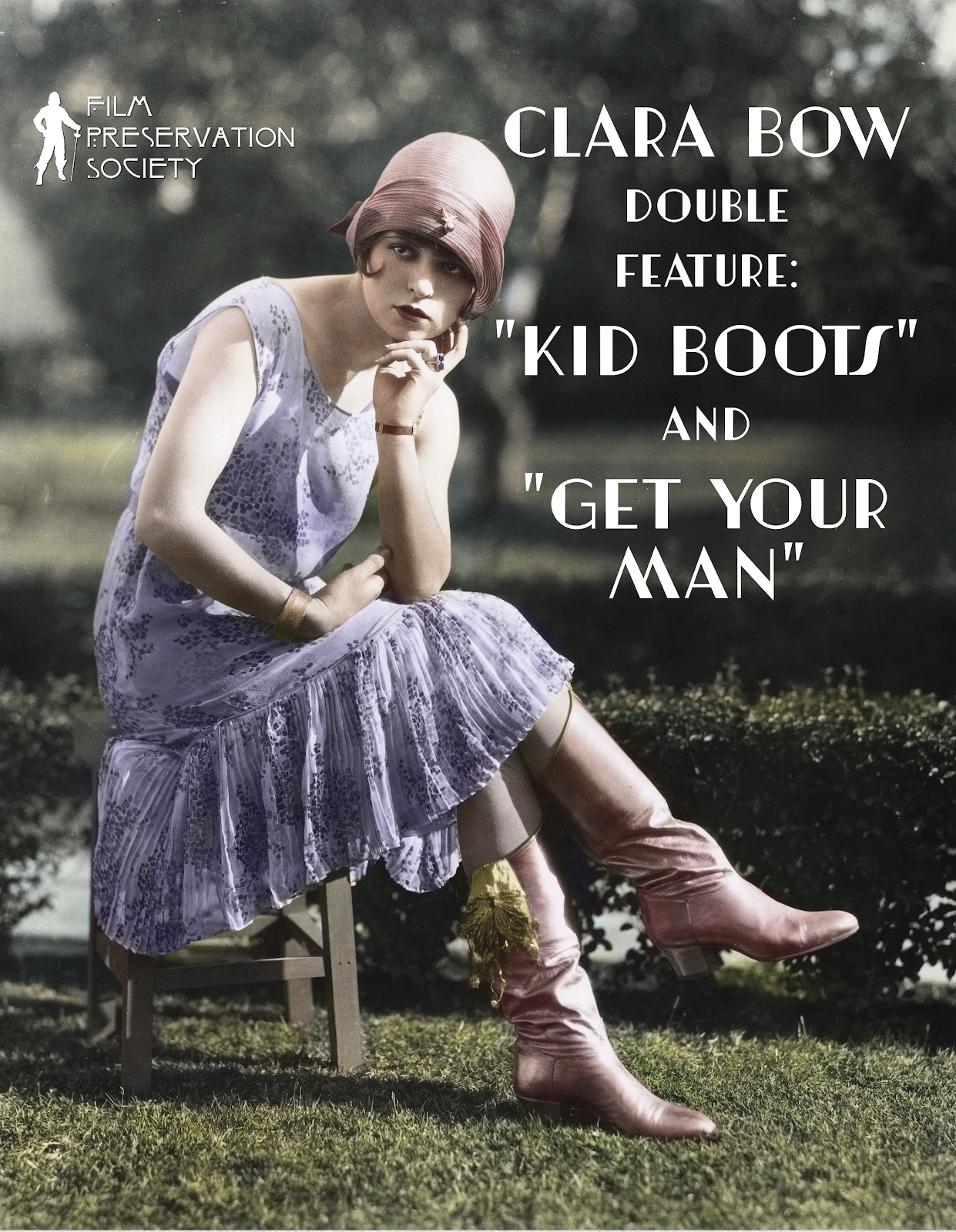


Clara Bow Double Feature: "Kid Boots" and "Get Your Man"

Known as the "It Girl," Clara Bow was one of the most popular actresses of the 1920's. Watching her movies today it is easy to see why. She is still just as charming and captivating to a modern audience as she was to movie fans of her time (if you ever get to see her movies with an audience this quickly becomes abundantly clear. She has the ability to make a good movie great and a weaker movie better. Her talents are fully on display in this new Blu-Ray from the Film Preservation Society. This Blu-Ray set includes two of her silent movies, both of which show her at the top of her game. The set starts with a new restoration of Kid Boots (1926). This is a delightful and incredibly funny comedy in which she co-stars with Eddie Cantor (in his first movie role). The new restoration is simply incredible, and this is the best this movie has probably looked since 1926. It is restorations like this that make you truly appreciate the hard work of those behind it. Get Your Man (1927) might not be as incredible of a restoration, but it is a really fun romantic comedy. Also included in this set is a very well made D.W. Griffith Biograph short, Decree of Destiny (1911), which stars Mary Pickford. 


Tom and Jerry: The Complete Cinemascope Collection

In the 1950's, the MGM cartoons went into the wide screen Cinemascope format with movie audiences now able to see Tom and Jerry (and others) in adventures with much wider and larger pictures. Sadly, when most of these theatrically released cartoons made it to TV, the picture was cropped to where cartoon fans were not able to see the whole picture. Even more sadly, those are still the versions that are shown on TV today, even on otherwise great cartoon channels. Many of us have grown up with these films in this horrendous format. As such being able to own all the Tom and Jerry Cinemascope shorts in the correct format is true treat for cartoon fans everywhere. Seeing these films in their correct format, you can see how visually pleasing many of these cartoons truly are in a way you can't on the cropped versions. Also included in this set are the two Spike and Tyke spin-off theatrical cartoons and Good Will to Men (1955). The latter is directed by William Hanna and Joseph Barbera and is a remake of the Hugh Harmon directed short, Peace on Earth (1939).    


Saturday, January 18, 2025

Some Cartoons for Saturday Morning #213

 Hello, my friends and happy Saturday morning. Once again, it is time for some classic cartoons. 

Today's cartoon selection begins with what has often times been called one of the greatest cartoons of all time, One Froggy Evening (1955). This is one of the masterpieces of the career of the great Chuck Jones. This film is beautifully made, with pitch perfect timing, clever gags and a very smart story. It would be placed at #5 in Jerry Beck's book, The 50 Greatest Cartoons. This short would get sequel decades later, Another Froggy Evening (1995). The Tiny Toons Adventures episode, Class Cut-Up (1990) would be a remake of this short. 


Up next is the Terry Toons cartoon, Go West Big Boy (1931). This is one of the few early Terry Toons shorts that is not named after a type of food or drink. 


Next is the Tom and Jerry short, Smitten Kitten (1952). This short film is a "cheater" cartoon meaning that it is a short that uses clips from previous Tom and Jerry films. This cartoon uses clips from The Mouse Comes to Dinner (1945), Solid Serenade (1946), Salt Water Tabby (1947) and Texas Tom (1950). The little green devil version of Jerry had previously appeared in the short, Springtime for Thomas (1946).  This character would later appear in a 2014 episode of The Tom and Jerry Show called Pranks for Nothing. This character would even be a playable character in the 2019 mobile game, Tom and Jerry Chase. He also appears (though he isn't playable) in the 2000 Gameboy Color Game, Tom and Jerry in Mouse Attacks! Tom and Jerry fans will immediately notice that his Jimmy Durante inspired voice is the same as Spike the Bulldog. By this point that voice had been used by Spike only in a few cartoons and back when people saw these films only in theaters many audience members would not have seen those previous shorts. So, while this is obvious to us now, it was not to most anyone watching the short back then.


Next is the classic Mickey Mouse film, Mickey's Rival (1936). The titular character is a mouse named Mortimer. Those of you who know your Disney history will know that Mortimer was a name that was considered for Mickey. This was Mortimer's first appearance though he bared more than a little resemblance to Mr. Slicker a character that appeared in the Micky Mouse comic strip. Though Mickey's Rival was his only appearance in a theatrically released short film, it was not his only appearance in animation. He became a reoccurring character in the television shows, Mickey Mouse Works (1999-2000) and House of Mouse (2001-2003). He also has a role in the direct to video movie, Mickey's Once Upon a Christmas (1999) and has appeared briefly in Mickey Mouse Clubhouse (2006-2016) and Mickey and the Roadster Races (2017-present). Outside of animation he has been used very often in the Disney comic strips and began to appear in them around the same time he made his debut in movie theaters. Mortimer's design is said to be based off of Walt Disney and those who have seen pictures of a young Walt, will find this easy to believe. The ending to Mickey's Rival has Mickey and Minnie simply shaking hands. However, it was originally planned for Mickey to have a buzzer on his hand to play a Mortimer type prank on Minnie. Though this would have been out of character for Mickey at this time it would have fit perfectly in with the Mickey Mouse of the late 1920's. A review in The Motion Picture Herald stated, "The subject is less complex than many of the recent Disney fabrications but wholly entertaining." The following is an exhibitor's review from The Motion Picture Herald, "Mickey's Rival: Mickey Mouse - We find that the bad characters often frighten our small children, and they go out into the foyer until it is passed over. - Harland Rankin, Plaza Theatre, Tilbury, Ontario, Canada, General Patronage." The following is another exhibitor's review from the Motion Picture Herald, "Mickey's Rival: Mickey Mouse—Played this the second time as it is one of the best of the Mickeys. — C. L. Niles, Niles Theatre, Anamosa, Iowa. General patronage." A review in The Motion Picture Daily stated, "Clever animation and fast-moving, but there have been better Mickey's. For instance, 'Alpine Climbers.'" The following is from a 1936 issue of The Film Daily, "United Artists' latest Walt Disney release, 'Mickey's Rival', introducing Mortimer Mouse, will open at the Radio City Music Hall with 'Swing Time' on Thursday, and at the Rivoii Theater with 'The Last oi the Mohicans.'"


Now it is time for a commercial break. 


Next comes the Out of the Inkwell silent short, Ko-Ko Nuts (1925).


Before Bugs Bunny, Daffy Duck or Porky Pig the star of the Looney Tunes series was Bosko. Here is an example of a Looney Tunes cartoon starring him, Bosko's Party (1932). 


Now for the delightful Silly Symphonies cartoon, The Cat’s Nightmare (1931). You may notice the video below titles the cartoon, The Cat's Out. J.B. Kaufman and Russell Merritt's essential book on the Silly Symphonies explains this, "Modern sources have sometimes identified this film as The Cat's Out. This was the working title and survives today in an original vault print. However, the finished film was copyrighted and released as The Cat's Nightmare." Interestingly this short played on The Mickey Mouse Club under both names (The Cat's Out on January 23, 1956, and The Cat's Nightmare on February 27, 1956). Whatever the name this is a darn good cartoon. It contains all of the atmosphere that enhances so many of the early Symphonies (especially the ones with a spooky theme). It may not quite be The Skelton Dance (1929), but it is a good film in its own right. Speaking of The Skelton Dance the animation of a rooster crowing (by Wilfred Jackson) is reused from that more famous Symphony. A review in The Film Daily states, "Right up to the high standard of this popular animated cartoon series." The following is a review from the Motion Picture Herald, "A clever piece of cartoon work, typical Silly Symphony number. The theme is as the titles suggests, and the animators have taken full advantage of its laugh making possibilities." However, a review in Motion Picture Reviews warns us, "A Halloween spooky atmosphere is so well done that it might frighten a sensitive child."


Today's cartoon post ends with The Simpsons in Shut Up, Simpsons (1988). This was a short from the Tracey Ullman Show before The Simpsons got their own TV series. 


Thanks for joining me. Come back next week for more animated treasures. Until then may all your tunes be looney and your melodies merry. 

Resources Used

The 50 Greatest Cartoons edited by Jerry Beck

Walt Disney’s Mickey Mouse: The Ultimate History by David Gerstein and J.B. Kaufman

Of Mice and Magic: A History of American Animated Cartoons by Leonard Maltin

Walt Disney's Silly Symphonies: A Companion to the Classic Cartoon Series by Russell Merritt and J.B. Kaufman 

https://disney.fandom.com/wiki/Mickey%27s_Rival

https://tomandjerry.fandom.com/wiki/Smitten_Kitten

https://mediahistoryproject.org/


Saturday, January 11, 2025

Some Cartoons for Saturday Morning #212

 Hello my friends and happy Saturday morning. Once again it is time for some more classic cartoons. 

Today's cartoon selection begins with Bugs Bunny in Frigid Hare (1949). This is the first of two theatrical cartoons where Bugs Bunny is paired with a little penguin. This penguin would later be known as Playboy Penguin. The other short film with this character would be 8 Ball Bunny (1950). Both of these shorts were directed by Chuck Jones. 


Next comes the Tom and Jerry short, Barbecue Brawl (1956). As the 1950's progressed more of the Tom and Jerry cartoons would feature the supporting characters in larger and more important roles. Here Spike and Tyke are just as much the stars of this film as Tom and Jerry. The ending gag in this short is very similar to the one in the earlier Tom and Jerry short, Pup on a Picnic (1955).


With how much I am not a fan of the Gene Dietch Tom and Jerry cartoons, I was surprised to learn that I actually like his Terry Toons shorts quite a bit. When Dietch was given control of the Terry Toons studio, he had little interest in the films, the studio had been making. Because of this he abandoned nearly all the Terry Toons characters to that point and replaced them with new characters. One of these new characters was John Doormat and here is John Doormat in Shove Thy Neighbor (1957).  


Next comes one of my favorite early Mickey Mouse cartoons, The Karnival Kid (1929). This film is famous for featuring Mickey Mouse's first spoken words. Though Mickey's earlier shorts had been sound pictures, they mostly revolved around music instead of dialogue. Though Walt Disney was excited about moving in this direction, his distributor, Pat Powers was not. Powers felt that an English-speaking mouse would have less appeal in countries where English is not the common language. To be fair the mouse does not receive a great deal of dialogue in this cartoon. His first words are the immortal, "Hot Dogs! Hot Dogs!" (in a scene animated by future Donald Duck director, Jack King). The voice is not the familiar high pitch falsetto, but a plainer undistinguished voice. I do not know who provided this voice. Carl Stalling speak about the early voices of the mouse in a 1969 interview, “all the animators were taking a shot at it, those who wanted to.” Of course, later on Walt himself would become the voice of Mickey. The cartoon features some men who would soon have a great input on Disney's animated films. Ben Sharpsteen (supervising director on the Disney features Pinocchio (1940) and Dumbo (1941)) animates the opening shots of the fairgrounds, the monkey playing all the instruments and the barker (a forerunner of Kat-Nip from the Mickey Mouse comic strip) pulling Mickey's nose. Burt Gillet (who would direct the most popular Silly Symphony, Three Little Pigs (1933)) animates the scene with the merry-go-round, Mickey playing the hot dogs like musical instruments, the emergence of Minnie and Mickey tipping his ears to her ("The Big Mooseketeer" Roy Williams stated that this scene inspired the Mickey Mouse ears that all of TV's The Mickey Mouse Club wore). Les Clark (one of Walt's nine old men and one of the greatest Mickey Mouse animators) receives very little footage in the cartoon. He animates Mickey catching a runaway hot dog and giving it a spanking, Mickey briefly strumming the guitar and the final shot of the movie. Les Clark's ending was originally going to be longer with Mickey riding the bed like a horse. The legendary Ub Iwerks (who co-created Mickey with Walt) animates the two cats' duet. Despite the forward-looking ideas in this cartoon borrowed a major gag from a previous Disney short. Mickey chasing and spanking the hot dog was originally done by Oswald the Lucky Rabbit in All Wet (1927).


Now it is time for a commercial break. 


Now for a classic silent Out of the Inkwell film, The Clown's Little Brother (1920). 


And now here is Mr. Know-it-All. 


Stephan Bosustow, cartoon producer and one of the founders of the UPA studio (home of Mr. Magoo and Gerald McBoing Boing) had a strong interest in creating an animated feature film based on the work of writer James Thurber. However, he could not get the funding for this, so he asked UPA director William T. Hurtz to adapt one of Thurber's stories as an animated short film. Hurtz took this idea very seriously and studied nearly every drawing Thurber made. The result was A Unicorn in the Garden (1953). Bosustow was reportedly disappointed with the end result. Because of this he refused to submit the cartoon for consideration for an Academy Award and changed plans for the studio's first feature to one starring Mr. Magoo. Cartoon fans certainly aren't disappointed by the result. This short is not only beloved by cartoon fans but received the 48th spot in Jerry Beck's book, The 50 Greatest Cartoons


Let us close with one of the greatest commercials in the history of TV. 


Thanks for joining me. Come back next week for more animated treasures. Until then may all your tunes be looney and your melodies merry. 

-Michael J. Ruhland

Resources Used

The 50 Greatest Cartoons edited by Jerry Beck

Walt Disney's Mickey Mouse: The Ultimate History by J.B. Kaufman and David Gerstein


https://cartoonresearch.com/index.php/mickey-mouse-in-the-karnival-kid-1928/


Saturday, January 4, 2025

Some Cartoons for Saturday Morning #211

 Hello my friends and happy Saturday morning. Once again it is time for some classic cartoons.

Today's cartoon selection begins with the Tom and Jerry short, Muscle Beach Tom (1956). In this short film, Tom and Butch (the black cat) are fighting over a girl cat on the beach. The girl cat has a similar design to a girl cat that Tom and a bulldog fight over in an episode of Hanna-Barbera's The Tom and Jerry Show entitled, The Ski Bunny (1975). The Tom and Jerry Wiki claims these are the same character, but I remain skeptical about that. A clip from this film would later be used in the made for TV short, The Mansion Cat (2001). 


Next comes the Terry Toons short, Squirrel Crazy (1951). 


The Old Mill (1937) is far from your typical Silly Symphony cartoon. This short film has no storyline to speak of nor has it any gags. This is instead a mood film, that is much more concerned with creating a sense of atmosphere than telling a story. As such it stands as one of the most powerful and unique short films Disney ever made. The basic idea for this cartoon had been on the minds of the Disney filmmakers for quite a while. In 1931 an idea for a film called The Old Mill Stream had been proposed. This story was elaborated further in 1934, though at that time the story was planned to be more comedic. This film introduced Disney's famed multiplane camera. This camera would create a three-dimensional effect by moving various pieces of artwork past each other at varying speeds. This would of course play a major role in Disney's later feature length animated films. To help the animators and layout artists Ferdinand Horvath would create a large model of the mill. This cartoon won the Academy Award for Best Animated Short Film, and the studio received a special Oscar for the multiplane camera. More recently it received the 14th spot in Jerry Beck's book, The 50 Greatest Cartoons. It is interesting to note that such an unusual cartoon was the first Disney film that was distributed by RKO. 


Next comes a silent Out of the Inkwell film, Koko Lamps Aladdin (1928). 


Now it is time for a commercial break. 


Next comes a Terry Toons cartoon staring Gaston Le Crayon (in his first appearance), Gaston is Here (1957). When Gene Dietch was given control of the Terry Toons studio, he had little interest in the types of cartoons that had been made there. During his time in charge of the studio, almost all of the starring characters (Mighty Mouse, Heckle and Jeckle, etc.) had been dropped in favor of new characters. This was not the only difference between these new films and the previous shorts. These new films featured a very stylized look inspired by modern art. 


Next comes our good friend Porky Pig in Porky and Gabby (1937). The credited director on this short film is Ub Iwerks, Walt Disney's former right-hand man and co-creator of Mickey Mouse. However, it is believed that the two credited animators Bob Clampett and Chuck Jones co-directed this film with Iwerks. This cartoon marks the first appearance of Porky's short lived sidekick Gabby Goat. 


Speaking of Chuck Jones, here is an early directorial credit for Chuck, Snowman's Land (1939). 


Let us close with a song that has become a Dixieland jazz standard. 


Thanks for joining me. Come back next week for more animated treasures. Until then may all your tunes be looney and your melodies merry. 

Resources Used

50 Greatest Cartoons edited by Jerry Beck

Silly Symphonies: A Companion to the Classic Cartoon Series by Russell Merritt and J.B. Kaufman

https://likelylooneymostlymerrie.blogspot.com/2012/05/163-porky-and-gabby-1937.html

https://mediahistoryproject.org/

https://tomandjerry.fandom.com/wiki/Muscle_Beach_Tom


Saturday, December 28, 2024

Some Cartoons for Saturday Morning #210

 Hello, my friends and happy Saturday morning. Once again it is time for some classic cartoons. 

Today's cartoon selection begins with a classic Tom and Jerry short, Designs on Jerry (1955). This short film is one of the best Tom and Jerry cartoons of the 1950's. While it may not have as many laugh out loud gags as the 1940's Tom and Jerry shorts, it more than makes up with this with a clever premise and a great execution. The idea of blueprints coming to life was later reused in the opening of TV's Tom and Jerry Tales. Clips from this film would later be reused in the Tom and Jerry cartoon, Shutter Bugged Cat (1967). 


I love of the cartoons of Chuck Jones from any period but there is something special about his films from 1942 and 1943. At this time, he was fully getting away from his slower paced cuter output of the late 1930's but had not yet gotten to the style of films he would make in the 1950's that everybody is familiar with today. So, what we get from output during these two years are cartoons that experiment with what you can do in an animated short. It doesn't hurt that he worked with such experimental artists as layout man John McGrew. Chuck gave McGrew plenty of freedom and what John accomplished in these movies is nothing short of amazing. This is especially shown in The Case of the Missing Hare (1942), where experimentation is seen in every moment. Just watch the abstract backgrounds that show a mixture of two colors at a time, but the colors change when there is a strong action in the foreground. This is something someone may not notice on their first watch, but it is something they can feel. A review in The Film Daily stated, "Here is another hilarious, the Leon Schlesinger creation that keeps growing in comic strength with every new release." I think anyone watching this cartoon today will recognize that the antagonist is not Elmer Fudd, but one reviewer from The Exhibitor didn't as in his review he stated "...this has Elmer, as a magician..."  A review from the same magazine less than a month later stated, "Elmer isn't in this." The latter is right. A review in Variety called this "One of the better Bugs Bunny subjects."


Up next is the early Terry Toons short, Scotch Highball (1930). 


A couple decades before The Flintstones, the Fleischer Studio made a series of cartoons taking place in the Stone Age. Here is one of those films, The Foul Ball Player (1940). 


Now it is time for a commercial break. 


Heavenly Puss (1949) is probably one of the best remembered and most beloved of the Tom and Jerry films. It certainly is one that has stayed in the minds of cartoon fans. The credited animators here are Ed Barge, Irv Spence, Kenneth Muse and Ray Patterson. Each of them gets their time to shine. Irv Spence animates the scene where Tom is crushed by the piano. Ed Barge handles most of the animation of the cat that grants passage to Heaven as well as the scene with the small kittens. Ray Patterson animates the scenes with the evil version of Spike the bulldog.  William Hanna and Joseph Barbera would later make a semi-remake of this film with the Pixie and Dixie cartoon (from The Huckleberry Hound Show), Heavens to Jinksy (1959). Clips from Heavenly Puss would later be reused in the Tom and Jerry cartoon, Shutter Bugged Cat (1967). 


Next comes the classic Disney cartoon, Orphan's Benefit (1934). This film marks the second Donald Duck cartoon, and the first time Donald appeared alongside Mickey and friends. As many of you know, Donald first appeared in The Silly Symphony short, The Wise Little Hen (1934). However, some of those who worked on the Disney cartoons at this time (including Walt), misremembered this as the first Donald Duck cartoon. This may be because the short was the first one the studio started work on. Historian J.B. Kaufman has stated that the Disney story department began work on this cartoon (with an outline entitled The Surprise Party) in November 1933, before they started work on The Wise Little Hen.  However, this outline was quite different from the finished film. Donald was a small boy who was dragged to a party by his mother and made to recite Mary Had a Little Lamb. The recitation of Mary Had a Little Lamb has its origins in the origin of Donald's voice. Clarence Nash had created this voice as a child himself not to be the voice of a Duck but of a crying baby goat. He used to entertain his friends by reciting Mary Had a Little Lamb in this voice. He would later do this act professionally both live and on radio. Walt Disney, having heard Nash do this voice on radio, felt that it sounded more like a duck and pitched the idea of voicing a duck to Nash. In the early 1940's several older Disney cartoons were considered for some shot for shot remakes. However, only one of these were made and that was Orphan's Benefit (1941). The remake was almost exactly like the earlier picture except being that in color and using the 1941 designs of the characters. In fact, the remake even uses the exact soundtrack of the original. However, I personally prefer this 1934 black and white original and I hope you love it too. A review in The Film Daily stated, "It's all very clever, screamingly funny and with a dandy of a musical score." The original ending for this film was going to be Mickey, Minnie and Donald dressed as pigs performing Who's Afraid of the Big Bad Wolf. However, that ending would be replaced by Donald's temper tantrum. Donald Duck's voice Clerance Nash later remembered, "I was more nervous about that picture than I as about The Wise Little Hen. I don't mind telling you that I prayed a lot, that the character would be a success. I was with a group of Disney people and my wife was with me too. I was just like an average audience - I got a big kick out of it, and I completely forgot I had anything to do with it." 


Now for a short silent cartoon starring Pongo the Pup, Pongo Cleans Up The Goat Family (1924). Sorry about the video not having music.


Today's cartoon selection ends with The Simpsons in Bart's Little Fantasy (1989). This is one of the shorts made for The Tracey Ullman Show before The Simpsons go their own TV show. 


Thanks for joining me. Come back next week for more animated treasures. Until then may all your tunes be Looney and your melodies merry. 

Resources Used

Donald Duck: The Ultimate History by J.B. Kaufman and David Gerstein

DVD audio commentary (Tom and Jerry Spotlight Collection Vol. 1) by Jerry Beck.

 https://cartoonresearch.com/index.php/orphans-benefit-revisited/

https://cartoonresearch.com/index.php/origins-of-the-duck/

https://tomandjerry.fandom.com/wiki/Heavenly_Puss

https://cartoonresearch.com/index.php/go-to-hades-part-2/


Saturday, December 14, 2024

Some Cartoons for Saturday Morning #207

 Hello, my friends and happy Saturday morning once again it is time for some more classic cartoons. 

Today's musical selection begins with one of director Art Davis's best cartoons, Riff Raffy Daffy (1948). Art Davis may have only directed Looney Tunes and Merrie Melodies cartoons for a short while, but the offbeat and often hilarious sense of humor has made him a favorite of many classic cartoon fans. I am especially a fan of his take on Daffy Duck. Though more energetic and wilder than Bugs Bunny, this version had some Bugs Bunny qualities to him as well. Like Bugs he was always at least one step ahead of his foes. The meshing of a newfound cleverness and remorsefulness with the wacky and energetic qualities that help define Daffy, creates a truly wonderful take on this character. 


Next is one of my favorite Christmas cartoons of all time, Mickey's Good Deed (1932).  This film was from 1932, at this time, Mickey was at the absolute height of his popularity. He was famous in a way that no cartoon character before had ever been. Critics often compared his popularity to that of Charlie Chaplin's little tramp, and like that character Mickey had fans of all types. He was equally popular with intellectuals and small children. In fact, this same year Walt Disney would receive a special Academy Award for creating Mickey. Renowned Soviet director Sergei Eisenstein (best known for his silent film The Battleship Potemkin (1925)) was a huge fan and even wrote essays on Walt Disney, that discussed the brilliance of Mickey Mouse cartoons (He would remain a huge Disney fan and even later call Snow White and the Seven Dwarfs (1937) the single greatest film ever made). Almost every other American cartoon studio was copying what Disney had done with Mickey Mouse. Characters like Foxy (at Warner Brothers) and Cubby Bear (at Van Beuren) were extremely thinly disguised copies of Mickey himself. In fact, in 1931, the Van Beuren studio was sued by Walt for using two mice characters that looked exactly like Mickey and Minnie. There was no doubt, Mickey was movie royalty. Mickey did for animated comedies, exactly what Charlie Chaplin's little tramp had done for live action comedies. Like the comedy films made before Chaplin, the animated comedies before Mickey were often very funny, but you very rarely felt any other emotional response to what was happening on screen. Mickey changed all that and nowhere was it clearer than in Mickey's Good Deed. You may notice that this doesn't sound like your typical cartoon short of the era, and my point is it isn't. This film while not sacrificing the slapstick comedy, also adds a lot of drama to the story itself. However, the Disney studio understood exactly what Chaplin had found out earlier. If the comedy and the drama are both driven by the story and characters, they can both easily co-exist. This idea is done to absolute perfection in this cartoon. This is a beautiful and moving film, while it never forsakes the comedy. The following is a review from The Film Daily, "Right up there with the best of these animated cartoons. Subject has a special holiday flavor in that it shows how Mickey and his dog manage to bring cheer into a big family of needy animal folks. Clever and lively as usual." The following is an exhibitor's review from The Motion Picture Herald, "Mickey's Good Deed: Mickey Mouse - Christmas cartoon. Kids like Mickey. That's why they come. One Mickey Mouse cartoon on your Saturday's program brings the kiddies out to the matinee. Running time, eight minutes. - Edmund M. Burke. Fort Plain Theatre, Fort Plain, N.Y. General Patronage."  


Now for a delightful Terry Toons short, Sparky the Firefly (1953). 


Now for a silent Aesop's Film Fables cartoon, The Pace That Kills (1923).


Now it is time for a commercial break. 


Mouse Trouble (1944) was the second Tom and Jerry short to win for best animated short film at the Oscars. The first of these shorts was the previous year's Yankee Doodle Mouse. The next year a Tom and Jerry cartoon would again win the Oscar for Quiet Please making three years in a row where Tom and Jerry won an Oscar. Unlike a Disney cartoon where the animators would often times be assigned different characters to work with, in this film (and many other Tom and Jerry cartoons) the animators would be assigned lengthy segments (for a 7-minute cartoon that is) of the picture to handle themselves. Pete Burness animated the begging of the cartoon with Tom receiving the book in the mail and animates until Jerry runs in the hole and Tom turns to his book for advice. Ray Patterson animates Tom's failed attempts at using a mouse trap and a snare trap. Kenneth Muse animates Tom trying to use Jerry's sense of generosity against the mouse only to have Jerry end up tricking tom by engaging Tom's curiosity. Pete Burness animates Tom finding out a cornered mouse does sometimes fight back. Kenneth Muse animates Tom using a stethoscope to find Jerry. Irven Spence animates Tom's use of a gun, a tiger trap and a mallet to catch Jerry as well as him disguising himself a surprise package. Tom's use of a wind-up toy girl mouse to catch Jerry is animated by Kenneth Muse. Tom tearing up the book is animated by Pete Burness. Tom using explosives by Kenneth Muse. The end of the film with Tom ascending to heaven was animated by Pete Burness.


Next comes the Captain and the Kids cartoon, The Captain's Christmas (1938). This short film was directed by Friz Freleng, during the brief time he left Warner Brothers to work at MGM. He was not happy working with the characters in these Captain and the Kids cartoons and would soon go back to Warner Brothers. 


Next is the Van Beuren cartoon, Opening Night (1932).  This cartoon introduced a new character, Cubby Bear. This is one of the many Mickey Mouse lookalikes that populated American cartoons of the 1930's. Almost every studio was guilty of having Mickey Mouse clones at this time, since Mickey had become such a sensation. In fact, the Van Beuren Studio once took this too far, when they made some cartoons featuring Mice that looked just like Mickey and Minnie in 1931. Walt would sue the studio over those cartoons. This cartoon is also a rather historically interesting film for another reason. It was made for the opening of the RKO Roxy Theatre. It is not subtle about this either. Since the theatre opened in late December, the film begins with Santa Claus riding his sleigh and takes out of his bag various stars which form the words "RKO ROXY." The meaning is simple to decipher, the theatre was a Christmas gift to movie fans.


/

For anyone wondering why Christmas is so awesome, let us close with this song.


Thanks for joining me. Come back next week for more animated treasures. Until then may all your tunes be looney and your melodies merry. 

Resources Used

Of Mice and Magic: A History of American Animated Cartoons by Leonard Maltin

Disney by Sergei Eisenstein  

Walt Disney’s Mickey Mouse: The Ultimate History by David Gerstein and J.B. Kaufman


Saturday, December 7, 2024

Some Cartoons for Saturday Morning #206

 Happy Saturday morning my friends. Once again, it is time for some classic cartoons. 

The Night Before Christmas (1941) was the third Tom and Jerry cartoon and one of the best. It is clear that Bill, Joe and the rest of the team were now fully understanding how to use these characters just right. The opening scenes with Jerry playing around the tree, the mistletoe scene and the ending were all animated by Jack Zander. George Gordon animated the scene of Jerry bouncing on Tom, and a very funny sequence involving boxing gloves. Cecil Surry animates Jerry freezing outside. Bill Littlejohn animates the scene of Jerry pretending to be a toy solider. Irven Spence who would later become one of the most prominent Tom and Jerry animators (known for animating over the top reactions) has a very limited role here. He animates Tom feeling guilty about Jerry freezing outside, while he is trying to sleep and a very brief scene of Tom shaking snow off of Jerry. This film was nominated for an Oscar. Its competition this year was Boogie Woogie Bugle Boy of Company B (1941, Walter Lantz), Hiawatha's Rabbit Hunt (1941, Warner Brothers, starring Bugs Bunny), How War Came (1941, Columbia), Lend a Paw (1941, Disney, starring Mickey Mouse and Pluto), Rhapsody in Rivets (1941, Warner Brothers), The Rookie Bear (1941, MGM, starring Barney Bear), Rhythm in the Ranks (1941, George Pal Puppetoon), Superman (1941, Fleischer Studios) and Truant Officer Donald (1941, Disney). Lend a Paw won the Oscar this year. 


/

Next is the Terry Toons cartoon, Spanish Onions (1930). Most of the early Terry Toons shorts (including this one) had food related titles. 


Disney cartoons have long been associated with sentimentality and cuteness. Yet this wasn't always the case. The early black and white Mickey Mouse films were mostly pretty much the opposite. They focused purely on the gags and jokes and with keeping the comic momentum going. A perfect example of this is Mickey's Orphans (1931). This short has all the makings for a sentimental cartoon. It takes place at Christmas time and the involves Mickey adopting a bunch of orphans. Yet all of this is play strictly for laughs and some of the kids can be a little sadistic. A review in the Motion Picture Herald stated, "The youngsters will get a real kick out of this short, and the oldsters will extract a bit of enjoyment." A review in The Film Daily gave the same sentiment stating, "It will delight all children and get many a laugh from their elders." An issue of The Film Daily (Dated February 7, 1932) stated "In addition to El Brendel in person this week's show at the Roxy is a special treat for the kids. The presentation includes four scenes based on 'Mickey's Orphans,' the Mickey Mouse cartoon that was held over for three weeks at this house. The characters of Mickey and Minnie are portrayed by the Arnaut Brothers, popular pantomimists. Patricia Bowman, Fred Waring's orchestra in a novelty entitled 'Dancing Melodies,' and the Roxyettes also are part of the proceedings. In the Mickey scenes, the Roxyettes and ballet group are made up to represent kittens, musical notes and animated furnishings in Minnie's boudoir." This cartoon was reissued to theatres in 1934. 


Now for a winter themed Foghorn Leghorn short, Weasel While You Work (1958). This is the third and last appearance of the weasel character in a theatrical short. His other two appearances were in Plop Goes the Weasel! (1953) and Weasel Stop (1956), both of which were Foghorn Leghorn cartoons. This film is also one of six shorts to use stock music from John Seely, rather than the usual Carl Stalling or Milt Franklin orchestral scores. This was due to a musician's strike at the time. The cartoon also marks one of the few times director Robert McKimson worked with writer Michael Maltese, who is most associated for his work with Chuck Jones. Weasel While You Work is one of only two Foghorn Leghorn cartoons written by Michael Maltese, with the other being Fox Terror (1957). 


Now it is time for a commercial break. 


Next comes a silent era cartoon starring Krazy Kat, Scents and Nonsense (1926).


Many of the later Betty Boop cartoons would turn the focus from Betty to her supporting cast. Quite a few shorts would focus on her dog Pudgy. One of these is Pudgy Picks a Fight (1937). 


Next comes Bugs Bunny and the Tasmanian Devil in The Fright Before Christmas (1979). This short was originally created for the TV special Bugs Bunny's Looney Christmas Tales (1979). This was the final of three segments in that special and was directed Friz Freleng. This makes this the first time Taz was directed by someone other than Robert McKimson. The result like the whole special is a delightful Christmas treat and one of the best uses of Taz after the golden age of Looney Tunes. Also appearing here is Bugs' nephew Clyde. Clyde had only appeared in two theatrical shorts, His Hare Raising Tale (1951) and Yankee Doodle Bugs (1954). Both of those were directed by Friz Freleng. 


Today's cartoon selection ends with A Garfield Christmas Special (1987). 


Thanks for joining me. Come back next week for another selection of animated treasures. Until then may all your tunes be looney and your melodies merry. 

Resources Used

Tom and Jerry: The Definitive Guide to Their Animated Adventures by Patrick Brion
Of Mice and Magic: A History of American Animated Cartoons by Leonard Maltin
http://cartoonresearch.com/index.php/mgms-the-night-before-christmas-1941-with-tom-jerry/ 
Walt Disney’s Mickey Mouse: The Ultimate History by David Gerstein and J.B. Kaufman
https://mediahistoryproject.org/


Saturday, November 30, 2024

Some Cartoons for Saturday Morning #205

 Hello my friends and happy Saturday morning. Once again it is time for some classic cartoons. 

Today's cartoon selection begins with the first cartoon featuring the Tasmanian Devil, Devil May Hare (1954). About Taz director Robert McKimson recalled, "I devolped him because we were looking for a new character. I made two of them, I think, and my boss [Eddie Selzer] told me not to make them anymore because he was too obnoxious. Actually he was just a stupid foil. He could tear things apart but a guy like Bugs Bunny could frustrate him. Shortly after that, Jack Warner asked Eddie Selzer, 'what happened to the Tasmanian Devil?' And Eddie said he'd stopped making them, 'get back and make more of them' [Jack Warner replied] 'He's a funny character.'" 


Santa's Surprise (1947) is an especially delightful Christmas cartoon from Famous Studios. This cartoon is best remembered as the first cartoon to feature the character of Little Audrey. Little Audrey was an original character for the studio and also a replacement for Little Lulu, who the studio had made a series of cartoons with, in the past. Little Lulu was not created by the studio but was the star of a comic strip by Marjorie Henderson Buell. When Paramount decided not to renew the license for Famous Studios to use that character, Little Audrey was created. The character was designed by veteran Disney animator Bill Tytla (possibly my favorite Disney animator), who was now a director at Famous. This short's lead animator was Myron Waldman, who specialized in cute animation (often shining his best in the studio's Casper series). Myron would later remember this cartoon as one he was especially happy with.


Next comes the Tom and Jerry cartoon, Cue Ball Cat (1950). This was the last Tom and Jerry film of 1950. The first year of the 1950's showed Tom and Jerry films still at the consistent high quality that they had maintained in the 1940's. The cartoon was reissued to movie theaters in 1956. 


Now for a classic black and white Walter Lantz cartoon, Queen's Kittens (1938). 


Now it is time for a commercial break. 


Let's continue with a Christmas classic, Pluto's Christmas Tree (1952). Like many of the post-1930's Mickey Mouse short films, Mickey is not really the star of this cartoon. Instead, the short centers around Pluto and Chip and Dale. Though Chip and Dale are mostly recognized for fighting with Donald Duck, they did make their film debut as antagonists for Pluto in Private Pluto (1943). This cartoon features a great cast of animators including, George Kreisl, Fred Moore, Bill Justice, Volus Jones, Blaine Gibson and Dan MacManus. Dan MacManus animates the opening scene of the cartoon. Fred Moore is recognized as one of the greatest Mickey animators of all time and he gets to show that off here as he animates Mickey chopping down the tree, Mickey decorating the tree, Mickey with the Christmas gifts, Mickey's reactions to Pluto's antics, Mickey holding the chipmunks and him and Pluto looking out the window. Bill Justice and Volus Jones animate much of the Chipmunks. Justice also animates the cameo of Minnie, Donald and Goofy at the end. George Kreisl animates much of Pluto's antics. Blaine Gibson animates very little in this short with the tree lights going off and on. This cartoon was directed by Jack Hannah, who directed the majority of the Chip and Dale shorts. 


Now for a silent Krazy Kat cartoon, The Best Mouse Loses (1920). 


Now for the Terry Toons cartoon, Codfish Balls (1930). At this time nearly every Terry Toon short had a title that was a type of food. 


Today's cartoon selection closes with a half hour TV special, I wish would play on TV. This is A Pink Christmas (1978) starring the coolest cat in all filmdom. The Pink Panther. While The Pink Panther has often been compared to Charlie Chaplin's Little Tramp, this is probably the clearest example. Like Charlie Chaplin's best films, this special effortlessly combines sentimentality and slapstick humor. The character is at his most likable and charming here creating what is to me a Christmas must watch. 


Thanks for joining me. Come back next week for more animated treasures. Until then may all your tunes be looney and your melodies merry.

Resources Used

Of Mice and Magic: A History of American Animated Cartoons
by Leonard Maltin

Walt Disney's Mickey Mouse: The Ultimate History by J.B. Kaufman and David Gerstein 

http://afilmla.blogspot.com/search/label/Shorts_RKO?updated-max=2006-08-26T01:00:00-07:00&max-results=20&start=25&by-date=false


Saturday, November 23, 2024

Some Cartoons for Saturday Morning #204

 Hello, my friends and happy Saturday morning. Once again it is time for some classic cartoons. 

Today's cartoon selection begins with the second Coyote and Roadrunner film (though Wile E. Coyote appeared sans Roadrunner in Operation Rabbit (1952) before this). When the first Roadrunner cartoon (Fast and the Furry-ous (1949)) was made, it was not intended to become a series. Writer Michael Maltese stated, "It was just another one-shot. Another workaday cartoon." This second entry proves that these characters had a power that lasted past one cartoon. Beep Beep remains one of the finest entries in the series. 


Up next is a true Thanksgiving classic, Tom Turk and Daffy (1944). Unlike Christmas or Halloween, there really aren't a wide variety of Thanksgiving cartoons, which is odd once you think about how hunting a turkey is a perfect subject for a cartoon. However, the idea of hunting a turkey in a cartoon was done to perfection in this film. The cartoon was directed by Chuck Jones, who is often credited with playing a major role in turning Daffy from his early crazy self into a self-centered character bent on self-preservation-ism. While Daffy had not fully turned into that character by this point this cartoon shows that sneaking into the character. In this film Daffy is willing to sell-out his friend he vowed to protect when temptation gets the better of him (Those darn candied yams!). The idea of Daffy simply being too weak to resist temptation is fully in line with the Daffy we would see in later Jones cartoons. Yet he still has the wild energetic streak that characterized the older Daffy Duck cartoons. In an interview with film historian Joe Adamson, Chuck would state, "What you do is multiply your own weakness, I guess, in a character like Daffy. There was no problem after I began to understand what he was all about. My Daffy and Friz's [Looney Tunes director, Friz Freleng] are also a little bit different, Friz was the one you might say, who got him into that cowardly self-preservation. The minute he did it, I understood what that was; I knew how I'd feel. It's that awfulness, when you're on the battlefield, of realizing when your buddy is shot that your basic feeling is one of relief: that it wasn't you. Well Daffy says that. He says, 'I may be a mean little duck but I'm an alive little duck.' or when he gave Bugs up to the Abominable Snowman, he said, 'I'm not like other people: I can't stand pain - it hurts me.' When I'd go home, I'd tell Dorothy [Chuck's wife] a line like that, which just occurred as I was working. I'd say, 'You know what that guy Daffy did today?' and I'd repeat the line and then she'd look at me. She never got used to this, she'd say, 'Well, you were drawing it you did it.' I'd say 'That's not true! It just developed! That's what he said. It was natural for him to say it.'" Despite this cartoon being Thanksgiving themed, Jerry Beck and Will Friedwald's book, Looney Tunes and Merrie Melodies: A Complete Illustrated Guide to Warner Brothers Cartoons, lists the film release date as February 12th, 1944. The story credit for this film goes to "The Staff" and as far as I know this is the only Warner cartoon with that credit. I do not know the reason for this if any of you do, please let me know.


Next is Tom and Jerry in the Hollywood Bowl (1950). In the vein of The Cat Concerto (1947) before it, this film once again features Tom trying to put on a concert and Jerry wanting to be a part of it. Tom has a big concert at the Hollywood Bowl as the conductor. Jerry wants to conduct alongside Tom, but Tom does not take to kindly to this. Tom tries his best to get Jerry out of his way, but the mouse proves to be incredibly stubborn. 


Now for a delightfully bizarre early Terry Toons short, Golf Nuts (1930). This is actually the first Terry Toon not to have the name of a food or drink in its title. All the Terry Toons before this were named after some food or drink. 


Now it is time for a commercial break. 


Next is a black and white Walter Lantz cartoon, Pixie Land (1938). While this may not be as funny as the Walter Lantz shorts of the 1950's it is still quite enjoyable on its own terms. 


Before Pat Sullivan produced the silent Felix the Cat cartoons, he produced a series of animated short films starring Charlie Chaplin's little tramp character. Charlie's Turkish Dream (1919) is a good example of one of these films. 


Now for a Mickey Mouse Works TV cartoon, Roller Coaster Painters (1999). This cartoon would later be used in the House of Mouse episode, Not So Goofy (2001). 


Today's cartoon selection ends with a classic Thanksgiving TV special, Garfield's Thanksgiving (1989). 


Thanks for joining me. Come back next week for another selection of animated treasures. Until then may all you tunes be looney and your melodies merry. 

Resources Used

Chuck Jones: Conversations Edited by Maureen Furniss

Looney Tunes and Merrie Melodies: A Complete Illustrated Guide to Warner Brothers Cartoons by Jerry Beck and Will Friedwald

Hollywood Cartoons: American Animation in it's Golden Age by Michael Barrier

Of Mice and Magic: A History of the American Animated Cartoon by Leonard Maltin


Saturday, November 16, 2024

Some Cartoons for Saturday Morning #203

 Hello, my friends and happy Saturday morning. Once again it is time for some classic cartoons. 

Today's cartoon selection begins with what is widely considered to be one of the greatest cartoon shorts ever made, Duck Amuck (1953). This short film has been analyzed as much as any live action feature and is sometimes considered to be a great commentary on the film medium itself. However, none of this was on the minds of anyone making the cartoon at the time. Director Chuck Jones would later say, "We started out, I sat down and started drawing, and I came up with the opening and it was just an idea that he runs out of background. From that point on it happened right on the board. We didn't even have a story as such, we made one afterward, but there wasn't one as we were making it." He would even state that the iconic ending didn't even happen until the last week of layout. This cartoon reached the number 2 spot in Jerry Beck's book, The 50 Greatest Cartoons and still delights audiences whether they are seeing it for the first or the 100th time. 


Quiet Please (1945) was the third Tom and Jerry cartoon to win the Oscar for Best Animated Short Film. It's competition that year included Disney's Donald's Crime (1945), George Pal's Jasper and the Beanstalk (1945), Warner Brother's Life with Feathers (1945, the debut of Slyvester), Terry Toon's Mighty Mouse in Gypsy Life (1945), Walter Lantz's Poet and Peasant (1946) and Columbia's Rippling Romance (1945). A scene from this film was recreated in the opening for the 1975 Tom and Jerry TV show. This scene features Tom chasing Jerry and coming to a stop when he sees Spike sleeping. The gag of Jerry making a drawing of Tom and writing "Stinky" underneath was reused in an episode of TV's The Tom and Jerry Comedy Show, called New Mouse in the House (1980). 


Now we join our good friend Dinky Duck in The Timid Scarecrow (1953). 


Now we will join our friend Toby the Pup, Down South (1931). While Charles Mintz was producing Krazy Kat cartoons for Columbia, he decided to create a separate series of cartoons for RKO, these starring a character named Toby the Pup. To head this series Mintz handed the duties to Dick Huemer, Art Davis and Sid Marcus. Dick Huemer had been a major contributor to the style of the Fleischer studio earlier and this is probably why these shorts have a Fleischer-type feel to them. Huemer, Davis and Marcus would later be the major creative factors for Columbia's Scrappy cartoons (also produced by Mintz).


Now it is time for a commercial break. 


Now for a Walter Lantz cartoon starring Jock and Jill, Ghost Town Frolics (1938). This is the only Jock and Jill cartoon. If there were plans to make this a full series it didn't pan out. Watching the film, it is understandable why. The cartoon is quite creative and full of fun gags. However, Jock and Jill don't have much in the way of personality or anything to make them stand out from similar cartoon characters of the same time. 


Now for a silent stop motion film, Green Pastures (1926). Yes, I think the horse looks like Pokey too. 


Now for a true Disney classic, Alpine Climbers (1936). Though this film teams Mickey, Donald and Pluto, it follows the same format as the Mickey, Donald and Goofy cartoons that Disney made around this time. Like those films, here each of the characters goes his separate way and has a separate adventure. Mickey tries to collect an eagle's egg. Donald tries to pick flowers. Pluto has a run in with a St. Bernard dog (designed by Joe Grant). This other dog actually has a name, and that name is Bolivar. The character however is unnamed in the film, nor would he ever be used again in an animated cartoon. Instead, the character would be named in the Disney comics. He started appearing in 1938 in Al Taliaferro's Donald Duck newspaper comic strip. Bolivar would soon become the family dog of the duck family and would even be a reoccurring character in Carl Barks' beloved Donald Duck comic books. Despite this being an odd name for a cartoon animal the name had almost been used before. A cartoonist named Pinto Colvig (best known to cartoon fans today as the original voice of Disney's Goofy) was interested in entering the making of animated cartoons when sound came to the movies. He felt due to the fact that he was a cartoonist, who was also capable of doing various voices and playing multiple musical instruments, he felt sound cartoons were a wonderful opportunity for him. He created a character named Bolivar the Talking Ostrich. Teaming with Walter Lantz (later of Woody Woodpecker fame), he made a film with this character called Blue Notes (1928). In this film, the animated ostrich interacted with a live action Pinto Colvig. Unfortunately, this film is considered lost and despite Colvig's best efforts, a series never materialized. Colvig would however talk much about this ostrich in later years, however Lantz would barely ever mention the character. It may be possible that Al Taliaferro named the dog character after Colvig's ostrich character, but there is no real proof either way. Alpine Climbers would be reissued to movie theaters in 1948. The short film would make its TV debut on an episode of TV's Disneyland entitled, The Adventures of Mickey Mouse (1955). The following is a review of Alpine Climbers from a 1936 issue of World Film News. "I laughed immoderately at the latest Mickey Mouse, Alpine Climbers. The spectacle of the frozen Pluto getting tiddly with his savior, a St. Bernard with a handy keg around his neck is wonderful. - Ian Coster" 


Now to end with a very educational short film. 


Thanks for joining me. Come back next week for more animated treasures. Until then may all your tunes be looney and your melodies merry. 


Resources Used

Of Mice and Magic: A History of American Animated Cartoons by Leonard Maltin

The 50 Greatest Cartoons edited by Jerry Beck

Walt Disney's Mickey Mouse: The Ultimate History by David Gerstein and J.B. Kaufman

https://cartoonresearch.com/index.php/bolivar-the-ostrich-unspoken/

https://lantern.mediahist.org/

https://tomandjerry.fandom.com/wiki/Quiet_Please!