Showing posts with label DW Griffith. Show all posts

Wednesday, February 19, 2025

When Mary Pickford Was a Little Girl

 Mary Pickford was once known by movie fans as "the little girl with the curls." While she did branch out into other types of roles, by far her most popular film were when she played these spunky little girl characters. She was so associated with these roles that she continued playing them into her 30's. Though today, we automatically look at her in these roles and think she was too old to play them, she does still bring a real charm to every character she played. 

The following is a 1924 article from Screenland magazine that talks about Mary's childhood. If you have trouble reading the below pages, click on them and use your touch screen to zoom in. If you don't have a touch screen, click here. Sorry about the quality of the left side of the first page. 


Some of Mary's earliest films are those for director D.W. Griffith.


One of my favorites of Mary's "little girl with the curls" films is Little Annie Rooney (1925).


Sunday, December 1, 2024

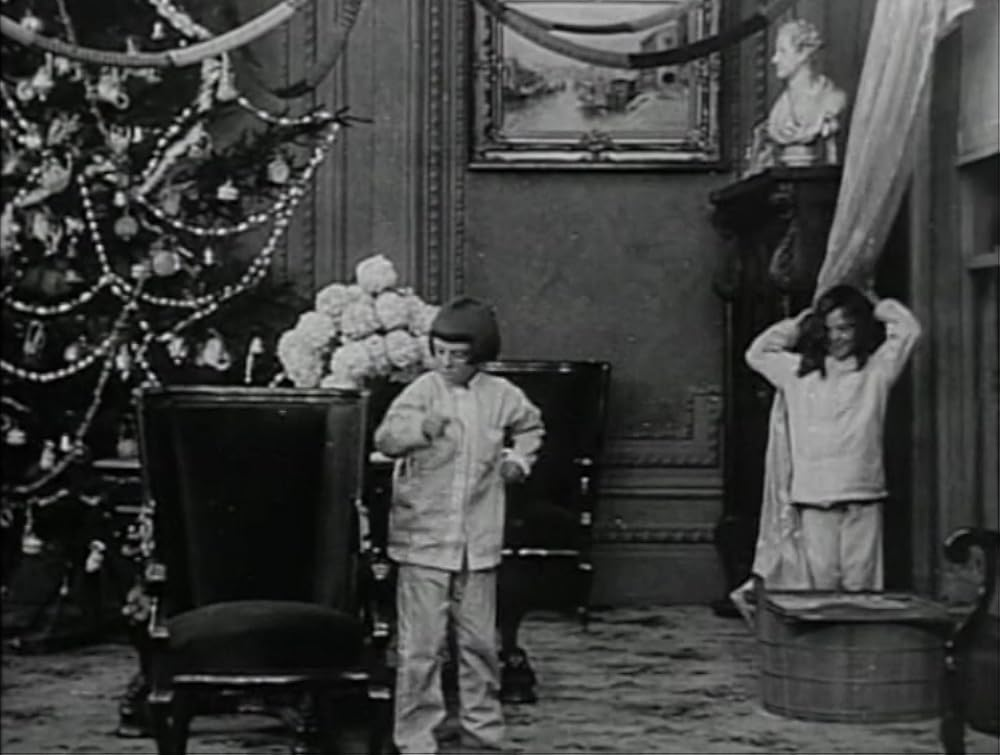
Silent Film of the Month: A Trap for Santa Claus (1909)


Run Time: 16 minutes. Studio: American Biograph. Director: D.W. Griffith. Main Cast: Henry B. Walthall, Marion Leonard, Gladys Egan, John Tansey, Kate Bruce, William J. Butler. Cinematographer: G.W. Bitzer.

It may seem like the concept of a Christmas film with a cynical edge would be a relatively recent one. The thought that such a concept dates back to the days of D.W. Griffith may seem absurd. However, Griffith's early Christmas film, A Trap for Santa explores some dark and heavy themes alongside its yuletide setting. While this film is not without its Christmas charm, it does not sugarcoat the darker themes of its story. 

At the start of this short film, an unemployed father (Henry B. Walthall) with no money for Christmas presents is seen getting drunk in a bar. He comes home completely intoxicated and scares his wife and daughter. He then decides to leave feeling that he can offer nothing but pain for his wife and children. Eventually things get so desperate for him that he decides to rob his own wife and children's house. At the same time the children decide to set a trap to see if they can capture Santa Claus. 

While this lacks the ahead of their time filmmaking techniques that Griffith's later films are known for, this short makes up for this with strong storytelling. One of Griffith's most overlooked talents was to tell a surpassingly complex story in a short amount of time. This is overlooked because Griffith's is best known for his longer length epics such as Birth of a Nation (1915) and Intolerance (1916). Yet the short films he made for American Biograph earlier in his career, show that he is perfectly able to tell a complex story in a compact amount of time. This is especially evident here. Despite the short runtime the story never feels rushed but seems to play out naturally. The filmmaking also makes the storyline easy to follow without the plethora of intertitles that would populate Griffith's later work. The story itself is very intelligent mixing the dark subject matter with a sense of Christmas sentimentality. Like Frank Capra's It's a Wonderful Life (1947), this short has its heartwarming and sentimental moments but we have to make it through some pretty dark and grim moments to get there. This however makes the heartwarming moments feel all the more rewarding. All of this makes this a real Christmas classic and one of Griffith's more underrated efforts.      

For anyone interested in watching this wonderful film, it can be seen on YouTube below. 


Wednesday, May 15, 2024

The Story of Flora Finch

 Flora Finch is one of those movie stars that was incredibly popular in her day but has become unjustly forgotten today. She was nothing if not prolific appearing in well over 300 films. She was at her most prolific in the silent era, where she was constantly working. Movie audiences knew her best for her 160 short comedies she made with the incredibly popular John Bunny. She can also be seen in many films from the legendary director D.W. Griffith, including The Helping Hand (1908), Those Awful Hats (1909), His Wife's Mother (1909) and the feature length Orphans of the Storm (1921). One of her best-known silent films today is the classic horror/comedy The Cat and the Canary (1927). During the sound era she appeared mostly in smaller roles with the occasional larger role. These movies included The Scarlet Letter (1934), Laurel and Hardy's Way Out West (1937) and The Women (1939). 

Below is a 1923 article from Motion Picture Magazine about Flora. If you have any trouble reading it click on the pages below and use your touch screen to zoom in.


Her is a short film starring John Bunny and Flora Finch, Her Crowning Glory (1911). 


Monday, June 22, 2020

Showing The Birth of a Nation in 1938

With all the debate about whether of not a lot of old movies are racist, I think most people can agree on one movie. The Birth of a Nation (1915) is racist and in a way that is much more horrifying than anything you would see in any other movie. Don't get me wrong I believe that modern audiences should be able to see this movie because as horrifying as it is it is still part of our history and there is a lot you can learn about both movie history and the culture of the world at the time it was made. Also despite its horrifying depictions of black people and the glorification of the KKK, the filmmaking and storytelling our excellent. This is not a film that is just controversial today, but one that received a lot of controversy when released. The following article from a 1938 issue of The Motion Picture Herald discusses the reaction to this film receiving a theatrical release that year. 

"The pages of history were turned back this week in East Orange, N.J, in the vicinage of Thomas Edison's pioneerings in motion pictures, where the local courts are to rule on the complaints of a group of Negros against the racial implications of 'The Birth of a Nation,' old Griffith film which has been resurrected and restored by Stone Film Company and is to be reissued immediately in New York and New Jersey. The picture during its early expositions in 1915 and thereafter was the subjects of attacks by Negros, particularly in Chicago and Boston who charged that it stirred race hatred. The Negros would have the authorities censor the picture on the same grounds.

"Adolph J Retting manager of the Ormat Theatre in East Orange was summoned to appear before Police Recorder Albert L. Vreeland to answer to a charge that he violated a New Jersey statute by showing 'The Birth of a Nation.'

"Mr. Rettig was arrested and paroled in custody of his counsel Edward R McGlynn of Newark. Mr. Retting is a former big league baseball player.

"The  complaint was signed by two local Negro physicians, Dr. Theodore R Inge and Dr. Harry W. Mickey. The two alleged that Mr. Retting violated Chapter 151 of the laws of 1935 which makes it a misdemeanor to show 'any picture, photograph or representation which in any way incites, counsels, promotes, advocates or symbolizes hatred, violence or hostility against any persons or group by reason of race, color, religion or matter of worship.' 

"The exhibitor waived examination and the case was referred automatically to the Essex County grand jury. His counsel said he intends to ask D.W. Griffith to testify.

"Dr. Inge said the picture had been prohibited in California, Kansas, West Virginia and Ohio.

"The film was shown at the Ormont from May 8th through May 11th. On May 9th Negro leader submitted a protest bearing 609 signatures to the city counsel. The manager deleted those parts which he understood were considered particularly objectionable.

"East Orange authorities said that as far as they know, this case was the first in which the 1935 statute had been invoked. The act provides for a fine of $200 to $5000 and 90 days to three years imprisonment or both.

"'Birth of a Nation' also meet with opposition in Hartford, Conn., where two negro ministers, the Reverend C.A. Moody and the Reverend C.A. Jackson, succeeded in having exhibition halted at the local state theatre."

I am curious as to what the cut version looked like as the whole second half of this film can be considered objectionable easily.

-Michael J. Ruhland


Thursday, September 5, 2019

"Orphans of the Storm" and "Way Down East" at the Strand Theatre

It is hard to think of any director who had a larger impact on film as an art form than D.W. Griffith. Mostly remembered for his controversial (and that is beyond an understatement), Birth of a Nation (1915). However that was only a small sampling of this directors great work. He had many films that were just as much great cinema and were also extremely popular in their time. Two of these were Orphans of the Storm (1921) and Way Down East (1920). Both these movies broke records when they played at the Strand Theatre. This is evidenced by this following 1922 advertisement from Motion Picture News.


This 1923 advertisement from the Film Daily for DW Griffith's One Exciting Night (1922) doesn't fail to mention how the two pervious movies did.


Orphans of the Storm was extremely popular in London as can be seen by the following 1922 advertisement from Motion Picture News.


-Michael J. Ruhland
 

Wednesday, August 28, 2019

Silent Films on TCM this September


Hello again my friends. Since me and many of you are fans of both silent film and TCM, today I am going to give you a list of all the silent films that will play on TCM this September. This is a fantastic lineup, that includes some regular silent films for the channel and some that are a bit different.

Sunday, September 1st

The Mating Call
(1928) Director: James Cruze. Starring Thomas Meighan and Evelyn Brent. 9pm Pacific. 12am Eastern.

Wednesday, September 4th

Broken Blossoms
(1919) Director: D W Griffith. Starring Lillian Gish and Richard Barthelmess. 5pm Pacific. 8pm Eastern.

Little Annie Rooney (1925) Director: William Beaudine. Starring Mary Pickford and William Haines. 6:45pm Pacific. 9:45 Eastern.

The Three Musketeers (1921) Director: Fred Niblo. Starring Douglas Fairbanks and Leon Barry. 8:30pm Pacific. 11:30pm Eastern.

The Gold Rush (1925) Director: Charlie Chaplin. Starring Charlie Chaplin and Mack Swain. 10:45pm Pacific. 1:45am Eastern.

Thursday, September 5th

The General
(1927) Directors: Buster Keaton, Clyde Bruckman. Starring Buster Keaton and Marion Mack. 12:30am Pacific. 3:30am Eastern.

Sadie Thompson (1928) Director: Raoul Walsh. Starring Gloria Swanson and Lionel Barrymore. 2am Pacific. 5am Eastern.

Friday, September 6th

The Cartoons of Winsor McCay
(2014) A compilation of classic silent cartoon shorts directed by Winsor McCay.

The Freshman
(1925) Directors: Sam Taylor and Fred Newmeyer. Starring Harold Lloyd and Joyba Ralston. 5pm Pacific. 8pm Eastern.

Sunday September 8th

The Circus
(1928). Director: Charlie Chaplin. Starring Charlie Chaplin and Merna Kennedy. 9pm Pacific. 12am Eastern.

Shoulder Arms (1918) Director: Charlie Chaplin. Starring Charlie Chaplin and Edna Purviance. 10:12pm Pacific. 1:12am Eastern.

A Dog's Life (1918) Director: Charlie Chaplin. Starring Charlie Chaplin and Enda Purviance. 10:50pm Pacific. 1:50am Eastern.

Tuesday September 10th

Greed
(1924) Director: Erich Von Stroheim. Starring Gibson Gowland and Zasu Pitts. 12:15am Pacific. 3:15am Eastern.

Sunday September 15th

Two Arabian Knights
(1927) Director: Lewis Milestone. Starring William Boyd and Louis Wolheim. 9pm Pacific. 12am Eastern.

Sunday, September 22nd

The Racket
(1928) Director: Lewis Milestone. Starring Thomas Meighan and Marie Prevost.

Tuesday, September 24th

The Unknown
(1927) Director: Tod Browning. Starring Lon Chaney and Norman Kerry. 1:45am Pacific. 4:45am Eastern.

Sunday, September 29th

Cleopatra
(1912) Director: Charles L. Gaskill. Starring Helen Gardner and Harley Knoles. 9:45pm Pacific. 12:45am Eastern.

-Michael J. Ruhland