Tuesday, December 21, 2021

Movie Review: Nightmare Alley


Michael's Movie Grade: A-

A fantastic modern day film noir that shows director, Guillermo del Toro at his best. 

One could argue that this story did not need to be told again on the big screen after the excellent 1947 film version, but Del Toro's new adaption of William Lindsay Gresham’s novel proves that wrong by being a truly great movie. This story definitely plays perfectly to the strengths of Del Toro as a director, and as soon as the movie starts his stamp is fully felt. Though this movie takes place in 1940's America, it feels like it takes place in a world all of its own. This is especially true of the early scenes in the carnival which has a creepy and disturbing vibe before anything even happens giving the audience and uneasy feeling of dread, perfectly foreshadowing what is going to follow. However, the sense of atmosphere is prevalent even when we leave the carnival. Much of this is due to the excellent work of not only Del Toro but also cinematographer Dan Laustsen (who previously worked with Del Toro on The Shape of Water and Crimson Peak), who does not waste a single shot of this movie. Yet none of this atmosphere overwhelms the story or characters. This story is a dark and disturbing fable that hits hard emotionally. Even if you figure out or already know where this story is going, the ending still sends shivers down your spine. That is because nearly everything in the story is perfectly setting this up and leading you to this natural conclusion. Despite how melodramatic these twists and turns can be looking back on them, when you watch the film, they are completely gripping. This movie also serves as a character study of a man whose greed and cockiness leads him down a dangerous and deadly path. This is not an easy role to play, but Bradley Cooper does an incredible job. He makes this character feel real and relatable. And while the character is in no way traditionally likable, we are fascinated by him and feel a sense of pity towards him that emotionally pulls us into the story. Cooper does all this seeming effortlessly. This is not to say the rest of the cast isn't excellent as well. This film features a wealth of great actors who all do an incredible job. This movie also benefits from incredibly intelligently written dialogue. The scenes our "hero" shares with the movie's femme fatale are so incredibly well written that it is hard not simply have your eyes and ears glued to the screen. 

For any fan of Film-noir, this movie is a must watch. 

Monday, December 20, 2021

Michael's Christmas Movie Guide: Holiday Inn (1942)


A near perfect movie musical comedy. 

Despite the fact that this movie has become a Christmas tradition for so many, Christmas is only one of the holidays featured in this film. The storyline revolves around an inn that is open only on holidays and each holiday features a live show with singing and dancing. This allows us to get 14 musical numbers that feature some of the great musical talents of the early 1940's. Though these songs are about holidays all over the calendar, two have become Christmas classics, White Christmas and Happy Holidays. With this in mind is it any wonder this has become considered a Christmas movie. 

This is the fourth film in which director Mark Sandrich, songwriter Irving Berlin and star Fred Astaire made together. They had previously all worked on the Astaire-Rogers pictures, Top Hat (1935), Follow the Fleet (1936), and Carefree (1938). The idea for this film had its birth with Irving Berlin. Berlin and playwright Moss Hart had had a major hit with the 1933 Broadway musical, As Thousands Cheer. They to follow this up with a musical play based on various holidays. However, this play never came to be. The idea stayed fresh in Berlin's mind though. When in 1941 he ran into Sandrich (who was now working at Paramount), he pitched this idea to the director as a vehicle for Paramount star, Bing Crosby. Sandrich loved the idea, and a story quickly began to take shape. Sandrich decided that the perfect person to play the second male lead was Fred Astaire. Paramount disagreed feeling that they already had one big star with Bing Crosby and the Astaire would cost too much money, However Sandrich was insistent and would get his way. He would tell the press, "I call this picture the A B C of American musical comedy. Astaire, Berlin, Crosby. Get it?" It is worth noting that the two main male stars of this movie would later star in a film with a song from this film as the title song. Bing Crosby would star in White Christmas (1954) and Fred Astaire would star in Easter Parade (1948). Both of those films would also be Irving Berlin songfests.  However, when it came to cast the female leads, the studio would have its way. Big name actresses were discussed for these roles (including Ginger Rogers and Rita Hayworth), but the studio insisted that lesser-known actresses should be used since they were already using Bing Crosby and Fred Astaire. Marjorie Renyolds had previously been working in B-westerns and when she got this role the Paramount publicity department dubbed her, "Saddle Cinderella."  Virginia Dale was a nightclub dancer who had only appeared in very tiny movie roles. However, both of them were perfect in their roles and I can't see how bigger stars could have improved upon their performances. 

Everything about this movie works beautifully. The musical numbers are all excellent. As mentioned before Irving Berlin has 14 songs used in this movie and there is not one song that misses the mark. Each musical number is also perfectly suited to the performers. Though White Christmas has been recorded by many artists, none ever come close to what Bing Crosby has done with the song. This song is just so perfectly suited to Bing Crosby's voice that no other singer could ever recapture the magic. Fred Astaire shows his magic in the Let's Say it With Firecrackers dance number. Despite the fact that he required 38 takes to get it just right, it comes off as so effortlessly perfect and natural that you can't help but get caught up in the pure charm of the dance. This is just as much pure magic as Bing Crosby singing White Christmas and something that could never be replicated. Both of their talents come together perfectly for Be Careful, It's My Heart. Bing Crosby is singing the song beautiful and doesn't notice Fred Astaire and Marjorie Renyolds doing an incredible dance behind him. This scene is perfectly choreographed but like the rest of this movie seems effortlessly so. The storyline may be mostly an excuse for the musical numbers, but it is fill of a sense of lighthearted fun that I find irresistible.


The Film Daily, 1942

The movie was not only a smash hit when released but remains just as delightful today. 

For more Michael's Christmas Movie Guide click here.

Resources Used

Christmas In the Movies by Jeremy Arnold

https://www.tcm.com/tcmdb/title/78199/holiday-inn/#articles-reviews?articleId=29971


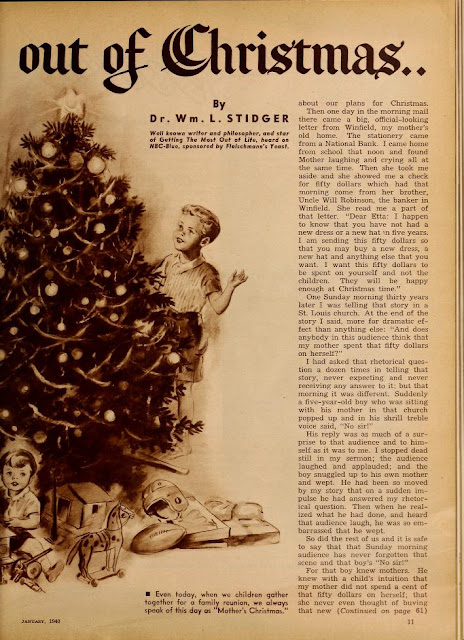
How to Get the Most out of Christmas


Radio and Television Mirror, 1940


Sunday, December 19, 2021

Christmas With the Young Stars


New Movie Magazine, 1932


Cowboy Church #150

 Hello, my friends and welcome back to another service of Cowboy Church. 

Today's musical selection begins with Roy Rogers and Dale Evans with A Christmas Prayer. This song comes from their 1969 Christmas album, Christmas is Always. This is followed by The Louvin Brothers with Are You Washed in the Blood. This hymn was written by Elisha Albright Hoffman (Leaning on the Everlasting Arms, Glory to His Name) in 1878. It first appeared in his book, Spiritual Songs for Gospel Meetings and the Sunday School. Yet it was strangely dropped from later versions of this book. This version of the song comes The Louvin Brothers' 1956 gospel album, Nearer My God to Thee. Next comes Joanne Cash with It is Well With My Soul. Though this is a hymn of hope and peace it was written in a time of great sadness. The song was written by Horatio G. Spafford in 1873. He had planned a European trip for himself, his wife and four daughters, however because of his work he was unable to go, and he let his family go without him and after he finished his work, he would meet them there. However, the ship was hit and quickly sank. Though his wife was saved all four of his daughters had gone down with the ship. Amazingly he wrote this hymn when approaching an area near where his daughters had sunk. Like her brother Johnny Cash, Joanne had spent much time backsliding from God's word before truly giving her life to him. She had been a drug addict and alcoholic. Pastor Greg Laurie's excellent Johnny Cash biography Johnny Cash: The Redemption of an American Icon quotes Joanne as saying "After I asked Jesus to come into my heart, I prayed, and I felt this heat come up my body to the end of my fingertips. I knew I was born again I knew I was saved. I knew I was gonna go to Heaven. I knew I would get to see Jack again (her brother who had died at 15 years old in a sawmill accident). I was just elated ... I then started praying for Johnny." Though she may not be as well-known as her big brother, she has spent much time sharing the word of God through her music. This recording comes from her 2008 album simply titled Gospel. This is followed by Red Foley with Put Christ Back into Christmas. This song is interesting today, because many assume saying "Happy Holidays" around this time of year instead of "Merry Christmas" is a rather recent development, but here Red Foley is singing about this in 1953 and he doesn't seem so happy about it. Next is The Petersons with Come Thou Long Expected Jesus. This song was always intended as a Christmas carol since Charles Wesley orinignally wrote it in 1774. He looked at the times he was living in including the situation for orphans and the class divide in Great Britian. After reading Haggi, 2:7, “Born Your people to deliver, born a child and yet a King, born to reign in us forever, now Your gracious kingdom bring. By Your own eternal Spirit, rule in all our hearts alone; by Your all sufficient merit, raise us to Your glorious throne. Amen,” he began to write this hymn. This is not the only Christmas carol Charles Wesley wrote as he also wrote the more famous Hark the Harold Angels Sing and here is Johnny Cash singing that song. Wesley's intentions as a hymnist were to teach the poor and illiterate what God had said. The Sons of the Pioneers join in the fun with Christmas on the Plains. We Continue with Gene Autry singing Everyone's a Child at Christmas. This comes from Gene's 1956 album, A Gene Autry Christmas. Today's musical ends with The Hee Haw Gospel Quartet with His Boundless Love


Up next is an episode of Roy Rogers' radio show.


Next is C.S. Lewis' essay, Religion and Science.


No temptation has overtaken you that is not common to man. God is faithful, and he will not let you be tempted beyond your ability, but with the temptation he will also provide the way of escape, that you may be able to endure it. 1 Corinthians 10:13

If we confess our sins, he is faithful and just to forgive us our sins and to cleanse us from all unrighteousness. If we say we have not sinned, we make him a liar, and his word is not in us. 1 John 1:9-10

If my people, who are called by my name, will humble themselves and pray and seek my face and turn from their wicked ways, then I will hear from heaven, and I will forgive their sin and will heal their land. 2 Chronicles 7:14

Now faith is the assurance of things hoped for, the conviction of things not seen. Hebrews 11:1 

Trust in the Lord with all your heart, and do not lean on your own understanding. In all your ways acknowledge him, and he will make straight your paths. Proverbs 3:5-6 

I have been crucified with Christ. It is no longer I who live, but Christ who lives in me. And the life I now live in the flesh I live by faith in the Son of God, who loved me and gave himself for me. Galatians 2:20

Psalm 136

1 Give thanks to the Lord, for he is good,


for his steadfast love endures forever.


 2  Give thanks to the God of gods,


for his steadfast love endures forever.


 3  Give thanks to the Lord of lords,


for his steadfast love endures forever;


 4  to him who alone does great wonders,


for his steadfast love endures forever;


 5  to him who aby understanding made the heavens,


for his steadfast love endures forever;


 6  to him who spread out the earth above the waters,


for his steadfast love endures forever;


 7  to him who made the great lights,


for his steadfast love endures forever;


 8  the sun to rule over the day,


for his steadfast love endures forever;


 9  the moon and stars to rule over the night,


for his steadfast love endures forever;


 10  to him who struck down the firstborn of Egypt,


for his steadfast love endures forever;


 11  and brought Israel out from among them,


for his steadfast love endures forever;


 12  with a strong hand and an outstretched arm,


for his steadfast love endures forever;


 13  to him who divided the Red Sea in two,


for his steadfast love endures forever;


 14  and made Israel pass through the midst of it,


for his steadfast love endures forever;


 15  but koverthrew1 Pharaoh and his host in the Red Sea,


for his steadfast love endures forever;


 16  to him who led his people through the wilderness,


for his steadfast love endures forever;


 17  to him who struck down great kings,


for his steadfast love endures forever;


 18  and killed mighty kings,


for his steadfast love endures forever;


 19  Sihon, king of the Amorites,


for his steadfast love endures forever;


 20  and O, king of Bashan,


for his steadfast love endures forever;


 21  and gave their land as a heritage,


for his steadfast love endures forever;


 22  a heritage to Israel his servant,


for his steadfast love endures forever.


 23  It is he who remembered us in our low estate,


for his steadfast love endures forever;


 24  and rescued us from our foes,


for his steadfast love endures forever;


 25  he who gives food to all flesh,


for his steadfast love endures forever.


 26  Give thanks to the God of heaven,


for his steadfast love endures forever.


Thanks for joining me, come back Christmas Eve for a special Christmas Eve service of Cowboy Church. Happy trails to you until we meet again. 


Saturday, December 18, 2021

Is There a Santa Claus?


Radio and Television Mirror, 1950 

Some Cartoons For Saturday Morning #153

 Hello, my friends and happy Saturday morning. Once again it is time for some classic cartoons.

Today's cartoon selection begins with a classic Donald Duck film, Toy Tinkers (1949). This movie features Donald once again going up against Chip and Dale. This film is directed by Jack Hannah, who at this time was directing the majority of the Donald Duck cartoons. When Chip and Dale had their very short-lived series of shorts, Jack Hannah directed all three cartoons in that series. This cartoon is laugh out loud funny. The slapstick is spot on and timed perfectly. Every joke works and they are all very funny. The humor is also displayed perfectly through the great character animation one should expect form a Disney cartoon. While Disney cartoons are often called sweet and cute in contrast to the hilarious antics at studios like Warner Brothers and MGM, the Disney studio could make slapstick cartoons as great as the rest of them (this is not an insult to Warner Brothers and MGM as I love there cartoons a lot as well). This stands as one of Disney's funniest shorts (a joke involving a telephone never fails to make me laugh out loud).


Next comes a wonderful Color Rhapsody Christmas cartoon, Gifts from the Air (1937). This movie was reissued to theaters in 1955.


The Philadelphia Exhibitor, 1935

Next up comes Mickey Mouse and Donald Duck on The Dognapper (1934). According to Animation Historian Mike Barrier, Dick Lundy (who had previously animated Donald's famous tantrum in Orphan's Benefit (1934)) was specifically sought to animate one scene in this movie. That scene is when Donald runs after Mickey's motorcycle. Other animators on this cartoon include Marvin Woodward (who animates our heroes listening to the radio at the start), Hardie Gramatky (who animates most of the car chase as well as the saw chasing Pete up the ladder)Johnny Cannon (who animates the boys entering the sawmill as well as our heroes dodging Pete's bullets), Gerry Geronimi (who animates Pete chasing Fifi as well as Pete shooting at our heroes), Bob Wickersham (who animates the closing scenes of the picture) and  Bill Roberts (who animates everything from Pete grabbing the cannon to Pete jumping up on a log to avoid the saw). The following is from an issue of The Film Daily (dated November 9, 1934), "'The Dognapper,' latest Walt Disney Mickey Mouse cartoon, will have its premiere at the Rivoli tomorrow in conjunction with Eddie Cantor's 'Kid Millions,' both released through United Artists." 


Screenland, 1935

Next is one of the last black and white Looney Tunes and Daffy Duck's last appearance in black and white. This is a fantastic Daffy Duck World War 2 themed short. This film is directed by Frank Tashlin. While directing these cartoons Frank had his mind on wanting to direct live action features (which he later did). Because of this his cartoons are the most cinematic of all the Looney Tunes. This is definitely shown here in a montage that is as well done as anything you would see in a serious war picture. This film is also filled with not only great slapstick but some of the sharpest satire of any of the World War 2 Looney Tunes. This cartoon appears in Jerry Beck's book, The 100 Greatest Looney Tunes. So, enjoy, Scrap Happy Daffy (1943). 


Now it is time for a commercial break.


Next comes the 11th Dogfather film, Rockhounds (1975). 


Up next is Farmer Al Falfa in Plane Goofy (1940). Farmer Al Falfa is a cartoon character who dated back to 1915. Though he had once been the star of the Terry-Toons, by this time he was appearing rather infrequently and often in supporting roles. This is one of his semi-rare starring roles of this period. The following is an Exhibitor's review from The Motion Picture Herald, "Plane Goofy: Terry-Toons - This is a fairly good color cartoon that gets away from the beaten path to some extent. - W. Varrick, Nevins III, Alfred Co-op Theatre, Alfred, N.Y. Small town and rural patronage." 


Up next is Felix the Cat in All Puzzled (1924). 


Today's cartoon selection ends with the TV Special, A Garfield Christmas Special (1987). 


Thanks for joining me. Comeback next week for another selection of classic cartoons. Until then may all your tunes be looney and your melodies merry. 

Resources Used

Walt Disney's Mickey Mouse: The Ultimate History by J.B. Kaufman and David Gerstein

The 100 Greatest Looney Tunes edited by Jerry Beck

http://afilmla.blogspot.com/search/label/Shorts_UA?updated-max=2008-11-18T21:00:00-08:00&max-results=20&start=8&by-date=false