Saturday, July 10, 2021

Some Cartoons For Saturday Morning #131

 Hello my friends and happy Saturday Morning. Once again it is time for some classic cartoons.

Today's cartoon selection begins with a unique Mickey Mouse short, Minnie's Yoo-Hoo (1930). The title song was written by Carl Stalling (later of Looney Tunes fame) for an earlier Mickey cartoon entitled Mickey's Follies (1929). This was the first original song from the Disney studio and it would become the theme song for the series with an instrumental version beginning every Mickey cartoon. This short presents a sing-a-long version of the song. The version heard here includes a second verse, that was not heard in Mickey's Follies but did appear on the song sheet that was published later the same year that it first appeared inn that cartoon. This short was made for The Mickey Mouse Clubs that appeared around the country. These were created by theatre owners and were gatherings of movie loving kids who were fans of Mickey Mouse. Walt loved this idea and while he did not start it he did all he could to expand it across the country. He also made this short so that club members could sing along during their meetings. There is very little new animation here. There is reuse of animation of Mickey and friends performing the song at the beginning that comes from Mickey's Follies. The animation of the curtain opening and closing was lifted from Fiddling Around (1930)
Next comes my personal favorite Pink Panther cartoon, Dial "P" For Pink (1965). Like all Pink Panther cartoons Henry Mancini's musical theme for Blake Edward's feature film, The Pink Panther (1963). However this cartoon also uses theme from its sequel, A Shot in the Dark (1964).
Next comes a pretty darn good, later day Looney Tunes short, Duck Dodgers in Attack of the Drones (2004). This is one of a series of Looney Tunes cartoons planned to be released in theaters following the feature film, Looney Tunes Back in Action (2003). However when that movie disappointed at the box-office, it was decided not to release these shorts theatrically. That is a shame because these shorts were quite good and deserved the theatrical release. Futurama fans will recognize Dr. Zoidberg in a cameo. Rich Moore this film's director had also directed episodes of that TV series.
Up next is the Van Beuren, Rainbow Parade cartoon, A Waif's Welcome (1936). The Rainbow Parade series was started by Burt Gillett. The Van Beuren studio was no receiving the same success that the Disney or Fleischer studios were and it was felt that brining in a successful director in to head the animation studio was the best solution. So Burt Gillett who had directed the most popular cartoon short at that time, Disney's The Three Little Pigs (1933) would become the head of the whole cartoon studio. There were however constant riffs between him and those who had worked at the studio for a long time. Animator Jack Zander would later say, "He worked like Walt did. We'd do pencil tests. Of course when we were working at Van Beuren, nobody ever heard of a pencil test. We'd just animate and they'd ink and paint it and that's all there was to it, He initiated pencil tests and movieolas. We'd have to animate this stuff and look at it; he'd look at it and then he'd make changes. It was a very stimulating thing. The only ones who had any trouble were the real old animators, animating for years in a set manner. They found it to difficult to adjust." Animator I. Klein went much further on the last comment stating, "The people who were there before him felt, 'why the hell did they take this swell-head from Disney?' They often took that attitude, you know; very seldom did they say, 'Gee that's great - a good man came in,'" However one can't argue that some of the animosity was partly Gillett's fault. Klein also stated, "He was constantly firing people. There was a swinging door all the time, people coming and going." The following is an exhibitor's review from The Motion Picture Herald, "A Waif's Welcome: Rainbow Parade Cartoons - Just a colored cartoon and not so hot. Why not stay by Molly Moo Cow. C.L. Niles - Niles Theatre, Anamosa, Iowa. General Patronage."
Now it is time for a Garfield Quickie.
Up next is a classic Tex Avery one shot cartoon for MGM, Doggone Tired (1949). This short shows Tex Avery doing what he does best taking a simple one joke idea, but still getting more laughs out of it than any other cartoon director could.
Let us finish with a song.
-Michael J. Ruhland Resources Used https://cartoonresearch.com/index.php/the-other-disney-cartoons-minnies-yoo-hoo/ Of Mice and Magic: A History of American Animated Cartoons by Leonard Maltin

Sunday, July 4, 2021

Movie Review: Summer of Soul (...Or, When the Revolution Could Not Be Televised)


Michael's Movie Grade: A+ An incredible concert movie and one of the best documentaries in recent years. In 1969, the same summer that Woodstock happened another less documented but no less important music festival accorded. This was The Harlem Culture Festival. This festival featured some of the greatest black musicians in America. This concert was just as much a celebration of black culture as it was an incredible array of great music. The importance of a celebration like this in 1969 in the midst of the civil rights movement can not be understated. When Gladys Knight is interviewed she states that the importance of the night goes far beyond just the music and as we watch this film it is hard not to agree. Like the concert itself this film is just as much about the place, time and culture as the While a concert movie can never fully capture being there in person, this film comes as close as a movie like this can. Watching the performances and the audience, you can feel the excitement and get caught up in it. Adding to this is great interviews with not only the artists but also the people attending the festival, people arranging the festival and some of the security (the security was provided by the Black Panthers). Because of this we see the concert from all sides and the movie becomes all the more immersive. Director Questlove (in his feature length directorial debut) appropriately leaves out any narration leaving the history to be told mostly by those who were there. The most obvious praise to give this movie is that the music is fantastic. Featured here is B.B. King, Nina Simone, Mahalia Jackson, Gladys Knight, The Staple Sisters and so much more. All of them are at the top of their game and this is American music at its best. My only complaint is that I would have liked even more music here. This film is a must watch for all fans of music and/or movies. This is both documentary filmmaking and American music at its finest. -Michael J. Ruhland

Saturday, July 3, 2021

Movie Review: The Boss Baby: Family Business


Michael's Movie Grade: C+


I don't think any of us were asking for a sequel to Boss Baby but this movie turns out to be surprisingly quite fun.


Like the first movie the biggest surprise here is the heart. In fact this is a department in which this sequel tops its predecessor. This film has a simple and straight forward message, "just because you have to grow up doesn't mean you have to grow apart." This may not be an original moral but it is a good one. The relationship between the two brothers is handled very well here and not just through comedic bickering but instead through some truly heartfelt moments. You never don't believe that these are brothers and that is what makes the film work. Equally as well handled is the relationship between Tim and his daughter. This sweet side story doesn't offer anything really new, but it does give some real heartwarming moments.


Like many family movies this film tries to constantly be funny without stopping to catch a breath. This is a hard thing to do right and this movie doesn't fully pull off. There are some really funny moments here, but there are just as many jokes that fall quite flat. Movie comedy often depends more on the quality of the jokes than the quantity. Because of this the film could have easily cut out quite a few of the jokes that don't work, because the ones that do are good enough to hold the film on their own. 


The main storyline of our two heroes against the villain is quite fun even if it never stands out. This plot is over the top silly fun and works quite well as this. This plot certainly feels like a feature length plot of a Saturday morning cartoon, but people like Saturday morning cartoons for a reason. This movie does not try to be anything spectacular in this department and it doesn't have to be. Sometimes silly fun is enough. However I do feel that the villain isn't an especially strong or memorable one. Still he does his job quite well and he works for what this movie is. 


This may not go down as the next animated classic but it isn't supposed to be that. Instead you should enjoy this film for what it is, a fun time at the movies. 


-Michael J. Ruhland. 

Some Cartoons For Saturday Morning #130

 Hello my friends and happy Saturday Morning once again it is time for some classic cartoons.

With the fourth of July tomorrow, today's cartoon selection begins with a cartoon that takes place on Independence Day. This is Parotitic Popeye (1957). This cartoon comes from the last year of the theatrically released Popeye shorts and despite its holiday theme it was released to theaters on May 10th. This cartoon features Popeye's nephews, who were in many ways the Fleischer and Famous Studios version of Donald Duck's nephews. Like the ducks, their parents were kept a mystery and they often got the better of their uncle. Unlike the ducks though, the number of nephews changed from four to three to two here in their last appearance. What happened to the other nephews is one of cartoonland's greatest mysteries.
Continuing the 4th of July theme, next are some TV PSAs from the 1980's about the U.S. Constitution staring the Looney Tunes characters.


In 1997 animation legend Chuck Jones wrote a children's book starring Daffy Duck and Bugs Bunny titled Daffy Duck for President. When Warner Brothers decided to follow the feature film, Looney Tunes Back in Action (2003) with a series of new animated Looney Tunes shorts for movie theaters, one of these shorts was a cartoon based off this book. Daffy Duck For President (2004) never got the theatrical release it should have as Looney Tunes Back in Action proved a disappointment at the box office. However this is a truly delightful cartoon. It was dedicated to Chuck who had passed away in 2002.
Now we go back just a few years to the silent era for one of the first great animated cartoon series, Earl Hurd's Bobby Bumps cartoons. Here is a Holiday appropriate entry with Bobby Bumps Fourth (1917).

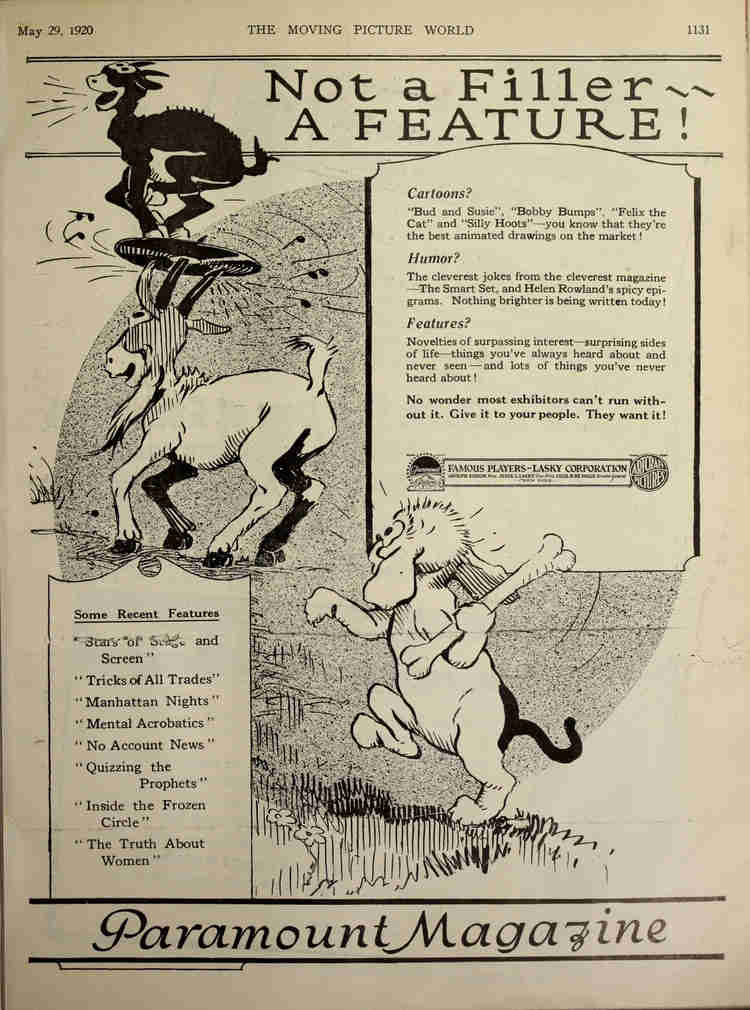
Motion Picture World, 1920 Now let us all sing along.
In December of 1941 the Secretary of the Treasury, Henry Morganthau contacted Walt Disney about making a short film encouraging Americans to pay their taxes. The story goes that Walt was surprised by this request believing that all American citizens paid their taxes on time. Disney writers Joe Grant and Dick Huemer wrote a story involving Donald Duck as an average tax payer. When an aide was surprised that Disney didn't create a new character to represent the average tax payer, but Walt felt that Donald was a natural choice. He argued that this was the same as when a Hollywood studio would use one of their biggest live action stars to promote the war effort. Donald was the Disney studio's biggest star at the time (as well as a character everyone loved and saw themselves in) and to have him push the war effort was vital to the project. The cartoon was titled The New Spirit (1942) and was a major success. The Treasury Department stated that about sixty million Americans saw this cartoon and a poll showed that 37% of these Americans stated that this positively influenced them when it came to paying taxes. In 1943 the Treasury Department approached Walt about making another one of these shorts. This resulted in The Spirit of '43 (1943).


Motion Picture Herald, 1942
Motion Picture Daily, 1943 Today's cartoon selection ends with Yankee Doodle Pink (1978). The ending to this short is especially educational.
Thanks for joining me come back next week for more animated treasures. Until then may all your tunes be looney and your melodies merry. -Michael J. Ruhland Resources Used https://cartoonresearch.com/index.php/ducks-and-taxes-the-story-of-the-new-spirit/ Of Mice and Magic: A History of the American Animated Cartoon by Leonard Maltin.

Thursday, July 1, 2021

Silent Film of the Month: The Hoodlum (1919)


Runtime: 78 Minutes. Studios: Mary Pickford Company, First National. Director: Sidney Franklin. Writer: Bernard McConville. Based on a book by Julie Mathilde Lippmann. Main Cast: Mary Pickford, Ralph Lewis, Kenneth Harlan, T.D. Crittenden. Cinematographer: Charles Rosher. Editor: Edward M. McDermott. Despite being one of the biggest stars of the silent era and some one who is still associated with silent movies, Mary Pickford's films often get overlooked by today's silent movie fans. Instead many silent movie fans gravitate towards slapstick comedians like Charlie Chaplin or Buster Keaton, or towards European art films. This is a shame because Mary's films hold up extremely well today and it is crystal clear why she was such a major star in her day. Mary has often been referred to as the little girl with the curls. This however can be misleading as it can make her character sound overwhelmingly girly but in reality her characters are very much tough tomboys. However her characters were often much younger than she was herself. Though Mary tried to branch out and play older characters, audiences latched on to these little girls and wanted and expected her to play these roles. In The Hoodlum her character is of indeterminant age. She is young enough to play with little kids like peers but old enough to have a serious romance. Mary plays Amy a spoiled girl who lives with her grandfather (Ralph Lewis). However when she moves in with her father (T. D. Crittenden), she finds herself in a completely different environment, the slums of New York. She starts out as stuffy and looking down on her new neighbors but soon she finds out that they are truly good hearted people. This is truly an excellent film that shows the appeal of Mary Pickford to its fullest. She plays the part to perfection. In her hands this part becomes more than just a spoiled little girl, but a tough and spunky but also sweet and good hearted character. She also equally gets tp show off her comedic and dramatic side. While Mary may not have been a slapstick comedian in the same way that Charlie Chaplin or Buster Keaton were, she could definitely pull of a physical joke very well and humor plays an important part in all her best movies. This movie also is an incredibly good hearted film. This is especially seen in the scenes with with the folks from the slums. Many of them are minorities and because this movie was made in 1919, they are obviously somewhat stereotyped (one of them is played by Max Davidson (who had a series of comedy shorts playing a stereotyped Jewish character)). However there is nothing mean spirited in this stereotyping and these are characters that are shown in an incredibly positive light. It is easy to see why Amy grows to care about them because we do too. While it is a good hearted sweet film, it does not overly sugarcoat anything and we see the sheer hardships of poverty in some startlingly real and effective scenes.
Exhibitor's Herald, 1919 This movie's director is Sidney A. Franklin, a fairly prolific director and producer. Some of his directorial efforts include The Good Earth (1937), Her Night of Romance (1924), The Barretts of Wimpole Street (1957) and Quality Street (1927). Movies that he produced include Mrs. Miniver (1942), Random Harvest (1942) and The Yearling (1946). Disney fans might recognize his name from a credit in Bambi (1942) stating "To Sidney A. Franklin - our sincere appreciation for his inspiring collaboration." This was because he originally bought the story for Bambi with intentions of making a live action film. However he came to the conclusion that this film should be done in animation, he sold the rights to Walt Disney. Charles Rosher is the cinematographer for this film. During the silent era, some actresses had their favorite cinematographer who they felt photographed them best. Mary's favorite was Charles Rosher and would work on most of Mary's films during this era.
Motion Picture News, 1919 Of course in 2021, we are all familiar with the idea of a wide-spread disease affecting the making of the movie. The same thing happened at the time when this movie was made, but instead of Covid-19, at this time it was the Spanish Flu. Mary caught this and production had to be delayed for four weeks. Her doctor advised her to wait longer to go back to work, but Mary resumed working on this movie before she was completely better. In 1918 Mary had signed with First National. First National was not like other studios at the time which completely ran the whole show. The studio had been formed by exhibitors Thomas Tally and John Williams in 1917. At this time "block booking" greatly effected many exhibitors. This was when the studios demanded that to get their big name movies you had to also get their less popular and sometimes quite bad movies as well. The two founders brought in other exhibitors from around the United States and started their own roster of stars. Two of these stars were two of the biggest names in Hollywood, Mary Pickford and Charlie Chaplin, both of whom received complete creative control over the films they made there. She received her own production unit, named Mary Pickford Company. First National shared the copyright for the movie with Mary Pickford Company. The Hoodlum marked Mary's second film for First National (preceded by Daddy Long Legs (1919)). After this movie she would only make one more picture for First National, The Heart O' The Hills (1919). The reason for this is that she would form United Artists with Charlie Chaplin, D.W. Griffith and Douglas Fairbanks and make all her future films there.
Exhibitor's Herald, 1919 The following are some exhibitor's reviews from Exhibitor's Herald. "The Hoodlum, with Mary Pickford.— This picture went over fine. Better than some of the others.—E. W. Blythe. Majestic theatre, Decatur, Tex.—Small town patronage." " The Hoodlum, with Mary Pickford.— Drew well. Patrons seemed pleased. Star draws well for me.—Dr. E. Webb, Majestic Theatre, Chillicothe, Tex. - Small Town Patronage." "The Hoodlum with Mary Pickford. Business extra good. Mary certainly makes them laugh in this one. I even liked it better than Daddy Long Legs. Henry Pelteer, Shelby Theatre, Louisville Ky. - Neighborhood Patronage." "The Hoodlum with Mary Pickford. Class A picture. Business good. Weather bad. P.D. Alleman, Strand Theatre, Clinton, Ia. - Neighborhood Patronage." "The Hoodlum, with Mary Pickford.— Good picture and drew fine, but after paying extra advertising and high rental nothing left for us.—R. R. Booth, Para- mount theatre, Nebraska City, Neb.— General patronage." For anyone interested this movie can be found on YouTube or in better quality on the DVD, Rags & Riches: The Mary Pickford Collection. The below video does not have any music so if you are going to watch it this way put on some instrumental music you like to accompany it.