Wednesday, June 14, 2023

Little Caesar (1931)


Little Caesar is one of the biggest landmarks in the history of the gangster film and helped usher in this genre as a force to be reckoned with. It also helped define what the style of Warner Brothers and what set it apart from many of the other movie studios of that time. The film also made Edward G, Robinson a major movie star. It is also simply a great movie. 

The storyline follows small time hoods Caesar Enrico "Rico" Bandello (Edward G. Robinson) and Joe Massara (Douglas Fairbanks Jr.) as they move to Chicago in hopes of finding great success. Rico aspires to become a big name criminal and a powerful man, while his friend Joe aspires to become a dancer. Yet Rico drags Joe into the gangster world.

As well as being a gangster movie, this film also serves as both a character study and a look at society. This is a film that takes a look at how such a monster as Rico is created. This picture was made during the great depression and though the depression is not mentioned a lot, it can be felt in nearly every scene. However it is especially seen during the opening scene. We see two men who are not very well off, dreaming of what they would do with money and power. This is something that everyone at the time could relate to and something that may have in many ways hit too close for home. This film shows how the more power Ricco gets the more power he craves. We also see how he becomes completely overcome by his own ego. In a time period when so many people simply dreamed to make good, Ricco takes this mentality to its unhealthy extreme. Despite the fact that it puts him in danger and makes him an easy target he wants to have his picture and name in the paper. He wants to show a world that has been indifferent or hostile to him that he has become somebody important. All this makes it so even though this character is a terrible person, he is still someone who we can relate to and understand.

Yet beyond just being a great character study, this is also a very entertaining movie. The shootout scenes are very exciting and well made (the wonderful use of lighting and staging helping out perfectly). These scenes truly do put you on the edge of your seat. In fact there is a good sense of suspense for much of the film.  The dialogue is simply wonderful. This is another one of those films from the 1930's or 40's, that have the great dialogue that we don't get anywhere near as often today. Also at only 79 minutes, this movie speeds by and seems to end as soon as it begins. Yet it never feels rushed or like anything is missing. 

Despite this film cementing Robinson's image as the ultimate movie gangster, his co-workers recalled him being anything but what he appeared like on screen. He was a complete gentleman, who treated everyone with respect and had a real love of the fine arts (especially painting (which he did as a hobby)). One of the differences between him and his screen character though caused a little bit of trouble. He was truly gun-shy and did not like the sound of gun's going off. Director, Mervyn LeRoy, recalled "Every time he squeezed the trigger, he would screw up his eyes. Take after take, he would do the same thing. In the end, we had to tape up his eyelids to make sure it wouldn't show." Watching this film it is very easy to understand why Robinson would soon become best known for playing these roles. All these years later there is still no one who played a gangster quite like Edward G. Robinson does. Rico is not in anyway a character who should garner any emotional connection from us. After all there is little about him that is in any way traditionally likable. Yet Robison commands our attention every time he is on screen (he may not have looked like your average movie star, but he certainly has the presence of one, even this early in his career). He also makes this character into a perfect combination of pure viciousness and human vulnerability. This vulnerability is not always seen but whenever it is shown, it is incredibly effective. The result is a character that is incredibly intimidating and would be very frightening to meet in real life, while also being a character that feels completely real and human. It is this combination that makes not only this character but other gangsters, Robinson would play, so intensely memorable and something that truly made him stand out as possibly the finest movie gangster. Despite how perfect Robinson is in the main role, producer Hal Wallis originally had him for the supporting character Otero (who ended up being played by George E. Stone). However Wallis soon became convinced that Robison would be perfect for the lead role instead. 

Before Douglas Fairbanks Jr. was set to play Joe, Mervyn LeRoy wanted Clark Gable to play the role and a test was even shot. Production head Daryl F. Zanuck immediately turned down the actor. LeRoy would later recall Zanuck saying, " You've just thrown away five hundred bucks on a test. Didn't you see the size of that guy's ears?" As much as all of us known that Gable was a truly great actor, Douglas Fairbanks Jr. proved to be a fine choice to play the character and he had wonderful chemistry with Edward G. Robinson. Joe's love interest was played by Glenda Farrell. Though Farrell may not be as talked about as she should be, she had a wonderful movie career that included such films as Three on a Match (1932), I Am a Fugitive from a Chain Gang (1932), Lady for a Day (1933), Heat Lightning (1934), Gold Diggers of 1935 (1935), Go into Your Dance (1935), Johnny Eager (1941), The Talk of the Town (1942), Kissin' Cousins (1964) and The Disorderly Orderly (1964). She also played the reporter character Torchy Blaine in a series of films. This character is said to have been a major inspiration for DC Comics' Lois Lane. 

Mervyn LeRoy was never a director who had his own distinct style, but he truly turned out some incredible movies over his long career. These movies could range from gangster films to musicals to costume dramas to war movies to Joe E. Brown comedies. Just some of his wonderful films include Five Star Final (1931), Local Boy Makes Good (1931), I Am a Fugitive from a Chain Gang (1932), Gold Diggers of 1933 (1933), Anthony Adverse (1936), Random Harvest (1942), Thirty Seconds Over Tokyo (1945), The Bad Seed (1956), The FBI Story (1959) and Gypsy (1962). 

This movie was a success at the box office and helped lead to many more gangster films both from Warner Brother and Edward G. Robinson. The film was even nominated for an Oscar for its screenplay (by Francis Edward Faragoh and Robert N. Lee). It is also a film that still stands today as a great movie and a delight for all fans of old movies. 

Resources Used

1001 Movies You Must See Before You Die by Steven Jay Schneider

https://www.tcm.com/tcmdb/title/81511/little-caesar#articles-reviews?articleId=23978


Tuesday, June 13, 2023

The Challenge of the Super Friends: Giants of Doom (1978)


A wonderfully silly and fun episode. 

This episode has a delightfully simplistic story. Bizzaro comes up with a plan to make the Legion of Doom into giants. The Legion of Doom then uses this idea to take revenge upon the Super Friends. 

This is exactly the type of corny superhero fun that I love. This episode is full of many moments of pure over the top fun. I especially love Batman, Robin and Superman putting back together the moon after Bizzaro and Sinestro break it in half is simply wonderful silver age style fun and for those who love this kind of corniness (like me) is simply a joy to watch. The action scenes with the Legion of Doom as giants are just as much of absurd fun as you could hope for. The very simplicity of the idea is also a lot of fun. Sometimes we want to see Superheroes face various moral conflicts or be pushed to their emotional limits, but sometimes we also just want to see them fight giant versions of their villains. This episode fully understands that concept and just has a lot of fun with this simple idea. At the same time this episode really does make the giant versions of the villains feel like major threats to our heroes and create a real amount of suspense. This episode also has a wonderfully atmospheric scene, with our heroes on Saturn. That scene features wonderful background art and great use of coloring. It also has a wonderfully creepy type of vibe that I love. I also really enjoyed the silly dialogue that Toyman is given in this episode. This is silver age type of dialogue at its best. 

Simply a lot of fun. 

This episode originally aired with The New Super Friends episode, Terror from the Phantom Zone (1978). 

Movie Review: Mending the Line


Michael's Movie Grade: B+

An excellent and very moving film about an important subject matter.

This film follows a young veteran, who returns home with strong PTSD, but who won't admit it because he would like to reenlist. After he storms out of a group therapy session, a doctor sets him up to learn fly fishing from a Vietnam veteran, who spends most of his time doing that alone. This is despite the fact that the doctor never told the Vietnam veteran about this, but she is worried about him fishing alone with his health problems. This may sound like very familiar territory and in many ways it is. However this is a movie that always has its heart in the right place and it easily shows. This movie has us connect with both the main characters deeply early on in the story, on a level that is more than us simply feeling sympathy for what they have been through. Much of this is due to them always feeling like real people. There is much more too them than the simple one or two personality traits that lesser films would have given them. It is also due to truly wonderful performances from Brian Cox and Sinqua Walls. Not only do both of them give good performances, but they also work incredibly well together and you truly believe this unlikely friendship. This movie's look at this topic is often quite intelligent. It does not simplify anything, nor does it suggest there are any easy answers. This movie never once applies that any of the pain these characters feel will go away or that it will even get much easier. Yet it does show that they can in fact learn to not let this pain control or define them. This is simply a powerful message and one that is much more emotionally effective than a more simplistic one. Hugely because of all this, many of the emotional moments here will simply tear at your heartstrings. 

This movie does have its faults though. The main one is the romance. This romance is cliché, underdeveloped and rushed. This romance simply never once felt real to me and in many of the romantic scenes, I simply wanted to get back to the fishing. There is also quite a bit of forced dialogue that sounds like it is trying too hard to be sentimental and too many times when characters go into big speeches. 

All in all this is a really good movie and I highly recommend it for anyone looking for a smaller film, with a strong emotional core. 

Sunday, June 11, 2023

Cowboy Church #228

 Hello my friends and welcome back for another service of Cowboy Church.

Today's musical selection begins with Roy Rogers and Dale Evans with In the Sweet By and By.  This song came about because of a friendship between composer, Joseph Webster and poet, Dr. Sanford Fillmore Bennett. One day Webster was depressed, and Dr. Bennett recognized this. Dr. Bennett asked his friend what was wrong. Webster replied, "Oh nothing. Everything will be alright by and by." These words brought up an idea in Bennett and he wrote down three verses and a chorus to this song as soon as he could. He handed it to his friend saying, “Here is your prescription, Joe.” Webster loved the lyrics and wrote music for them in practically no time at all. Dr. Bennett later said, “It was not over thirty minutes from the time I took my pen to write the words before two friends with Webster and myself were singing the hymn.” The hymn was first published in 1868 and went on to great fame since. 

Next comes Anne Wilson with Seventh of June. In the comments section for this video Anne wrote, “'Seventh Of June' is a song that was written about the day that forever changed my life. The day that I lost my big brother Jacob in a tragic car accident. No matter how much time passes, this is a day that will always be so important to me. I really pray this song impacts people and reminds them that it’s ok to grieve. Jesus is with us in the midst of it all!! This is for you, Jacob."

Then comes Connie Smith with How Can You Refuse Him Now. This comes from Connie's 1975 album, Sings Hank Williams Gospel, an album made up of gospel songs written by Hank Willaims.

Afterwards is Ray Price with What a Friend We Have in Jesus. This hymn still has an important message for us today. When it seems like there is no one to turn to at any moment of our lives, Jesus is always there. He is always there to listen to us, no matter what. More than that though he deeply cares about every single one of us. A better friend than Jesus could never be found no matter how hard we try. What a friend we have in Jesus indeed. 

Now for Wanda Jackson with I Love Jesus from her 1973 gospel album, Country Gospel.

Next is George Jones with Leaning on the Everlasting Arms. This hymn began with a man named Anthony Showalter. As a fan of gospel music and an elder in a Presbyterian church, he held many "singing schools" at various churches in the south. One day he received two letters from former students who were struggling after their wives had passed. To respond to these letters, Showalter consulted scripture. He came across Deuteronomy 33:27, "The eternal God is thy refuge, and underneath are the everlasting arms." After reading this verse lyrics for a song chorus went through his head and he wrote down, "“Leaning, leaning, safe and secure from all alarms; Leaning, leaning, leaning on the everlasting arms.” After using this in the letters to his former students he sent this chorus to his friend hymnist, Elisha Hoffman. In the letter he also wrote, “Here is the chorus for a good hymn from Deuteronomy 33:27, but I can’t come up with the verses.” Hoffman then wrote the rest of the lyrics to which Showalter put to music. The hymn was published in 1887.

Then comes Homer Rodeheaver with his 1913 recording of The Unclouded Day.

Today's musical selection ends with The Sons of the Pioneers with God's Got His Arms Around Me. This song reminds us that no matter what we go through in life, we will never have to walk through it alone. God is always there with his arms around us for both the good times and the bad and that is true no matter how hard the bad times get. 


Now Dale Evans shares her testimony. 


Now for the silent short film, Broncho Billy's Narrow Escape (1912).


For the word of God is living and active, sharper than any two-edged sword, piercing to the division of soul and of spirit, of joints and of marrow, and discerning the thoughts and intentions of the heart. Hebrews 4:12 

Draw near to God, and he will draw near to you. Cleanse your hands, you sinners, and purify your hearts, you double-minded. James 4:8

For with the heart one believes and is justified, and with the mouth one confesses and is saved. Romans 10:10

In all your ways acknowledge him, and he will make straight your paths. Proverbs 3:6

Fear not, for I am with you; be not dismayed, for I am your God; I will strengthen you, I will help you, I will uphold you with my righteous right hand. Isiaih 41:10

And without faith it is impossible to please him, for whoever would draw near to God must believe that he exists and that he rewards those who seek him. Hebrews 11:6

The Lord is good, a stronghold in the day of trouble; he knows those who take refuge in him. Nahum 1:7

Some trust in chariots and some in horses, but we trust in the name of the Lord our God. Psalm 20:7

But God shows his love for us in that while we were still sinners, Christ died for us. Romans 5:8

But someone will say, “You have faith and I have works.” Show me your faith apart from your works, and I will show you my faith by my works. James 2:18

No, I tell you; but unless you repent, you will all likewise perish. Luke 13:3

And we know that for those who love God all things work together for good, for those who are called according to his purpose. Romans 8:28

The steadfast love of the Lord never ceases; his mercies never come to an end; they are new every morning; great is your faithfulness. Lamentations 3:22-23

Thanks for joining me. Come back next week for another service of Cowboy Church. Happy trails to you until we meet again.


Saturday, June 10, 2023

Looney Tunes: Collector's Choice Vol. 1


The Looney Tunes cartoons are quite possibly the greatest short films ever made and can hold their own with the greatest comedy films ever made. They are true gems of movie history and when a new Blu-Ray of classic Looney Tunes shorts come out it is a time of rejoicing for movie fans everywhere. This is especially true when the Blu-Ray set is as great as Looney Tunes: Collector's Choice Vol. 1.

This Blu-Ray is made mostly of shorts that did not make it on to the Golden Collection and Platinum Collection sets. The fact that great shorts like these did not make it on to those previous sets says a lot about how many truly great Looney Tunes and Merry Melodies shorts were made in the golden age of animation. There is not one weak link in this whole set, which is just filled with one absolute classic after another. The disc even starts off with one of the truly great pairings of Bugs Bunny and Daffy Duck, Chuck Jones' Beanstalk Bunny (1955). Yet this is only the beginning and there are 19 more classic shorts to follow. These shorts range from offbeat Art Davis directed films such as Catch as Cats Can (1947), Doggone Cats (1947) and The Foxy Duckling (1947), two of Chuck Jones' classic Coyote and Roadrunner shorts, Hip-Hip Hurry (1958) and Hot Rod and Reel! (1959) and one of my favorite Sylvester and Tweety shorts Greedy For Tweety (1957) to some of the lesser appreciated characters. These include two of Chuck Jones' wonderful Three Bears cartoons, What's Brewin' Bruin? (1948) and The Bee-Deviled Bruin (1949). I am a huge fan of these characters and it is always enjoyable to see their films, especially two that are as laugh out loud funny as these. Add to this, some more classic films starring the likes of Bugs Bunny, Daffy Duck, Porky Pig, Sylvester, Foghorn Leghorn and Charlie Dog and you have nearly two and a half hours of great entertainment. 

As well as being a great selection of cartoons, these shorts also look incredible. Many of them are newly restored and these new restorations are fantastic. I have never seen any of these cartoons look anywhere near this good before. While some may find a few nitpicks with the restorations, we are so blessed to be able to watch them in this great of quality. Despite me having seen all of the shorts here before, these new restorations made some of them feel brand new to me. There is not one short on here which doesn't look great. 

The only complaint I have is the lack of bonus features. However when the main content is this good that is a small complaint. 

Regardless of if you are a movie buff or simply someone who enjoys a good cartoon, this new Blu-Ray is a must have. 


Michael's Christmas Movie Guide: Batman Returns (1992)


Despite the major success and popularity of Batman (1989), one person who was not a fan of the film was its director, Tim Burton. Burton called his earlier film boring and was unhappy with how much control the studio had over it. Because of this Burton was not excited about returning to the Caped Crusader and only agreed to do so when he was promised more creative control over this sequel. The original script for the film was written by Sam Hamm, who had written the script for the first movie. This script was in many ways much more of a direct sequel to the first movie and much more faithful to the comic books. That script would have introduced Robin to the mix and continued Bruce Wayne's romance with Vicky Vale (the final version of the film has a couple passing mentions of Vicky but never actually shows her on screen and makes it clear the two broke up). Burton instead wanted to distance himself and this movie from its predecessor. Hamm was let go from the film and Daniel Waters was brought on as the main writer. Waters' script bared little resemblance to either the previous film or the comic books. The result is a movie that is much more of a Tim Burton film than it is a Batman film. This movie is 100% Burton. It finds the filmmaker fully in his element and in the tradition of many of the best Burton movies, this is a wild and very fun ride. 

The film opens with a wealthy couple putting their deformed baby into the sewers to fend for himself. He is then adopted by a family of penguins. One Christmas season, with the deformed child having grown to adulthood, this man (Danny DeVito) raised by penguins decides it is time to go to the surface and return to Gotham City. With the help of wealthy businessman, Max Shreck (Christopher Walken), he decides to run for mayor of Gotham City. Meanwhile a former employee (Michelle Pheiffer) of Shreck gets too close to finding out the dark truths about her boss and he kills her. When she is brought back to life as the dangerous femme fatale Catwoman, she seeks revenge upon her former employer. Batman seeks to stop both The Penguin and Catwoman, who in turn team up to get rid of him. All the while a romance is blooming between Bruce Wayne and Selina Kyle (who is really Catwoman). 

In a very Burton-eque film, The Penguin is the most Burton-eque part. This take on the classic villain bears little to no resemblance to his comic book counterpart. Instead he becomes a perfect example of a Tim Burton type of character. Burton has always associated with and cared deeply about the outsiders, the outcasts and the people who are looked upon by society as freaks. Though the Penguin is definitely eviler than most of these types of characters in Burton's films, he fits in perfectly. Though the character is pure evil, there is still part of us that sympathizes with him as an outcast rejected by society. We recognize and relate to his want to be loved and treated as a human being. At the same time we are horrified when he nearly bites off a man's nose and when his ultimate plan for Gotham City is revealed. This is the sign of a great villain. One who's motives we can easily understand and relate to but never enough to excuse the horrific and violent acts he does. Adding to this is a truly grotesque look to the character and a wonderfully animalistic performance by Danny DeVito. The character may not resemble his comic book counterpart but he is a very memorable and well written villain.

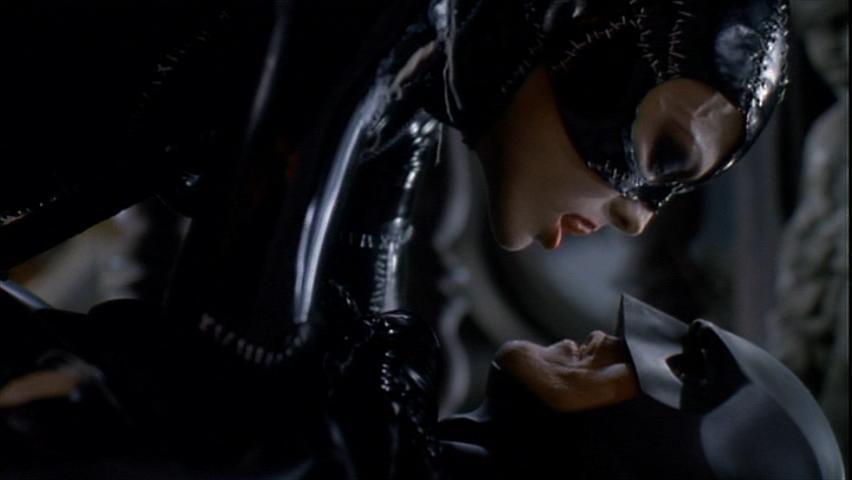
Catwoman is also a very interesting take on the classic villain. Again it is one that bears little resemblance to her comic book counterpart but one that is still a lot of fun to watch. Admittedly the supernatural element added to this character is never explained, but the idea of Catwoman actually having nine lives is still explored in an interesting way. The idea of coming back from the dead and realizing just how much you have been pushed around and seeking revenge on those who used you is simply a great idea for a movie character. While Catwoman has always been a character with more than a bit of sexuality to her, in this film she is at her most overtly sexual. In fact nearly every line she speaks with her in costume is some sort of double entendre. This is something that could have easily work against the film if it wasn't for Michelle Pheiffer playing the character. She delivers each one of these lines absolutely perfectly (or purrrr-fectly) and her sexy drawl really gets the most out of each line. Out of her Catwoman costume, Michelle Pheiffer and Michael Keaton (who once again returns as Batman and once again is perfect in the role) have wonderfully romantic chemistry. You can fully see each one letting their usual guard down when meeting out of costume. 

While the first film introduced movie fans to a darker take on Batman, this film took it to a whole new level. While the first movie showed some glimmers of hope at the end, there is no such luxury here. There is a feeling that even if Batman can stop the villains here, Gotham can't truly be saved. Even the Christopher Nolan and Matt Reeves Batman films showed that there was an element of good beneath the people of Gotham City. Not here. Gotham here is simply full of people who are either corrupt or incompetent. There is no way for such a city to every redeem itself and this gives the film a much bleaker and darker feel than its predecessor. In a city like this even Batman cannot truly stand as a figure of hope in a dark world. Instead he is simply fighting a long and endless battle, where he can save the day, but can't save the city. This creates a darker and more brooding Batman. While in the previous movie, Bruce Wayne hosted social gatherings and met with people, here he is a solitary figure, that spends most of his time completely alone. The only people he lets into his heart are Alfred and Selina Kyle, but the latter is a romance that is doomed from the start. All this gives this movie a unique atmosphere and feel that works beautifully. 

This is also a very good-looking movie. The look of Gotham City and the sewer world (where The Penguin dwells) are both beautifully realized and take one immediately into these worlds. The look of Gotham City is enhanced here by the Christmas setting. The Christmas setting allows for an even more stylized look and one that plays very cleverly with the contrast between the beautifulness of Christmas and the darkness of Gotham City. The result is simply wonderful and makes this movie a joy to look at. 

As much as this movie has a darker feel to it, it also enjoys some of the cornier aspects of superhero stories. This movie is filled with the types of one-liners and delightful types of over-the-top moments that one may more associate with the 1960's Batman played by Adam West. Yet this pure campy fun is never at odds with the darkness of the story but instead enhances it with its own brand of playfulness.

The movie definitely divided audiences. Some were pulled into its unique charms while others (espically those with kids) were turned off by the film's dark tone, grotesqueness, violent moments and overtly sexual moments. There was more controversy caused when McDonalds had Happy Meal toys based off this not even slightly kid friendly film (this was back when PG-13 really meant something). Because of this the next live action Batman film, Batman Forever (1995) was a much more lighthearted and family friendly affair. Because of disagreements with the more family friendly direction of the movie franchise, Batman Forever would not be directed by Tim Burton and Michael Keaton would not be playing Batman. Unlike the previous movie, this film did not receive many imitators and there is not another mainstream superhero movie even remotely like Batman Returns. Luckily for us though we have this one very delightful film. 


Some Cartoons for Saturday Morning #229

 Hello my friends and happy Saturday morning. Once again it is time for some classic cartoons. 

Today's cartoon selection begins with Mighty Mouse in The Feuding Hillbillies (1948). In this short film Mighty Mouse helps a group of mice who are tormented by hillbilly cats. 


Next comes a black and white Looney Tunes short that I have always had a real fondness for, Porky's Bear Facts (1941). This cartoon was directed by Friz Freleng and while it is not as completely crazy as the black and white Looney Tunes directed by Tex Avery, Bob Clampett or Frank Tashlin it does certainly have moments that show what was quickly becoming the studio's signature sense of humor. Characters break the fourth wall and silly visual gags certainly find their way in at times. Yet at the same time the film feels more grounded and story driven than some of the studio's other efforts at this time. The story itself is somewhat of a takeoff on The Grasshopper and the Ants (which Disney had made a Silly Symphony based around in 1934). In typical Warner style the ending here goes completely against the moral of the story. Like many Porky cartoons of this era, Porky's role is very minimized. The truth was most of the directors were getting tired of working with the pig and this made him become a supporting character in his own cartoons for a while. A reviewer in The Film Daily was not that impressed with this cartoon stating "Rate it just as fair." A reviewer in the Motion Picture Daily found the true main character of the film quite likable stating, "An engaging character that shiftless bear." The following is an exhibitor's review from The Motion Picture Herald, "PORKY'S BEAR FACTS: Looney Tunes — Fine. Vitaphone is our best bet for good cartoon fare. Running time, nine minutes.—Fred C. Allen, Princess Theatre, Piedmont, Ala. Small town patronage."


Now for a really fun Talkartoon cartoon from the Fleischer Studios featuring an early version of Bimbo the Dog (best known as Betty Boop's canine boyfriend), Tree Saps (1931). At this time Bimbo was the star character at the Fleischer Studios, but it would not be long until his girlfriend would eclipse his stardom and he would be playing supporting roles in Betty Boop cartoons. Eventually Bimbo would stop appearing in the Betty Boop series and Betty would receive a different group of supporting characters. Bimbo's last appearance in a theatrical cartoon short was in the Betty Boop film, I Heard (1933). The climatic scene of Tree Saps will easily remind cartoon fans of the much more famous Mickey Mouse short, The Band Concert (1935). However this movie predates that classic. 


Next comes the Popeye movie, Me Musical Nephews (1942). Though the Famous Studios Popeye cartoons have a poor reputation, I have a real fondness for the earliest of the Famous Studios Popeyes (especially the black and white ones). They are filled with a wonderful sense of comic energy that is simply a joy to watch. This is on full display in this short film. This movie would be remade in color as Riot in Rhythm (1950). That later short pretty much was the exact same cartoon but in color. 


Now it is time for a commercial break.


Now for the Oswald the Lucky Rabbit cartoon, The Wily Weasel (1937). Now that Disney has the rights to Oswald it is natural that everybody thinks of him as a Disney character. Many know the history that Walt Disney created Oswald. However distributor Charles Mintz hired away Walt's animators and let Walt know that if he did not give into Mintz's demands Mintz could make Oswald cartoons without him, because Walt had no rights to the character. Walt would leave and create Mickey Mouse. However this is where the character's history ends for many people. However that is not when Oswald's film career stopped. Mintz made a few cartoons with Oswald until Universal took the rights away from Mintz and put another Walt in charge of the series. This other Walt was Walter Lantz, later of Woody Woodpecker fame. From 1929 through 1943 Lantz would produce Oswald cartoons. The earliest of these kept the original design that had been used in the Disney films, but by the time this movie was made the character had been redesigned to the point of being unrecognizable. Interestingly with this design change, the character's shorts became much more like the cartoons Disney was making around this time and less like the earlier wilder Lantz cartoons. 


Now for a silent movie, Koko Packs Up (1925). 


Motion Picture News, 1921

As I have stated many times on this blog some of my all-time favorite cartoons are the Goofy cartoons directed by Jack Kinney. Up next comes a very fun example of these short films, Father's Weekend (1953). Like many of Jack Kinney's Goofy cartoons, this movie places the Goof in the role of the everyman, which is a role he worked very well in.


Today's cartoon selection ends with the Looney Tunes webtoon, Junkyard Run #3 (2001).


Thank you for joining me. Come back next week for more animated treasures. Until then may all your tunes be looney and your melodies merry.