Saturday, December 3, 2022

Michael's Christmas Movie Guide: White Christmas (1954)


A simply wonderful musical. 

This film's storyline is incredibly simple. Two men (Bing Crosby, Danny Kaye) meet in the army and form a song in dance team. After leaving the army the two become major stars. One day they catch a sister act (Rosemary Clooney, Vera-Ellen) and fall in love with these two girls and follow them to Vermont. In Vermont they meet their general (Dean Jagger) in the army. The general is running a struggling inn and the two men decide to put on a big Christmas Eve show at that inn to help him. All the while they have various romantic entanglements with the two sisters. 

Within this simple story is an incredible amount of charm. Everything about this film works beautifully. The most obvious praise to give this movie is the great musical numbers. All the songs used in this film were written by the great Irving Berlin and the songs chosen show off the songwriter's work to great advantage. There is not one song here that is not a delight to hear. Yet what is visually happening during these song numbers is just as delightful. Danny Kaye and Vera-Ellen's wonderful dance numbers are a definitely highlight and make the two simply light up the screen during these scenes. Not only is their dancing amazing, but they also bring a wonderfully fun energy to each of these numbers that will even put a smile on the face of those who don't normally like musicals. Danny Kaye performing Choreography, especially puts a smile on my face every time I see it. His dancing there is equally parts comedic and impressive, showing off both his dancing and comedic talents to their fullest. The beautiful singing voices of Bing Crosby and Rosemary Clooney don't hurt at all. The two are in great form and show off why both are such respected singers. To this day there is no one who can sing a Christmas song as well as Bing Crosby. His voice simply fits the season perfectly and when he croons the title song, one gets that unexplainably wonderful Christmas feeling. The final reprise of the title song may be one of the most perfect moments in Christmas movie history. The image of our four main stars in front of a giant Christmas tree decorated in wonderful Christmas outfits with a group of very talented kids dancing and a beautifully snowy backdrop simply feels as warm and cozy as a cup of hot chocolate at home on a Christmas Eve night.  Yet this movie is even delightful beyond just the musical numbers. The storyline may be simple and sentimental but it is the type of sentimentality that really works. We truly care about these characters and want to the romances work out and for the general to see how much he has meant to so many of his men. The humor is also fantastic and there are quite a few wonderfully funny moments. The banter between Bing and Danny Kaye's characters is especially fantastic and can still make audiences laugh to this day. However the biggest comedic highlight is the two main male characters doing their own kidding of the sisters' Sisters musical number. If you look at Bing Crosby's face during that scene, you can see Bing trying not to break into laughter. This film being directed by the legendary Michael Crutiz (Casablanca (1942), Yankee Doodle Dandy (1942), The Adventures of Robin Hood (1938)), it is wonderfully paced, giving a warm nostalgic feel while never feeling too slow. 

To make a movie revolving around the song White Christmas was a natural idea. The song had been a major hit since it premiered in the movie, Holiday Inn (1942). In fact, that is in understatement. To this day Bing Crosby's version of the song is still considered to be the highest selling song of all time. In fact Bing Crosby had already reprised the song in another feature film, Blue Skies (1946). This movie was originally indented to not only reprise the most popular song from Holiday Inn but it was meant to be a reunion of the two stars of that film, Bing Crosby and Fred Astaire. Both stars turned down the picture. Bing Crosby would change his mind though Fred Astaire did not. Fred's role was then given to Donald O'Connor (who would have been great in this movie). However Donald became very sick before production began so the role was given to Danny Kaye. Danny Kaye luckily was a wonderful choice for the role. Rosemary Clooney would later state that the Sisters number worked because she couldn't dance and Vera-Ellen couldn't sing, but together they could pull it off. Vera-Ellen's voice in this number is actually dubbed in by Rosemary Clooney.

This is simply a wonderful piece of old-fashioned entertainment that will simply put a smile on any movie fan's face. 

 The following is a 1955 article from TV Radio Mirror where Rosemary Clooney talks about Bing Crosby. If you have any trouble reading the following pages click on them and use your touch screen to zoom in.




Resources Used

Christmas in the Movies by Jeremy Arnold

https://mediahistoryproject.org/ 


Some Cartoons for Saturday Morning #202

 Hello my friends and welcome back for another selection of classic cartoons.

Today's cartoon selection begins with a wonderful Christmas themed Donald Duck cartoon, Toy Tinkers (1949). This movie is a personal favorite of mine and in my opinion is the best of the cartoons were Donald faces off against Chip and Dale. The film has some wonderful cartoony gags that could have come from a Looney Tunes cartoon of the same time, and I love that. The telephone gag is especially wonderful. I have always loved the really cartoony side of Disney and movies like this that show off that side have a special place in my heart. This cartoon would make its TV debut on a 1958 Christmas episode of Walt Disney Presents. That version starts with some new animation featuring Chip and Dale telling Jiminy Cricket how they celebrate Christmas. 


Variety, 1943


Next comes one of the Sylvester and Hippety Hopper cartoons, Hoppy Days (1961). All of these films were directed by Robert McKimson and followed the same basic formula of Sylvester mistaking the baby kangaroo for a giant mouse. There were 13 of these films and this was the next to last one. 


Now for a delightful Betty Boop cartoon, PArade of the Wooden Soldiers (1934). The following are some exhibitor's reviews from the Motion Picture Herald, "Parade of the Wooden Soldiers: Betty Boop: A clever short subject and fine for children. - C.A. Pratt, Texas Theatre, Smithville, Texas. Small Town Patronage." " PARADE OF WOODEN SOLDIERS: Betty Boop Cartoons — One of the best Betty Boop cartoons. The musical score by Rubinoff is splendid. Running time, nine minutes. -A.B. Jeffries, New Piedmont Theatre, Piedmont, Mo. Rural and small town patronage." 


Up next is Christmas Night (1933). This cartoon comes from the delightfully underrated cartoon series, Van Bueren's Little King cartoons. These films are full of the type of surreal cartoony gags that 
I simply love and this movie is one of my favorites in the series. 


Now it is time for a commercial break. 


Now for a classic Mickey Mouse film, Mickey's Rival (1936). The titular character is a mouse named Mortimer. Those of you who know your Disney history will know, that Mortimer was a name that was considered for Mickey. This was Mortimer's first appearance though he bared more than a little resemblance to Mr. Slicker a character that appeared in the Micky Mouse comic strip. Though Mickey's Rival was his only appearance in a theatrically released short film, it was not his only appearance in animation. He became a reoccurring character in the television shows, Mickey Mouse Works (1999-2000) and House of Mouse (2001-2003). He also has a role in the direct to video feature film, Mickey's Once Upon a Christmas (1999) and has appeared briefly in Mickey Mouse Clubhouse (2006-2016) and Mickey and the Roadster Races (2017-present). Outside of animation he has been used very often in the Disney comic strips and began to appear in them around the same time he made his debut in movie theaters. Mortimer's design is said to be based off of Walt Disney and those who have seen pictures of a young Walt, will find this easy to believe. The ending to Mickey's Rival has Mickey and Minnie simply shaking hands. However it was originally planned for Mickey to have a buzzer on his hand to play a Mortimer type prank on Minnie. Though this would have been out of character for Mickey at this time it would have fit perfectly in with the Mickey Mouse of the late 1920's. A review in The Motion Picture Herald stated "The subject is less complex than many of the recent Disney fabrications but wholly entertaining." The following is an exhibitor's review from The Motion Picture Herald, "Mickey's Rival: Mickey Mouse - We find that the bad characters often frighten our small children and they go out into the foyer until it is passed over. - Harland Rankin, Plaza Theatre, Tilbury, Ontario, Canada, General Patronage." The following is another exhibitor's review from the Motion Picture Herald, "Mickey's Rival: Mickey Mouse—Played this the second time as it is one of the best of the Mickeys. — C. L. Niles, Niles Theatre, Anamosa, Iowa. General patronage." A review in The Motion Picture Daily stated, "Clever animation and fast-moving, but there have been better Mickey's. For instance 'Alpine Climbers.'" The following is from a 1936 issue of The Film Daily, "United Artists' latest Walt Disney release, 'Mickey's Rival', introducing Mortimer Mouse, will open at the Radio City Music Hall with 'Swing Time' on Thursday, and at the Rivoii Theater with 'The Last of the Mohicans.'"


Next comes a delightful Christmas treat from Famous Studios with Hector's Hectic Life (1948). This movie was directed by former Disney animator, Bill Tytla (probably my favorite Disney animator). Tytla had worked on some of Disney's finest feature films including Snow White (1937), Pinocchio (1940), Fantasia (1940) and Dumbo (1941) and his animation was often a highlight even in these masterpieces. Though the Famous Studios cartoons he directed might not be as highly praised as his animation for Disney, these films often showed him as a very capable director. This movie is a good example of this. 


Next comes The Pink Panther in Sherlock Pink (1976).


Now let us close with a song.


Thanks for joining me, come back next week for more animated treasures. Until then may all your tunes be looney and your melodies merry. 

Resources Used

Walt Disney’s Mickey Mouse: The Ultimate History by David Gerstein and J.B. Kaufman

Of Mice and Magic: A History of American Animated Cartoons by Leonard Maltin

https://mediahistoryproject.org/

https://disney.fandom.com/wiki/The_Disney_Wiki


Thursday, December 1, 2022

Movie Review: Devotion


Michael's Movie Grade: B+

An excellent war film. 

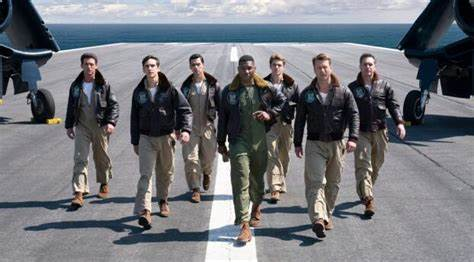
This film tells the story of a real-life hero, Jesse Brown, who was a naval aviator during the Korean war. He was the first African American naval aviators and broke many racial boundaries. This movie does a wonderful job painting a portrait of this great man. This is especially true during the scenes that show him dealing with racial prejudice and biases from people, who do and don't realize they are treating him differently. Through Jonathan Majors' wonderful performance, you can always see the pain that this treatment causes him, yet he always holds himself with the utmost dignity and respect, never letting what anyone else says, effect how he feels about himself. While he recognizes himself as a flawed man, he also recognizes himself as a man deserving the respect that he is not always given. Yet the character never feels too perfect, to not feel human and relatable to us. While I never met the real man and can't tell you how close this representation is to the real person, I can say that the character here always felt like a real human being. His relationship with his white commanding officer is especially well handled. The two are great friends and you can feel the warmth between them in every scene, even those where they have disagreements. This is where much of the heart of the film lies, and it works wonderfully. Not only do Johnathan Majors and Glen Powell have wonderfully chemistry, but the script looks at this relationship in a very intelligent way. The commanding officer always tries to stand up for his friend, whenever he experiences any racism. However, he is not always much help and can even make things worse. Jesse prefers to stand up for himself and fight his own battles his own way. This creates a wonderful dynamic that allows us to relate to both characters and fully understand why it might cause some conflict between friends. This is not an action movie by any means, only having two real action sequences. However these action sequences are truly wonderful and exciting. They are wonderfully paced and have a great sense of suspense.   

This movie can be broken into two parts. One is before our characters see conflict and the other is when they are fighting. I admit that the first part felt kind of padded out with scenes that weren't necessary and didn't really add much to the story or the characters. If these scenes were left it, it would have created a tighter constructed film. Unfortunately they can affect the pacing and feel of this first part. This film also has a problem that is common in war movies. There are quite a few characters in the main group and to give time to the main two characters, the rest come off as kind of bland and clichéd.

None of this can take away from the pure emotional punch this movie delivers in its last act. I don't want to go into much more detail (for those who don't know the true story), but the ending of this film is quite powerful and more than makes up for any flaws it had along the way. 

If you are a fan of war movies, I can highly recommend this one. 

Movie Trailer: Guardians of the Galaxy Volume 3

Movie Trailer: Indiana Jones and the Dial of Destiny

Movie Trailer: Transformers: Rise of the Beasts

Silent Film of the Month: A Christmas Carol (1910)


Studio: Edison. Runtime: 13 mins. Director: J. Searle Dawley. Based on the short story by Charles Dickens. Main Cast: Marc MacDermott, Charles Ogle, William Bechtel, Carey Lee, Viola Dana, Shirley Mason.

Probably no Christmas story is more familiar to movie fans than that of Charles Dickens' A Christmas Carol. This story has been made into countless films, from straight adaptions to parodies to versions with popular characters (Disney cartoon characters, The Muppets, Looney Tunes, The Flintstones, Mr. Magoo, etc.) and this doesn't look like a practice that is going to end anytime soon. This makes it fascinating to go back and look at an early film version of this story that dates back to 1910. This is especially true when that film version is still very entertaining to a modern audience. 

Everyone knows the story of A Christmas Carol. Scrooge is a greedy and mean old man. He mistreats his employees and cares little about those who are less fortunate than him. However, around Christmas time, he receives ghostly visits where he sees memories from past Christmases that helped make him into who he is today, present Christmases where he sees how his actions affect others and a future Christmas the consequences of his actions now. After seeing these visions, he repents from his evil ways and receives the true Christmas spirit. This short film follows the story very closely, with one major exception. Rather than seeing multiple ghosts, Scrooge only sees one ghost.

The reason for this change is very understandable and that is the film's length. It was very common in the days before feature films became a major part of the moviegoing experience, to have films that told shorter abridged versions of classic literary stories. Many of these films would simply show highlights from the story, excepting movie audiences to already know the story (back then people where more read, so most probably did know the story). This film applies that type of storytelling, where we only catch brief glimpse of the Christmases from Scrooge's past, present and future. For this, having only one ghost was the simplicist way to frame these Christmas visions.   

Despite the short length this movie does a great job of capturing the spirit of Charles Dickens’ famous story. While understandably many today will prefer the later longer Christmas Carol films, this movie is still quite engaging and a lot of fun. Even in this short time, the themes of the story are wonderfully conveyed and we understand and relate to Scrooge’s character arc. The sets are wonderful and set up perfectly the atmosphere of the story. The special effects are not only really good for the time but hold up quite while today. 

This movie’s director was J. Searle Dawley. He was one of the finest directors the Edison studio had at this time. The same year he made this film, he made a similar short film version of Frankenstein. That film starred Charles Ogle (who plays Bob Cratchit here) as the monster.  His work after leaving Edison is also fantastic. Of special note are his movies with actress Marguerite Clarke, which would include Snow White (1916) and Uncle Tom’s Cabin (1918). Though he does not get as much attention as he should today, Dawley is a truly remarkable director, whose films are just as wonderful today as they were when originally made. 

For anyone interested, this film can be found on YouTube.