Monday, October 2, 2017

Happy 67th Birthday to Peanuts

Okay today's post may not be about film, but this is my blog and I can write about whatever I want. So today I am going to write about a comic strip that happens to mean a lot to me. This is Peanuts. As many of you know this strip was created and written by Charles M. Schultz and introduced such amazing characters as Charlie Brown, Snoopy, Sally Brown, Linus and Lucy Van Pelt, Woodstock, Peppermint Patty, Schroder, Pigpen and so many more. It also spawned off many animated TV specials, two TV series and a few theatrical feature films. The appeal of these characters is actually very easy to understand. They are us. We relate to them highly. We understand the insecurities of Charlie Brown and Linus, the daydreaming side of Snoopy and Peppermint Patty's boredom when it comes to school. However there is actually more to their appeal than this, we don't just relate to these characters we kind of admire them. Charlie Brown may never successfully fly a kite, kick a football, or win a baseball game. Similarly we know that Linus will never see the great pumpkin, and Peppermint Patty will remain D- student for her entire time in school. However these characters preserve through all of this. They never give up and when they fall off the horse they get right back on. If after all these characters go through they still hang in there so can we. At the end of the day this gives us hope that we can make it through any hardships or failures in our lives.

The reason I am talking about this comic strip today is simple. On this day in 1950, this strip first graced the newspaper funny pages. Below is the very first comic. Though a lot has changed and the strip would later have a much larger cast than the three characters featured here (Charlie Brown, Sherman, Patty (not Peppermint Patty mind you)), this strip gave birth to all that followed.
-Michael J. Ruhland

Sunday, October 1, 2017

Silent Film of the Month: The Monster (1925)

Run Time: 86 minutes. Studio: MGM. Director: Roland West. Writer: Roland West. Based on a play by Crane Wilbur. Main Cast: Lon Chaney, Gerutrde Olmstead, Hallum Cooley, Johnny Arthur. Cinematographer: Hal Mohr.


It is October again and of course with Halloween, this is the perfect month to watch a scary movie. To me (and I am sure many other film enthusiasts) that means it is the perfect time to watch a Lon Chaney movie. While I like many of you love Phantom of the Opera (1925), The Hunchback of Notre Dame (1923), The Unknown and many more of the most popular films he starred in, this month we are going to look at an often very overlooked movie starring The Man of a Thousand Faces. This is a horror-comedy called The Monster.

This movie was directed by Roland West. If some of you are not familiar with this name it may be because during his brief movie career (1916-1931). He only directed 12 films and over half of them are unfortunately currently lost films. Two of his movies however may be known by comic book buffs. These are The Bat and its sequel The Bat Whispers. Both of which played a part in inspiring the character of Batman. The Monster is the oldest of West's currently surviving films.


This movie was based off a stage play by Crane Wilbur. Crane Wilbur is quite a name himself in film history. My fellow short subject fans might know him for directing some 1930's Technicolor short subjects for Warner Brothers about the history of the USA. On the other hand horror movie buffs might know him for writing 1953's The House of Wax. My fellow country music fans on the other hand might be interested to know Crane Wilbur directed a 1951 film called Inside the Walls of Folsom Prison, which inspired Johnny Cash to write his song Folsom Prison Blues.

As mentioned before this film stars Lon Chaney himself. One of the things that Chaney is best remembered for now is his understated and often subtle way of acting. This is often attributed to his parents being both deaf and mute and because of this he needed to learn to communicate through pantomime. However in this film he is anything but subtle. He is over the top and very exaggerated in his movements. Since the character he plays is anything but subtle it works very well here. Still this holds an interest to film enthusiasts to see such a beloved actor use such a different acting style.

As this film starts Johnny Goodlittle (played Johnny Arthur) fights over a beautiful girl named Betty (played by Gertrude Olmstead) with his rival Amos (played by Hallam Cooley). Johnny being an amateur detective decides to investigate a disappearance at an asylum. When he gets there however he learns that the evil Dr. Ziska (played by Lon Chaney) has taken over the place. Dr. Ziska kidnaps Amos and Betty. Johnny, Amos and Betty struggle to find a way out of the asylum alive as they learn just how sinister Dr. Ziska really is.

Though I would be lying if I said this movie ranks among one of Chaney's best films, this movie is still a sheer delight, especially for my fellow film buffs. The comedy while not consistently laugh out loud hilarious is often pretty funny. Scenes like the dance hall scene or Johnny being drunk certainty make me laugh. The characters are very likable and always fun to watch, and the acting is fantastic. However the best thing about this movie in my mind is its sense of atmosphere. As soon as you enter the asylum, there is a feeling of dread. You just know things are going to get worse. The lighting and cinematography are perfect here and really accentuate the idea of something not being quite right.

At time critics were not very fond of the movie's combination of comedy and horror. However this is what this movie's current fans loves about the film.


-Michael J. Ruhland

Resources Used
http://www.tcm.com/tcmdb/title/3040/The-Monster/

Friday, September 29, 2017

Silent Horror Movies at the Old Town Music Hall

Hello again fellow film lovers. I great news for my southern California readers and for my fellow silent movie buffs. This October, the Old Town Music Hall (which is located in El Segundo, California), one of the best places to see movies will be playing some classic horror films from the silent era. Each of these films will be accompanied live by a very talented musician (Bill Field) on the Mighty Wurlitzer Organ (which dates back to 1921), and be preceded by a sing along and comedy short. The films that will be plying are Dr. Jekyll and Mr. Hyde (1920), Nosferatu (1922), The Cabinet of Dr. Caligari (1919) and The Phantom of the Opera (1925). If you are able to go to any of these don't you dare miss it. Seeing these movies in a theater with live music is an experience you will never forget.

For dates and show times as well as finding the theaters address, click here.

-Michael J. Ruhland

Thursday, September 28, 2017

Animated Feature Films Before Snow White

Though I cannot deny that the Disney animated classic Snow White and the Seven Dwarfs is a milestone in film history and a great movie, it is not the first animated feature film ever made. Why it is sad that this is often believed is because some of the animated features that came before are really good and definitely deserve more attention. That is why today we are going to look at these films.


El Apostol
1917. Director: Quirino Cristani. Writer: Quirino Cristani. Animator: Quirino Cristiani. Character Designs: Diógenes Taborda. Models: Andrés Ducaud.

El Apostol
is believed to be the first animated feature film made. This was a silent film from Argentina. Unfortunately this film is lost today due to a fire in 1926. The film was a political satire about Argentinian president Hipolito Yrigoyen, and the film ran around 70 minutes.

Sin dejar rastros1918. Director: Quirino Cristani. Writer: Quirino Cristiani. Animator: Quirino Cristiani. Producer: Federico Valle.

Sin dejar rastros (or in English Without a Trace) was a silent movie from the same country and director of El Apostol. It is based on a true story of Baron von Luxburg and how he affected Argentinian history. It is unknown if any copies of this film exist today and the film is considered lost.

The Adventures of Prince Achmed1926. Director: Lotte Reiniger. Technical Director: Carl Koch. Animators: Walter Ruttman, Berthold Bartosch, Walter Turck, Alexander Kardan. Titles: Edmund Delco.

This German silent film is the earliest animated feature available for viewing and it is a delight. Through expert film making and subtle but extremely expressive character animation, this film tells a simple story in the best way possible. Director Lotte Reiniger started directing animated films in 1919 and specialized in a style of animation called silhouette animation. This was achieved by cut out figures made from cardboard. Each limb of these cardboard figures had wires attached, creating the onscreen illusion of these characters moving of their own will. The rest of the crew working on the film had amazing film careers themselves. Carl Koch would for instance be a co-writer for Jean Renoir's 1939 classic The Rules of the Game. Walter Ruttman and Berthold Bartosch would direct some films themselves. Ruttman would direct the 1927 classic Berlin: Symphony of a Great City and Bartosch directed one of the most brilliant animated art-house films ever made with the 1932 short The Idea. In The Adventures of Prince Achmed, Ruttman and Bartosch animated mainly on the special effects. Because of this Animation Historian Jerry Beck has referred to them as "the world's first effects animators". When originally made it was hard for the film to find a distributor in Germany. However a composer named Wolfgang Zeller got permission to book a showing at a concert hall with his own  music. Reviews from this showing were extremely positive and the film was picked up for a year at a theater in Paris. This was followed by the film playing all over the world.

  Peludópolis1931. Director: Quirino Cristiani. Music: José Vázquez Vigo.

Peludópolis is believed to be the earliest sound animated feature. This is another film from Argentina and directed by Quirino Cristiani. Unfortunately like his earlier features this one is assumed lost. It is another political movie, this time about Argentine president Hipólito Yrigoyen and how a group called The Radicals were trying to overthrow him.

The New Gulliver1935. Director: Aleksandr Ptushko. Writers: Aleksandr Ptushko, Sigizmund Krzhizhanovsky, Grigori Roshal. Cast: Vladimir Konstantinovich Konstantinov, Ivan Yudin, Shaolin Santiago. Cinematographer: Nikolai Renkoi Renkov.

This stop motion/live action hybrid was the first Russian feature to make extensive use of animation and the first mostly stop motion feature film released. This movie takes Jonathan Swift's famous book Gulliver's Travels and turns it into soviet propaganda. While this film's combination of stop motion and live action is well ahead of its time, it is really only of interest to film buffs with a special interest in the history of animation, or those who want to see soviet propaganda. All others will surely find this movie just boring.

The Adventures of Pinocchio Directors: Raoul Verdini, Umberto Spano.


This is a debatable film to put on this list because it was never actually finished. The film had production trouble from the start and simply seemed to be fated not to be. If released when it was planned to (1936) it would have been the first cell animated feature and the first animated feature from Italy. It would have also beat Walt Disney's animated adaption of Collodi's book by four years.

The Tale of the Priest and of His Workman Balda1936. Director: Mikhail Tsekhanovsky.

Based on a poem of the same name by Alexander Pushkin, this was the first hand-drawn Russian feature film. Sadly due to a fire only six minutes of this movie still exist today as the rest was destroyed in a fire.

The Tale of the Fox 1937. Directors: Irene Starevich, Ladislas Starevich. Writers: Irene Starevich, Ladislas Starevich, Roger Richebé, Jean Nohain, Antoinette Nordmann, Johann Wolfgang von Goethe. Voices: Romain Bouquet, Claude Dauphin, Sylvain Itkine, Léon Larive, Robert Seller, Eddy Debray, Nicolas Amato, Pons, Sylivia Bataille, Suzy Dornac, Jamie Palma, Marcel Raine. Music: Vincent Scotto. Cinematography: Ladislas Starevich. Animators: Irene Starevich, Ladislas Starevich. Editor: Laura Sejourné.

This was the first French animated feature, and the first feature to be completely stop motion. It is only appropriate that one of the directors was Ladislas Starevich, one of the pioneers of stop motion animation and one of the first filmmakers to prove animation was art and not just a novelty. Not surprisingly this film is a pure work of art and one of the all time great animated features. Sadly this is the only animated feature film he worked on. The film was originally finished in 1930, but it there were problems with its original French soundtrack. This film ended up being released in Germany and in the German language in 1937, and wouldn't play in France or French until 1941.

Academy Award Review of Walt Disney Cartoons1937. Cartoons directed by Wilfred Jackson, Burt Gillett, Dave Hand..

With no new animation and simply being some short films put together and released as a feature, it is very debatable to include this here. This film is made up of five of the Disney studio's Silly Symphonies cartoons (Flowers and Trees (1932), Three Little Pigs (1933), The Tortoise and the Hare (1934), Three Orphan Kittens (1935), The Country Cousin (1936)). It would be released in 1966 with four cartoons added (The Old Mill (1937), Ferdinand the Bull (1938), The Ugly Duckling (1939), Lend a Paw (1941)). Naturally as these short films are all great the feature film is a lot of fun to watch, but there is nothing new offered here, which leaves it out of most lists of Disney feature films.

The Seven Ravens
1937. Directors: 
Ferdinand Diehl, Hermann Diehl. Writer: Paul Diehl. Cinematographer: Alfonse Lufteck. Music: Walter Pepper. Animators: Ferdinand Diehl, Hermann Diehl.

This stop motion animated feature from Germany just barely makes this list as it was released earlier the same month as Snow White and the Seven Dwarfs. This movie is based off of a story by the Brothers Grimm.

-Michael J. Ruhland

Resources UsedThe Animated Movie Guide edited by Jerry Beck
Animation Art edited by Jerry Beck 


Tuesday, September 26, 2017

Teen Titians Go! Movie and What it Might Mean

Ok so some of you might have heard about the Teen Titians Go! theatrical released feature film. For those of you not in the know, this will be a movie based off the Cartoon Network animated TV series Teen Titians Go!. This show is a hit show, but has also alienated many fans of the 2003-2007 Teen Titians TV series who hate this show with an undying passion. Naturally because of this show getting a feature film based off it many cartoon fans are extremely upset about this news. I on the other hand am not angry as much as curious. My curiosity isn't all dedicated to this simple film, but rather to what this means for other Cartoon Network shows. Many of you may be aware of a 2002 movie called The Powerpuff Girls Movie and based off the Cartoon Network show, The Powerpuff Girls. Well this movie when released did not do as well as expected either at the box office or with critics. Because of this Cartoon Network decided to stop production on any other theatrical released feature films based off their TV shows. And from that day forward, there has not been another theatrically released movie based off a single Cartoon Network show. This is why the announcement of a Teen Titians Go! movie for theaters got me thinking. This movie will be released July 22, 2018 and I have to wonder if it does well at the box office, will there be more movies based on Cartoon Network TV show based movies made for theaters? I don't have an answer to this but it is an interesting thought. Personally I want a Courage the Cowardly Dog movie, hey I can dream can't I?

-Michael J. Ruhland 

Monday, September 25, 2017

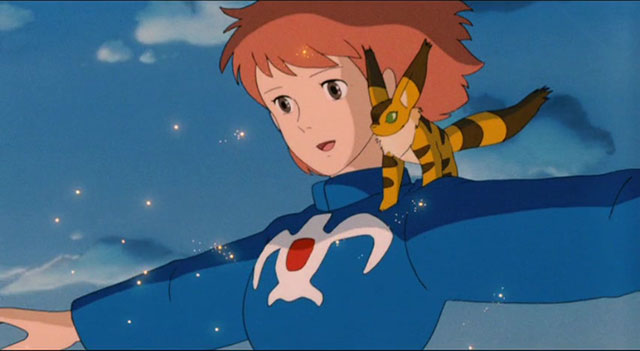
Movie Review: Nausicaä of the Valley of the Wind (1984)

Review Written By Michael J. Ruhland


Note: I am writing a review of this movie because thanks to Fathom Event's Ghibli fest. If you want to see one of these films on the big screen, look it up on your computer, it is well worth it.

Michael's Movie Grade: A+

Review: Hayao Miyazaki's film adaption of his own manga series is an incredible movie that works on all levels.

One of the most incredible things about this movie is its wealth of atmosphere. The whole world this movie takes place in is so intricately and perfectly set up that it feels completely real. Doing this the movie achieves what ever fantasy film wants to, in that it creates its own perfectly believable reality. The sense of atmosphere becomes completely different during a flashback sequence. During this sequence the animation becomes more abstract and sketchy. However this new kind of animation works perfectly as it brings you into the mind of the character and see the world as a little child would. This scene is not just an experiment in style but rather a way to bring you further into the movie. Speaking of this scene Joe Hisaishi's musical score during this part is absolutely beautiful and I find myself humming it while writing this review. In fact the sound is very important to this movie. The film knows when to awe you with great music and sound effects and when to be silent and let the film speak for itself. Adding to all this is an extremely likable main character. Though she is a role model, she never comes off as too perfect, but always keeps a sense of relatability. She makes mistakes and lets her emotions get the better of her at the wrong time, but her intelligence and bravery win out to make her a very strong character. The story is simple in a way, but also complex on a deeper level. One wonders if any of the villains are really that evil, or if they all simply want what they feel is best and go about it in a way that never seems right. Similarly the environmental message is much more though provoking than how most films would handle the subject as it brings in ideas of the Earth going through a cycle, and how sometimes the way nature works is not so black and white.


This is an incredible movie and seeing it on the big screen with an audience makes it all the better.

-Michael J. Ruhland  

Sunday, September 24, 2017

A Few Thoughts on Porky Pig 101

I am sure many of my other giant Looney Tunes buffs have been awaiting something like the Porky Pig 101 DVD set. I certainty have been waiting a while for something like this. In the end I am very very happy with what I got, even if I do admit it has a few things missing.

What really makes this set is the wealth of cartoons on it. This set is made of the first 101 cartoons staring Porky Pig. This means it includes many classic films, that are not easy to find elsewhere as well as some old favorites. It also lets us see each of these films chronically and see how the Looney Tunes series developed over time. With that being one of the major perks of this DVD set it has cartoons from the perfect time period for this kind of exanimation. That is the mid 1930's to the early 1940's. During this time Looney Tunes were getting away from being imitations of what Disney cartoons were doing and instead becoming their own thing. The truth is the Disney studio was simply the best at what it did and the only way to compete was to do something different. That evolution is perfectly shown here. This period was also the time when each Looney Tunes directors had their own identities most clearly defined. In a way no American animation studio has been before or since, the Warner Brothers studio at this time was simply full of auteur filmmakers. Tex Avery's films were delightfully successful experiments in how far he could go with a zany idea in ways most comedy directors (live action or animated) would never dare to try. Bob Clampett's cartoons were filled with pure imagination and childlike energy. Frank Tashlin employed many cinematic ideas with cinematography and cutting in ways that hadn't been seen before in animation. Jack King's cartoons were much more story based and less gag based than the other directors. In fact some of King's Porky cartoons on this set can't even really be considered comedies (such as Shanghaied Shipmates) and are more action/adventure films. This is interesting considering he directed some really funny Donald Duck cartoons for Disney later. Chuck Jones' cartoons on this disc are his early work and because of this they are the slowest paced and most atmospheric cartoons here. Friz Freleng's cartoons on this set are extremely structured and entertaining but also are the most safe and least experimental cartoons here. These kind of observations you can clearly see watching these cartoons are absolutely perfect for my fellow Looney Tunes history buffs. However there is still plenty here to entertain a causal cartoon fan. This set features many classic cartoons and I don't see how any lover of Looney Tunes can't enjoy watching such films as Porky in Wackyland, Porky and Daffy, Porky's Preview, You Ought to Be in Pictures, The Case of the Stuttering Pig, Porky's Romance, Porky's Duck Hunt, The Film Fan and so many more.

However this set is not perfect. The picture quality is good, but leaves something to be desired after The Golden Collection and The Platinum Collection sets. However the main thing missing is new bonus features. All the bonus features here (both commentaries and storyboard reels) have been seen on the Looney Tunes Golden Collection sets. This is great for newcomers because these are great bonus features, but disappointing for those who already have those sets. Despite any of the faults though the sheer amount for cartoons, and the rarity of many of them, making this a must have for Looney Tunes fans, and a must add set to any cartoon DVD collection. Get it now you won't regret it.

-Michael J. Ruhland