Showing posts with label Looney Tunes Compilation Movies. Show all posts

Saturday, June 7, 2025

Bugs Bunny Superstar (1975)


Bugs Bunny Superstar marked the first Looney Tunes feature length movie. The movie itself was part documentary and part a compilation film. The movie consisted of interviews with such notable Looney Tunes directors as Friz Freleng, Tex Avery and especially Bob Clampett, vintage footage of the studio when they were making the classic cartoon shorts, narration by no less than Orson Welles and nine full cartoon shorts. The movie itself came about because of a filmmaker named Larry Jackson. Jackson felt that those these cartoons were popular on TV in the 1970's, they should be put back in movie theaters (where they played originally). Jackson originally played on simply making a retrospective of these cartoons but as the film developed it turned into the part documentary we now have. 

The cartoon shorts used in this movie are What's Cookin' Doc? (1944), The Wild Hare (1940), A Corny Concerto (1943), I Taw a Putty Tat (1948), Rhapsody Rabbit (1946), Walky Talky Hawky (1946), My Favorite Duck (1942), Hair-Raising Hare (1946) and The Old Grey Hare (1944), These are a wonderful selection of cartoon shorts. While there are a few obvious choices here and quite few less obvious choices, each cartoon is a winner and some of them even hold their own against the best Looney Tunes and Merrie Melodies shorts. My Favorite Duck is one of my favorite Porky and Daffy pairings and one of the highlights of the movie. If this film only consisted of these cartoons, it would still be a joy to watch. 

The home movie footage of the animators at work and play are simply wonderful. They take up too brief of a time, but they are nicely employed, a lot of fun to watch and a treasure for classic cartoon fans. 

While every Looney Tunes fan will agree that the cartoons and the home movie footage are wonderful, the interviews are much more controversial. Friz Freleng and Tex Avery barely appear and don't get to say much, while Bob Clampett takes up nearly all the screen time where cartoons are not being shown. This is not accidental. On his blog historian Thad Komorowski states, "In order to secure Clampett’s participation and access to the Clampett estate’s unprecedented collection of Warner history, Jackson had to sign a contract that stipulated Clampett would host the documentary and also have approval over the final cut." Clampet himself was reluctant to speak about the other Looney Tunes directors. While he doesn't directly take credit for too much here (as he did in a 1969 interview with historian Michael Barrier), he does imply that he was the main force behind these cartoons. Tex Avery was not happy about what he felt was Bob Clampett taking credit for creating Bugs Bunny. Chuck Jones, who famously had a fued with Bob Clampett, feeling that the Clampett took too much credit was unhappy with the movie as a whole. It is perhaps no coincidence that when Jones directed The Bugs Bunny-Road Runner Movie (1979), Bugs would list a group of his "fathers" and Bob Clampett would not be included. Friz Freleng told Jackson not to worry about the feud saying that the two were always “squabbling like kids with sibling rivalry more or less since they were kids, and if the shoe had been on the other foot when you were making your film, Chuck would have probably done the same thing to Bob and give him the short end of the stick if he had the chance.” Frankly this film can feel at times too much like Bob Clampett: The Movie and one wishes that more time could have been spent discussing the other creators of these cartoons. The main problem with Bob Clampett's hosting though is that he doesn't really give much information about these cartoons. He gives a few of the better-known facts and never goes into much detail. This especially stands out today, when so many great books about classic cartoons have been written and much information is also readily available on the internet. This can make his hosting scenes seem very fluffy today (not helped by the obviously very low budget filmmaking). However, they are very pleasant fluff and have a real charm to them. 

Jackson wanted Robert McKimson, Mel Blanc and Chuck Jones to appear in the film. Robert McKimson turned this down as he didn't feel comfortable in front of a camera. Mel Blanc said that Clampett never reached out to him but that he would have declined as he was still frail from an auto accident fourteen years earlier. Clampett claimed to have talked to Jones secretary who said he was out of town that month. One wonders if any of them would have gotten much screentime or would have barely appeared in the final film the way Friz Freleng and Tex Avery did. 

The movie reached theaters on December 19, 1975, and received a mostly positive reception from critics and audiences. It would find itself on VHS in 1988. It would strangely enough air once on the Disney Channel in 1989. Even stranger is that the Disney Channel did not edit the blackface gag in I Taw a Putty Tat. 

Resources Used

Looney Tunes and Merrie Melodies: A Complete Illustrated Guide to Warner Brothers Cartoons by Jerry Beck and Will Friedwald

https://www.whataboutthad.com/2012/11/28/bob-clampett-superstar/

https://www.combustiblecelluloid.com/classic/bugs_bunny_superstar.shtml

https://looneytunes.fandom.com/wiki/Bugs_Bunny:_Superstar


Thursday, July 27, 2023

Bugs Bunny's 3rd Movie: 1001 Rabbit Tales (1982)

  .


The 3rd of the Looney Tunes compilation movies may not be as strong as the previous two (The Bugs Bunny/Road Runner Movie (1979), The Looney Looney Looney Bugs Bunny Movie (1981)) but it is still a fun watch. Plus it was a childhood favorite of mine. 

Like the previous two movies in the series, this movie combines newly animated scenes with classic cartoon shorts to create a feature length movie. However unlike the previous two this film combines this all into one story.  Though like The Looney Looney Looney Bugs Bunny Movie this film is also directed by Friz Freleng. However unlike the previous two movies, the classic cartoons used here come from diffrent directors. The Bugs Bunny/Road Runner Movie features all cartoons directed by Chuck Jones (who also directed the new scenes) and The Looney Looney Looney Bugs Bunny Movie featured cartoons directed by Friz Freleng. This movie instead features classic cartoon shorts from Chuck Jones, Friz Freleng, Robert McKimson. The cartoon shorts used in this film are Cracked Quack (1952, directed by Freleng), Apes of Wrath (1959, directed by Freleng), Wise Quackers (1949), directed by Freleng), Ali Baba Bunny (1957, directed by Jones) (also used in The Bugs Bunny/Road Runner Movie), Tweety and the Beanstalk (1957, directed by Freleng), Bewitched Bunny (1954, directed by Jones), Goldimouse and the Three Cats (1960, directed by Freleng), Red Riding Hoodwinked (1955, directed by Freleng), The Pied Piper of Guadalupe (1961, directed by Freleng), Mexican Boarders (1962, directed by Freleng), One Froggy Evening (1955, directed by Jones) and Aqua Duck (1963, directed by McKimson). Despite Yosemite Sam playing a large role in the story, none of the classic shorts used here include him.

The storyline involves Bugs Bunny and Daffy Duck as book salesmen, competing to see who can sell the most books. Meanwhile a sultan (Yosemite Sam) is looking for a new storyteller for his spoiled brat son (who is very much like the character Junior from the Friz Freleng directed Looney Tunes short, A Waggily Tale (1956)). Finding Bugs at his door trying to sell a book of stories. Sam then forces Bugs to be his son's new storyteller. 

There is a whole lot to enjoy about this movie. Every one of the classic cartoon shorts used here is gem. Each one put a smile on my face. They not only charming and fun but some of them are laugh out loud funny. In fact many of these shorts are why this was a childhood favorite of mine. This movie marked the first time I had seen Cracked Quack, The Pied Piper of Guadalupe and Mexican Borders, all of which I simply loved. So as I kid, I would watch this movie over and over again to see these shorts again. To this day, I can still quote nearly every line of this movie off the top of my head. Watching this movie today, still brings me back to watching the film as a kid. Yet even the new scenes are pretty good. The storyline is basic and simple but fun, just like all of the best Looney Tunes films. Yet it never feels like it is stretched to make it feature length, but instead fits into the time period. While these new scenes may not be as laugh out loud funny as the classic shorts, they are still quite charming. The new gags for the most part work well enough and definitely made me smile and even laugh at times. The dynamics between Bugs, Yosemite Sam and his son are a lot of fun as well and I enjoyed Bugs' Groucho Marx type comments about the kid. 

This movie does have its faults that make it not as strong as the previous two feature length compilation films. Though there was some editing of the classic shorts in the previous movies, here there is quite a bit more of it. This is obviously done to make it fit better with this movie's more typical story. For fans of the classic shorts, this editing can get annoying as there are some truly great moments cut out of here. Some of the cartoons also feature unnecessary narration from Bugs that they would all be better off without. This narration especially hurts One Froggy Evening. Though it is not the fault of the filmmakers, Mel Blanc (the voice of most of the Looney Tunes) had definitely grown older by the time this movie was made and the difference in how his voice sounded can be felt between the new and old sequences. 

Despite its flaws this movie is still a delight to watch. Enjoy it yourself or show it to a kid, it might be one of their childhood favorites like it is mine. 


Wednesday, June 15, 2022

The Looney Looney Looney Bugs Bunny Movie (1981)


In 1979 Chuck Jones made a compilation movie, The Bugs Bunny/Road Runner Movie (1979) that combined new animation with Chuck's classic Looney Tunes and Merrie Melodies short cartoons. In 1981 it was now time for another great Looney Tunes director to do the same thing, this was the great Friz Freleng. Friz Freleng had worked with Looney Tunes from the beginning and received an animation credit on the very first Looney Tunes cartoon, Sinkin' in the Bathtub (1930). Though he may not always receive the same accolades from film buffs as Chuck Jones or Tex Avery, I would argue that Friz was easily their equal. His sense of comic timing is still to this day unequaled when it comes to comedy cartoons. He also played a large role in the creation of Porky Pig, Sylvester and Yosemite Sam, as well as being the one to team up Sylvester and Tweety. In 1981, Friz's DePatie-Freleng studio (which was run by him and David DePatie) had been bought by Marvel Comics and became Marvel Studios. DePatie-Freleng had been responsible from the Pink Panther, Inspector and Ant and the Aardvark cartoons. This left Friz Freleng available, and he soon rejoined Warner Brothers. After rejoining Warner Brothers, Friz set out to make a series of feature length Looney Tunes compilation movies. These films would have around 20 minutes of new animation and the rest of the runtime would be taken up by classic cartoon shorts. The first of these movies was The Looney Looney Looney Bugs Bunny Movie. Like Chuck Jones earlier compilation movie, this film would feature only shorts by one of the Looney Tunes directors, Friz himself. 

This movie is made up of three separate, almost unrelated acts, that were only tied together by Bugs' narration. The first of these acts was titled Satan's Waitin' and features Yosemite Sam ending up not in heaven but the other place after an unsuccessful battle with Bugs. Here he pleads the devil and the devil agrees that Sam doesn't have to stay there if he can bring someone else down to take his place. Sam naturally thinks Bugs is the perfect candidate for the job. This is problem the least original of the three acts. It had been done before as an episode of The Bugs Bunny Show called Satan's Waitin' (1961) and as a short Merrie Melodies cartoon, Devil's Feud Cake (1963). Surprisingly only a couple of very tiny clips from Devil's Feud Cake were used in this segment. However just because something is not original does not make it bad. In fact this act is extremely entertaining and I'd argue that it is actually better than Devil's Feud Cake. This segment shows just what you would want from a movie like this and many of the cartoons used are downright hilarious. Also because of the similar theme and a tried but true wrap around story, these all fit together very well. The classic shorts used in this segment include Hare Trimmed (1953),  Roman Legion-Hare (1955), Sahara Hare (1955) and  Wild and Woolly Hare (1959). The title Satan's Waitin' was also used for a 1954 Sylvester and Tweety short and a tiny clip featuring some bulldogs was reused from that short. 

The second act is entitled The Unmentionables which shares its name with a 1963 Bugs Bunny cartoon. In this segment Bugs under the codename Elegant Mess (a play on Elliot Ness) is a detective after gangsters Rocky and Mugsy. This segment is probably the least of three. This is because all the cartoons aren't put together perfectly and when another cartoon starts it can feel like a break in the story. For instance focusing on Bugs Bunny to focusing on Daffy Duck feels like an abrupt change that comes out of nowhere. Yet this is not to say this segment is bad as it still very entertaining. The classic cartoons here are fantastic. One reason I have such a fondness for these movies is because they introduced me to Looney Tunes cartoons that I didn't see on TV much. This movie is where I first saw and fell in love with the Slyvester and Tweety cartoon, Catty Corned (1953). Some of the new animation is quite good too. Daffy in fact gets a line to Bugs Bunny in a newly animated moment that cracks me up every time. The new courtroom scene is also a lot of fun. Cartoons in this act include, The Unmentionables (1963), Golden Yeggs (1950) and Catty Cornered (1953). 

The third and best act is entitled The Oswald Awards. This act has an award show for cartoon characters and all of the Looney Tunes are there. This segment is a representation of Looney Tunes at their best. I simply love everything about this act. The newly made scenes are quite excellent and really made me laugh. They almost feel as if they could have come from a 1950's Looney Tunes short (though the animation differences and Mel Blanc's aging voice give away that it isn't). Not only this but the classic cartoons are truly some of Friz Freleng's best. The cartoons in this act include Three Little Bops (1957), Birds Anonymous (1957), High Diving Hare (1949) and Show Biz Bugs (1957).

This movie may have its faults, but I couldn't love it more if I tried. It is a complete delight and I think any Looney Tunes fan will find themselves having a great time watching this. 


Resources Used

The Animated Movie Guide edited by Jerry Beck

Looney Tunes and Merrie Melodies: A Complete Illustrated Guide to the Warner Brothers Cartoons by Jerry Beck and Will Friedwald 

Sunday, April 17, 2022

Daffy Duck's Movie: Fantastic Island (1983)


After three feature length compilation movies starring Bugs Bunny, it was Daffy Duck's turn to receive such a movie. The result was Daffy Duck's Movie: Fantastic Island the first of two feature length compilation films starring the looney duck. 

Like the two Bugs Bunny movies that directly preceded this film, this movie was directed by Friz Freleng. Freleng is an animation legend whose work with the Looney Tunes characters dated back to the very beginning. In fact he was an animator on the very first Looney Tunes short, Sinkin' in the Bathtub (1930). By 1934 he was already getting director credit on various Looney Tunes shorts. Over his time of working on Looney Tunes and Merrie Melodies, he played a major role in the creation of Porky Pig, Sylvester and Yosemite Sam. He also directed You Ought to be in Pictures (1940), which is questionably the first film where the greedy side of Daffy become apparent. This movie sadly was the last time Friz would direct the Looney Tunes characters. 

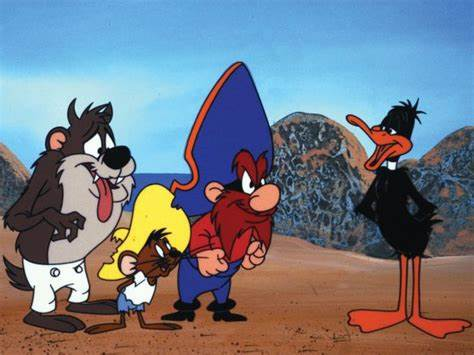
The movie's storyline is a light parody of the TV series Fantasy Island (1977–1984). Daffy Duck and Speedy Gonzales are stranded on a deserted island with nothing to eat but coconuts (which Daffy hates). However pirate Yosemite Sam (with his first mate Taz) is having a battle nearby with Bugs Bunny. This battle ends poorly for Sam and Taz and the two lose their treasure map. Daffy and Speedy find it and it leads them to wishing well that will grant all of their wishes. Daffy decides to take advantage of this and have people (or cartoon animals) from all over come to the island to have their wishes granted, for which Daffy will make a large profit. 

The cartoon shorts included in this movie are Buccaneer Bunny (1948, directed by Friz Freleng), Stupor Duck (1956, directed by Robert McKimson), Greedy For Tweety (1957, directed by Friz Freleng), Banty Raids (1963, directed by Robert McKimson), Louvre Come Back to Me! (1962, directed by Chuck Jones), Tree for Two (1952, directed by Friz Freleng), Curtain Razor (1949, directed by Friz Freleng), A Mouse Divided (1953, directed by Friz Freleng), Of Rice and Hen (1953, directed by Robert McKimson), Lovelorn Leghorn (1951, directed by Robert McKimson) and From Hare to Heir (1960). These are an excellent selection of cartoons and there are many true gems to be found among them. It is hard to think of a Looney Tunes fan being unhappy with this great selection. Yet at the same time these are not the most obvious choices and I really appreciate that. I fell in love with these movies as a kid, largely because they introduced me to shorts that I had not seen a million times on TV. Once more while there is some editing going on (mostly to make the shorts fit better into this movie's story), the majority of them remain very much intact with everything that us Looney Tunes fans have loved about the classic shorts fully on display. Because of this for Looney Tunes fans there are plenty of laughs to be had.  

The new footage may not be as funny as the old footage, it is still quite entertaining. The characters are the same characters we have always loved and just as likable and fun as ever. It is hard not to enjoy spending time with these characters. I especially really enjoyed watching the interactions between Yosemite Sam and Taz. These two may not have ever worked together in the classic shorts, but they work fantastically together and get to really shine here. The storyline also moves at a fast and fun pace and never drags. With the idea of the wishing well, many of the classic cartoons are better integrated here than they were in other Looney Tunes compilation movies. This gives the movie a great flow that makes the feature length go by quickly. However there is no doubt that these new scenes are more charming than they are funny and you won't find yourself laughing as much as the classic cartoon segments. Still these doesn't mean that they aren't quite fun to watch. It also doesn't hurt that the animators for these new scenes included Norm McCabe, Warren Batchelder, Richard Thompson and Bob Bransford, who worked on the classic Looney Tunes and Merrie Melodies as well. Also working on these new scenes are layout artist, Robert Givens and background artist Richard H. Thomas, both of whom worked on the classic shorts. 

While this may not be my favorite of these Looney Tunes compilation movies, there is still a lot to enjoy here. 

The end credits state that the movie is dedicated to writer John Dunn. John Dunn was one of Friz Freleng's favorite writers and came up with the basic story for the movie. He passed away only months before the film was released. 


Tuesday, July 27, 2021

The Bugs Bunny/Road Runner Movie (1979)


The Bugs Bunny/Road Runner Movie is considered by many to be the best of the Looney Tunes compilation movies . It was also a movie that I watched over and over again as a kid and have firmly embedded in my mind. Watching it again today, I still love it just as much as when I was a kid. 

In the late 1970's animation legend Chuck Jones was called back to once again work with the Looney Tunes characters. This began with a couple of TV specials, Carnival of the Animals (1976) and A Connecticut Rabbit in King Arthur's Court (1978). This TV specials had enough success that it was decided to have Chuck Jones head a feature film starring Bugs Bunny. The feature would consist of Chuck Jones most popular Looney Tunes and Merrie Melodies shorts with new animated scenes directed by Jones (and written by his long time collaborator, Michael Maltese) connecting the shorts. Unlike late compilation movies, The Bugs Bunny/ Road Runner Movie does not try to tie these shorts into a storyline. Rather the movie centers around Bugs giving us a tour through his home and remembering his past adventures (the classic cartoon shorts). Much to the delight of cartoon fans everywhere, these cartoons are mostly unedited (except for the opening titles). The exception to this is a great 15 minute compilations of spot gags from the roadrunner cartoons. This structure works extremely well creating a light, breezy and unpretentious feel to this movie that I find hard to resist. 

This movie includes such classic cartoon shorts as Hare-Way to the Stars (1958), Duck Dodgers in the 24 1/2 Century (1953), Robin Hood Daffy (1958), Duck Amuck (1953), Rabbit Fire (1951), Bully For Bugs (1953), Ali Baba Bunny (1957), For Scent-imental Reasons (1949), Long Haired Hare (1949), What's Opera Doc (1957) and Operation Rabbit (1952). There is a reason these cartoons are considered classics. They are comedy masterpieces on the level of anything Charlie Chaplin or Buster Keaton ever made (and with how much I love their movies that is saying a lot). The timing, the humor and the characterizations are all top notch and couldn't be better. 

The new scenes while not on the level of the classic shorts (what could be?) are delightful. Michael Maltese's writing is still very sharp and witty and these new scenes include some easy and fun to quote lines that delight me each time I watch. Having these scenes have the same director as the classic shorts certainly help them transition very naturally into the cartoons (something later compilation movies would have trouble with). Also helping this out is that some of the classic Looney Tunes animators worked on the new scenes including Phil Monroe, Ben Washam, Virgil Ross, Lloyd Vaughan and Manny Perez.

This film unfortunately only received a limited theatrical release and was not a great success there. However it would have quite a bit of success later on TV and home video. The movie would also spawn 4 more compilation features (The Looney, Looney Looney Bugs Bunny Movie (1981), Bugs Bunny's 3rd Movie, 1001 Rabbit Tales (1982),  Daffy Duck's Movie: Fantastic Island (1983), Daffy Duck's Quackbusters (1988)). 


Resources Used

Of Mice and Magic: A History of American Animated Cartoons by Leonard Maltin

The Animated Movie Guide Edited by Jerry Beck


Tuesday, March 9, 2021

The Looney Tunes Compilation Movies


Are the Looney Tunes compilation movies flawed? Yes. Do I absolutely love them? Heck yes.

For those of you unaware well after the golden age of Looney Tunes, Warner Brothers made 5 feature length movies combining the classic cartoon shorts and new animation. These movies are The Bugs Bunny/ Road Runner Movie (1979), The Looney Looney Looney Bugs Bunny Movie (1981), Bugs Bunny's 3rd Movie: 1001 Rabbit Tales (1982), Daffy Duck's Movie: Fantastic Island (1983) and Daffy Duck's Quackbusters (1988) (I am not including Bugs Bunny Superstar (1975), because the film is a documentary with no new animation). The first of these was directed by Looney Tunes legend Chuck Jones. The next three were directed by another classic Looney Tunes director, Friz Freleng. The last was the only directed by people who did not work on the classic Looney Tunes shorts, Greg Ford and Terry Lennon. 

As a kid these movies were just as much of a part of my Looney Tunes diet as any of the classic shorts were. Kids have the ability to watch the same movies over and over and never grow tired of them and that is just what I did with these movies. As such these features have become and remain just as much of a part of my Looney Tunes vocabulary as any of the classic shorts. Since I got into these movies as a kid, they actually served as my introduction to some shorts that weren't on TV as often (Mexican Borders (1962), The Pied Piper of Guadalupe (1961), The Unmentionables (1963), Curtain Razor (1949), Catty Cornered (1953))  still whenever I watch those shorts I think of these features. Childhood is probably the best time to be introduced to these movies (though they are aimed just as much at all audiences as the old shorts). When you are a kid you are not a film critic but rather someone simply looking to be entertained. The faults of these movies may be obvious but none of them stop the films from being incredibly entertaining. The classic cartoons are just as funny as ever when watched as part of a feature length movie and while the new scenes do not reach the heights of the classic cartoons they are still entertaining in their own way. The largest faults come from the connection of the old and the new. The animation is obviously better in the old and Mel Blanc's voice has aged. This can make it all too obvious what is old and what is new and therefore disrupt the flow of the movie. There are also times when the inclusion of certain cartoon shorts can feel forced into a movie's story. However while these faults may be very noticeable to the film critic in me, they make little difference to the movie fan in me. Every time I watch these movies I find me enjoying myself too much to care about these faults. That is why they remain common choices for watching movies at home for me (I hope that one day I can see these on the big screen).

These movies may not be for purists and I fully understand anyone who doesn't like them. However I admit that I not only like them but love them.   


Tuesday, October 15, 2019

Daffy Duck's Quackbusters (1988)

The Bugs Bunny/ Roadrunner Movie (1979) started a series of Looney Tunes feature films. These films are often today called the compilation films. The reason for this is very simply. They use new footage to tie together old Looney Tunes and Merrie Melodies cartoon, creating a new feature length narrative. None of these films do this better than Daffy Duck’s Quack Busters. As a huge Looney Tunes fan, of course I love watching the classic short films used here. Looney Tunes and Merrie Melodies will always remain some of the greatest cartoons ever made, and they are such a joy to watch in this movie. However while not as brilliant as the short cartoons, the new footage here is quite good. I found myself laughing a few times at this story, and not just light chuckles either. The story here also brilliantly ties the cartoons into this story. The cartoons fit perfectly into the story and none of them feel like they are just there to fit another great cartoon in.

One of the things I love about this movie is that the shorts are not your typical best of Looney Tunes shorts. These is no Duck Amuck or What’s Opera Doc here. However this shorts are still complete classic shorts that hold up extremely well. The shorts include Daffy Dilly (1948), The Prize Pest (1951), Water Water Everyhare (1952), Punch Trunk (1953), Claws for Alarm (1954), Jumpin’ Jupiter (1955), Hyde and Go Tweet (1960), The Abominable Snow Rabbit (1961) and Transylvania 6-5000 (1963). A delightful line up if I do say so myself.

This film was the first of these compilation features to have the new footage not directed by one of the directors from the golden age of Looney Tunes. The directors were animation historian Greg Ford and cartoon director Terry Lennnon. These two had previously made a very funny theatrical Daffy Duck short called The Duxorcist (1987) (which was also used in this feature). While exploring the Warner Brothers vaults, Ford found several recordings Carl Stalling and Milt Franklin made for 1950’s Looney Tunes and Merrie Melodies cartoons. These scores where used as backing music for the new scenes making them feel more like the classic cartoons. These recordings were later used for the CD set, The Carl Stalling project. The animators of the new scenes for this movie where some of the best of the then current generation. These include Mark Kausler (Heavy Traffic (1973), Beauty and the Beast (1991), Looney Tunes Back in Action (2003)) Brenda Banks (Lord of the Rings (1978), American Pop (1981), The Smurfs (1981-1990)) Daniel Haskett (The Brave Little Toaster (1987), The Little Mermaid (1989), Toy Story (1995) and Darryl Van Citters (The Fox and the Hound (1981), Box Office Bunny (1990), The Tom and Jerry Show (2014-2019). Also animating on the new scenes was an old veteran Norm McCabe who was an animator and director during the golden age of Looney Tunes.

The only complaint I have about this film is that Mel Blanc’s voice has obviously aged (This and Who Framed Rodger Rabbit (1989) marked his last times voicing the Looney Tunes characters). With this it is all too easy to tell what new footage is and what is old due to the sound of his voice alone.

This is simply a wonderful movie.   

-Michael J. Ruhland

Resourses UsedThe Animated Movie Guide Edited by Jerry Beck