Showing posts with label King of Jazz. Show all posts
Showing posts with label King of Jazz. Show all posts
Monday, March 6, 2023

Sunday, February 19, 2023
Sunday, November 17, 2019
Jazz Legends on Film #1
Hello my friends. I don't know about you guys but being a fan of classic films has introduced me to a lot of great vintage music. For instance I don't think I would listen to jazz music if it wasn't for great old films. When talkies came about jazz was at the height of its powers and many music fans wanted to see their favorite jazz musicians performing on screen. Because of this many true legends of jazz appeared in films. Today (and a few days in the future) I am going to share with you some great examples of jazz music in classic films.
If you had to ask me what the best jazz film ever made was, I would have to go with Jammin' the Blues (1944). While most short subjects featuring popular musicians performing, simply placed the camera in front of the performers and let them play. This film does not do that at all. Instead director Gjon Mili and cinematographer Robert Burks (who my fellow film buffs will know went on to become Alfred Hitchcock's cinematographer on many of his most famous films) create a visually unique and jaw dropping film. The music is jazz music at its finest featuring such great musicians as Lester Young, Red Callender, Harry Edison, Matthew Morris, Sidney Catlett, Joe Jones, Barney Kessel, John Simmons, Illinois Jacquet and Marie Bryant. A review in The Exhibitor said "Lighting, camera work and direction by Gjon Mili are first rate."
Unusual for a short subject this film received a three page article in American Cinematographer. You can read this below. If any of the pages are hard to read you can click on them and use your touch screen to zoom in.
If you had to ask me what the best jazz film ever made was, I would have to go with Jammin' the Blues (1944). While most short subjects featuring popular musicians performing, simply placed the camera in front of the performers and let them play. This film does not do that at all. Instead director Gjon Mili and cinematographer Robert Burks (who my fellow film buffs will know went on to become Alfred Hitchcock's cinematographer on many of his most famous films) create a visually unique and jaw dropping film. The music is jazz music at its finest featuring such great musicians as Lester Young, Red Callender, Harry Edison, Matthew Morris, Sidney Catlett, Joe Jones, Barney Kessel, John Simmons, Illinois Jacquet and Marie Bryant. A review in The Exhibitor said "Lighting, camera work and direction by Gjon Mili are first rate."
Unusual for a short subject this film received a three page article in American Cinematographer. You can read this below. If any of the pages are hard to read you can click on them and use your touch screen to zoom in.


Next comes a classic short subject starring the King of Hi De Ho himself, Cab Calloway. This film is called Cab Calloway's Hi De Ho (1934). The story isn't much to write home about but the music is fantastic. However I will admit I really like the ending gag.
The feature film Stormy Whether (1943) featured quite a few jazz greats in it, including the one and only Fats Waller. Here is Fats Waller performing Ain't Misbehaving in that movie.
Many vintage music fans are familiar with the Vitaphone Varieties. This was a series of short films from the late 1920's and early 1930's that featured various musicians and vaudeville acts performing in front of the camera. While few of these are cinematic masterpieces, they give us a great glimpse into a type of entertainment that is gone today. Here is a typical Vitaphone Variety, Jazzmania Quintette (1928). This film features the jazz violinist Georgie Stoll as well as Edythe Flynn.
I have not been shy about my love for the Paul Whiteman feature film, King of Jazz (1930). Here is the great Rhapsody in Blue scene in that movie.
One of the all time great film scores is for Louis Malle's Elevator to the Gallows (1958). The score for this movie was done by the one and only Miles Davis. Here is a scene from the movie featuring some great music by Miles.
Thanks for joining me, I will have more of these posts in the future.
-Michael J. Ruhland
Friday, August 30, 2019
Rereleasing "King of Jazz"
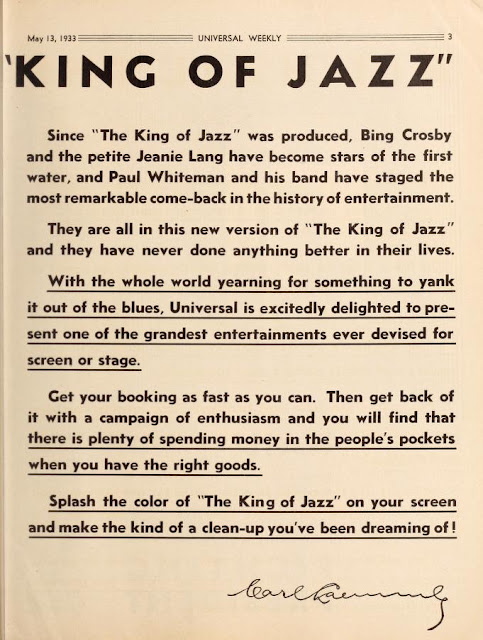
I have a real fondness for the movie, King of Jazz (1930). It is a one of a kind movie with lots of great music and an excellent cartoon segment from the Walter Lantz Studio. This movie was just as loved by audiences back in its day and was rereleased in 1933. That version added newly filmed comedy sequences but also cut nearly 35 minutes.
The following page from Universal Weekly shows various ways this movie was advertised upon its rerelease.

The following is a 1933 article about the film from Universal Weekly.


Next is an advertisement for King of Jazz from the Universal Weekly.
As you can see by this follow page of Universal Weekly this was not the only 1930 Universal movie rereleased in 1933. Also rereleased that year was All Quiet on the Western Front (1930) and Captain of the Guard.

One last article from Universal Weekly. The line "No producer in these times could afford to a picture near as costly as was 'King of Jazz,'" seems odd considering the movie was only three years old at this point.


Now let's enjoy some great music from the movie. First is George Gershwin's Rhaposdy in Blue.
Now for So the Bluebirds and the Blackbirds Got Together. This song is performed by The Rhythm Boys (Bing Crosby, Harry Barris, Al Rinker)
We end our post with the cartoon segment for the movie. This was created by the Walter Lantz studio, and at the time their starring character was Oswald the Lucky Rabbit who can be seen briefly here.

The following page from Universal Weekly shows various ways this movie was advertised upon its rerelease.

The following is a 1933 article about the film from Universal Weekly.

Next is an advertisement for King of Jazz from the Universal Weekly.

As you can see by this follow page of Universal Weekly this was not the only 1930 Universal movie rereleased in 1933. Also rereleased that year was All Quiet on the Western Front (1930) and Captain of the Guard.


Now let's enjoy some great music from the movie. First is George Gershwin's Rhaposdy in Blue.
Now for So the Bluebirds and the Blackbirds Got Together. This song is performed by The Rhythm Boys (Bing Crosby, Harry Barris, Al Rinker)
We end our post with the cartoon segment for the movie. This was created by the Walter Lantz studio, and at the time their starring character was Oswald the Lucky Rabbit who can be seen briefly here.
Friday, May 3, 2019
Bing Crosby Songs From the Movies
Today is the birthday of the one and only Bing Crosby. To celebrate today we will look at a selection of Bing performing some great songs in the movies.
Our first song is from Bing's film debut, a delightful movie that is just starting to get the attention it deserves recently, King of Jazz (1930). This movie is pretty much the movie equivalent of a TV variety show. There is no story, but instead just a bunch of musical numbers and comedy skits. The film would star the man who at that time was known as the King of Jazz, Paul Whiteman and his orchestra. At this time Bing had not yet begun his solo career instead he was part of the vocal trio The Rhythm Boys. At this time the group was touring with Paul Whiteman so they ended up appearing in the picture. The following is a song from the movie that featured them. This is the extremely catchy Happy Feet written by Milton Ager and Jack Yellen. If this song doesn't make you want to dance nothing ever will. Now we have a delightful song from the often overlooked movie Double or Nothing (1937). This song, The Moon Got in My Eyes features Bing performing without any instruments but instead with a band of singers taking the place of the backing instruments. In the film they were called the sing band. This song was written by Johnny Burke and Arthur Johnson. A year before this film, Bing had recorded another song by these two, one of his most popular songs, Pennies From Heaven. Next comes Bing performing one of my favorite songs he recorded, Moonlight Becomes You. Johnny Burke served as one of the writers on this song as well. He cowrote it with James Van Heusen. The would also write together such major hits for Bing as Swinging on a Star, Sunday Monday or Always and Going My Way. This version of Moonlight Becomes You is from Road to Morocco, one of the series of fantastic "Road" movies Bing made with Bob Hope. Last is Bing Crosby performing the Cole Porter song, That's Jazz with Jazz legend Louis Armstrong in the movie, High Society (1956), a musical remake of the classic The Philadelphia Story (1940). I admit to preferring The Philadelphia Story but this is a great musical number.
-Michael J. Ruhland
Saturday, September 22, 2018
Overlooked Classics: My Pal Paul (1930)


A movie that is happily getting more attention lately is King of Jazz starring Paul Whiteman. This is an excellent film, with many great songs, some corny but funny comedy and a lovely two stirp Technicolor look. One of the highlights of that movie is a brief animated sequence from Walter Lantz about how Paul Whiteman was crowned the King of Jazz. This sequence was fast paced, funny and represented Lantz and his team at its best. This sequence however was not Walter Lantz's only work that had to doe with King of Jazz. Lantz also made a Oswald the Lucky Rabbit cartoon that was in many ways an advertisement for the feature film.
This cartoon was titled My Pal Paul. As this film starts a silhouette resembling Paul Whiteman is standing in front of a billboard poster for King of Jazz. This silhouette turns around and reveals himself as Oswald. Oswald is playing a dog's tail as a musical instrument with a bow similar to what Mickey Mouse did with a cat two years earlier in Steamboat Willie. However a small dog finds that Oswald is not really playing the music as he discovers a record player underneath Oswald's "bandstand." All the animals in the barnyard make fun of Oswald and this upsets Oswald so much he decides to hang himself. He is stopped by none other than Paul Whiteman. Oswald decides to show off to his new pal by taking apart Paul's car and playing each part as a musical instrument. They join together in a jam session that includes songs from King of Jazz, such as Happy Feet, Song of the Dawn (Written by Jack Yellen and Milton Ager), It Happened in Monterey (Written by Billy Rose and Mabel Wayne) and Ragamuffin Romeo (Written by Mabel Wayne and Harry Da Costa). This is all fun until Paul realizes what his "pal" has done to his car.
It seems that many of the best Walter Lantz cartoons center around music, whether classical or jazz. There is something about music that always seemed to bring out the most energy in the films of this studio. One only has to think of the great Swing Symphony cartoons or the Woody Woodpecker classics Barber of Seville and Convict Concerto. My Pal Paul is no exception. James Dietrich's music direction here is fantastic as it is in all these early Lantz cartoons. There is a sense of pure fun and energy in this cartoon that I find irresistible. While the animation itself doesn't reach the level of what Disney was doing at this time, it is well above average for a Lantz short of this time. Adding to the fun of fun is that we get to here Paul Whiteman's real voice here singing some of the songs.

Also working on this film is a great crew of animators. Animating here are Ray Abrams, Bill Nolan, Clyde Geronimi, Manuel Moreno and Pinto Colvig. Geronimi would become a legendary Disney animator and director. He would go on to codirect such films as Cinderella, Alice in Wonderland, Peter Pan, Lady and the Tramp and 101 Dalmatians. Abrams would continued animating for Lantz all the way through the 1950's. Nolan was an incredible animator who played a huge role in this early Lantz cartoons, and he would go onto to become an important animator and director for the Fleischer studio and later Famous Studios. Moreno would spend most of his career animating on these 1930's Lantz cartoons. Though Colvig worked as an animator for Lantz and as a writer for Fleischer, he is probably best remembered as the voice of Goofy for Disney.
Though many today recognize Oswald as a Disney character at this time he was not. Walt Disney would learn that he did not actually own the rights to Oswald, and after refusing to take a pay cut would have the character taken away from him. The man who was responsible for taking the character away was Charles Mintz. However Universal which was distributing these cartoons took the character away from him and gave it to the head of their new animation department, Walter Lantz, who would continue making Oswald cartoons until 1943.
This cartoon can be found on the Criterion release of King of Jazz along with another Lantz Oswald entitled Africa which features animation that is reused from the animated segment of King of Jazz. My Pal Paul can also be found on youtube.
-Michael J. Ruhland
Subscribe to:
Posts (Atom)