Showing posts with label Roscoe "Fatty" Arbuckle. Show all posts

Wednesday, July 1, 2026

Silent Film of the Month: Tillie's Punctured Romance (1914)


Run Time: 82 minutes. Studio: Keystone. Director: Mack Sennett. Writer: Hampton Del Ruth. Based off of the stage play Tillie's Nightmare by Edgar Smith and A. Baldwin Sloane. Producer: Mack Sennett. Cast: Marie Dressler, Charlie Chaplin, Mabel Normand, Mack Swain, Charles Bennett, Douglas Banks, Chester Conklin, Edgar Kennedy, Charles Parrott, Glen Cavender, Harry McCoy, Phyllis Allen, Gordon Griffith, Rube Miller, Billie Bennett, Frank Opperman, Nick Cogley, Fritz Shade, Morgan Wallace, Charlie Murray, Minta Durfee, Hampton Del Ruth, Hugh Saxon, Fred Fishback, Ted Edwards, Hank Mann, George "Slim" Summervillie, Al St. John, Edwin Frazee, Bill Hauber, Dan Albert, Billy Gilbert, Robert Kerr, Alice Howell, Eva Nelson, Dixie Chene, Wallace McDonald, Alice Davenport, Eddie Nolan, Grover Ligon, Josef Swickward, Frankie Dolan, Dick Smith, Meiklejohn and Hazel Allen, Helen Carruthers. 

Often referred to as the first feature length comedy, Tillie's Punctured Romance is far from an obscure film. Yet at the same time, I often feel that it gets too overlooked. Many tend to just view it as a footnote in film history. Even with Charlie Chaplin in it, dedicated Chaplin fans tend to not discuss this movie and instead prefer to look at Chaplin's later features that he directed and wrote. This may not be on the same level as such masterpieces as The Gold Rush (1925) or City Lights (1931). However, it is a comedy that is over a century old and is still quite entertaining. That definitely accounts for something.

In this film, a con man (Charlie Chaplin) from the city tricks a naïve country woman (Marie Dressler) to flee to the city with him. As soon as the con man gets her money, he leaves her flat. When he discovers that the woman is heir to a large fortune, he comes back to her having had "a change of heart."

The storyline for this film is pure melodramatic hokum. This is not by accident nor is this lazy writing. From its very start the Keystone studio made short films that were parodies of melodramas, using these familiar storylines that were often taken seriously and use them as an excuse for slapstick comedy. It is no wonder that the studio's first feature length movie would also parody melodramas. Adapting the stage play Tillie's Nightmare was a perfect idea for the studio's first feature length movie as the stage play didn't take these melodramatic conventions very serious either. 

For fans of silent comedy, this movie is a delight. Of course, one of the treats is to see so many silent comedy greats in one film. Cinephiles can have a great time seeing just how many silent comedy stars, they can catch and name. Another delight is to see Charlie Chaplin play against type. He is wonderful as the villainous conman here. His performance is a bit more over the top than he often is as his famous Tramp character. However, this is just what the movie calls for, and he does a great job. He commands the screen every time he appears. 

While most of the gags here may not be as laugh out loud funny as some later silent comedies, many of them do get some good chuckles and there is a great sense of comic momentum that lasts through the whole movie. Many of these gags may be simplistic and crude but they are delivered with such dedication, and zest that they actually work. There is such a lighthearted playful spirit here, that even when you don't laugh at a gag, you still enjoy it. The comedic highlight however is the whole climatic chase with the Keystone Kops getting involved. This chase is silent comedy making as its finest. There are so many slapstick gags in this finale and many of them are quite funny and creative. This climatic scene alone would make this movie essential watching for silent comedy fans. 

Another creative and charming scene involves Charlie Chaplin and Mabel Normand's characters sitting in a movie theater watching a film that greatly resembles what has been happening in their lives. This scene is not especially funny, but it is still delightful. I have always been a sucker for a well-used film in a film, and this is an early example of just that. Not only is the film in a film quite entertaining in its own right but it is a delightfully fun and creative way to express what is going on the characters' minds.  For cinephiles, it is also a delight to get a glimpse into what the movie going experience was like in the 1910's.


The play, Tillie's Nightmare, itself was very popular. At the Herald Square Theatre (1331 Broadway (29 W. 35th St.), New York, NY), it ran from May 05, 1910, to Jul 09, 1910. At the Manhattan Opera House (30 Lincoln Center Plaza, New York, NY) (now Manhattan Center), it ran from Dec 18, 1911, to Dec 23, 1911.  Director, producer and studio head, Mack Sennett stated in his autobiography, King of Comedy, that scenario editor Craig Hutchinson had suggested to make an adaption of the play. The play was a musical, well-known at the time for the song Heaven Help the Working Girl, and naturally a lot had to be changed from stage to screen. Sennett recalled that Hampton Del Ruth and a team of other writers used only the play's story as a loose guideline.     

The star of stage play was Marie Dressler. Dressler was a very popular stage actress, and Tillie's Nightmare had been her greatest stage success. Mack Sennett mostly planned to fill the movie's cast with Keystone regulars, but he did want Dressler to reprise her role on screen. This had not been Sennett's first interaction with Dressler. When Sennett was a young novice in the entertainment industry, Dressler had helped the young man. She wrote him a letter of introduction to David Belasco (a popular theatre producer and playwright). Later Sennett would claim that Dressler moved to California to make this movie. Dressler however denied such claims, stating that she moved to California because of her nerves after a recent failure in her stage career.  

Sennett would meet Marie Dressler outside a movie theater. They agreed to meet a hotel to discuss the film project. During the hotel meeting Marie Dressler agreed to work for $2,500 a week (for comparison Charlie Chaplin was being paid $200 a week). During this meeting there seemed to be a verbal agreement that Dressler would own half the film and her husband, James Dalton, would distribute it. This is not how things worked out. Though Sennett was in charge of the studio's production, the Keystone company was actually created and owned by Adam Kessel and Charles Bauman from the New York Film Company. Kessel and Bauman would sell the distribution rights to the Alco Film Corporation. Because of this, Dressler took legal action against the Keystone Studio, but this was ultimately unsuccessful. 

Filming began in late April 1914 and wrapped up late July of the same year. There would be some delays in filming. Of these delays Glenn Mitchell writes in The Chaplin Encyclopedia, "The main difficulty lay in Miss Dressler's memory of him [Sennett] as an unknown, rather than as the boss of a studio, and consequent unwillingness to take direction until baffled by the techniques of filmmaking." 

Much of this movie was filmed on location in Hollywood. Anyone has been to Hollywood recently will find it unrecognizable watching this film. At the time, Hollywood was not the major city that it is today. However certain buildings can still be seen today. 

One of these is The C.E. Toberman Building (6410-6146, Hollywood Boulevard), which can be seen when two cops meet Tillie in the middle of the street after Tillie gets drunk as well as when Charlie falls in the middle of the street and Tillie picks him up. The same building can be seen in the classic Harold Lloyd feature, Why Worry (1923), when Harold announces to his giant friend that he is going to be a father. A shot of the back of this building can be seen in Buster Keaton's classic comedy short, The Goat (1921). 

When Tillie waves to a cop flirtatiously, she is standing on the porch of the Hollywood Hotel. This hotel was located on the northwest corner of Hollywood and Highland. At one time this hotel was a center for the social life in Hollywood. However, it would be demolished in 1956. There today is the Hollywood & Highland Retail and Entertainment Center. 

 When two cops are escorting a drunk Tillie into the police station, they are actually taking her to the entrance door for the Keystone Studio. This was also used as an entrance to a police station in the Roscoe "Fatty" Arbuckle short, Fatty's Plucky Pup (1915). It even appeared as the entrance to a dentist's office in the Charlie Chaplin short, Laughing Gas (1914). 

When Tillie flirts with a cop after being released from jail, she is on Duane Street by the back corner of the wall for the Selig studio (the first permeant movie studio in Los Angeles). You can also see two homes in these shots. The homes were 2212 and 2216 Duane Street, both of which are now apartment buildings. 

The entrance to Tillie's wealthy uncle's place is Castle Sans Souci, which had formerly been located at 1901 Argyle. It was torn down in 1928 and the Castle Argyle Apartments, which are still standing today. 

During the climax, you can see in the background the original Los Angeles Fire Engine Co. No. 20, which was located at 2144 Sunset. You can also see this in the background of the Charlie Chaplin short, Cruel, Cruel Love (1914). 

Comedian Milton Berle often times claimed to be a newsboy in a brief scene. This has been greatly disputed with many historians crediting the role to child actor Gordon Griffith. Later Griffith approached Charlie Chaplin and described the scene he claimed they made together, while Chaplin was filming A Countess from Hong Kong (1968). Chaplin just unenthusiastically stated, "oh I see ... exposition" and then went back to work. 

Moving Picture World, 1915


Moving Picture World, 1915


This film was reissued to theaters in 1920. The following is an article about this reissue from an issue of The Moving Picture World (dated January 17, 1920).

"From W.H. Productions comes information that 'Tillie's Punctured Romance' is being revived by Tower Film Corporation. This Mack Sennett favorite, featuring Charlie Chaplin, Marie Dressler, Mabel Normand, Mack Swain and Chester Conklin, has a great reputation to be revived with the showings. 

"It early accomplished what the 'glooms' argued couldn't be done - that the screen could make people laugh. Yet thousands laughed at 'Tillie's Punctured Romance.' This production mad history for screen comedy and records for exhibitors and exchange men.

"A special exploitation campaign, unique in character and destined to put the picture over in an even bigger way than heretofore is being planned. This will include new advertising material of every description, new posters, lobby photos and displays. 

"'Tillie's Punctured Romance' is one of the pictures which serves as sort of a high watermark in box office receipts by which others are measured. 'As big a winner as 'Tillie'' or 'as good as 'Tillie,'' are expressions of motion picture exchange men and exhibitors. Seldom does the independent market get unusual money makers, and when they do, they are not soon forgotten. 

"A special exploitation and press sheet is now being prepared for 'Tillie,' containing copies of newspaper cuts, special advertisements, press stories, catch phrases, exploitation ideas, suggestions and special 'stunts.' Every aid that can be given to the exhibitor to put this picture over as provided."


Moving Picture World, 1920


The movie was so popular that it spawned three sequels Tillie's Tomato Surprise (1915), Tillie Wakes Up (1917), and The Scrub Lady (1917), all of which featured Dressler reprising her role. The film would also be remade in 1928 with the same title. That remake would star Louise Fazenda, W.C. Feilds and Chester Conklin. Unfortunately, that remake is considered lost. 

You can watch this movie on YouTube below. 


Resources Used

The Chaplin Encyclopedia by Glenn Mitchell.  

A-Z of Silent Film Comedy by Glenn Mitchell

Chase! A Tribute to the Keystone Cops edited by Lon and Debra Davis


Sunday, November 9, 2025

The Complete Films of Buster Keaton (1993)


Many writings on Buster Keaton tend to focus on his silent movie work. It is very easy to see why. During the silent era, Buster enjoyed the most creative freedom over his films. It was also during this time that Buster released what are considered his greatest masterpieces. However, Buster had a much longer career, and one should not overlook his sound films. Even if his sound films never reached the heights of his silent work, there are moments of Keaton brilliance found in them.

This is why I greatly appreciate Jim Kline's book, The Complete Films of Buster Keaton. As the title states, this book covers every single film Buster Keaton ever made ranging from The Butcher Boy (1917) to The Scribe (1966). After an introduction giving an overview of Buster's career, this book adopts a very simple format. It goes over each film individually and in order. For each film Kline provides a list of credits, a story synopsis, his own personal opinion on the film and some background information. All this makes for a fun, easy and approachable read. While I greatly enjoyed reading about the all the classic silent films here, it was the looks at the underdiscussed talkie films that made me love this book. Though very well-written everything he has to say about the silent films has also been said in other books. However, to read such well-written reviews of such little discussed films from the career of one of the movies' finest comedic talents is truly fascinating. I especially enjoyed his reviews of Buster's shorts for Colombia, where Three Stooges director/producer Jules White gave Buster material more fitting of the Stooges (though as us Stooge lovers know, White was hardly the Stooges' best director). However with his writings about Buster’s silent era work, I enjoyed what the author had to say about the early shorts he made with Roscoe "Fatty" Arbuckle as he gives great insight into how both comedians' personal styles came together to create these films. 

One thing you can't hold against this book is that there has been a lot of research done since it was written, therefore film buffs may know more about Buster's most popular films than is said here. 

This is a delightful read for any fan of classic movie comedy. 


Tuesday, October 21, 2025

Hello Mabel Normand

 I am sure at least some of you reading this blog have a familiarity with Mabel Normand. She is often times considered the best female comedian of the silent era and many of her films are still very entertaining today. She has even been referred to as the female Chaplin (her and Charlie Chaplin even worked together in a few films). 

Here is a 1921 article from Photoplay magazine about the great comedian. If you have any trouble reading the following pages, click on them and use your touch screen to zoom in. If you don't have a touch screen click here. 


Now enjoy a classic silent comedy short starring and co-directed (with Mack Sennett) by Mabel Normand, Mabel at the Wheel (1914). This film also features Charlie Chaplin in a villainous role that differs greatly from the little tramp. 


The following is a review of Mabel at the Wheel from Motion Picture News Magazine.

"'Mabel at the Wheel.' (Keystone. Two Reels, April 18) - This is an excellent burlesque on the 1914 Grand Prix automobile race. It is a laugh from start to finish. The last reel, taken up with the race, is well produced; some of the scenes make the spectator firmly grasp for breath, notwithstanding that it is a burlesque all the way through.

"The outline of the story: the villain after many attempts succeeds in capturing the hero, who is to run in the race, and tying him up so that he can't start. 

"Mabel the fond sweetheart of the hero, rises to the occasion and runs the car herself. The villain tries in many ways to wreck her and the car. Throwing bombs on the track and wetting it are two of his fiendish plots. But his efforts were to no avail, and the girl wins the race amid great rejoicing."


Motion Picture News, 1917


Let us end this post with another high-speed silent comedy starring Mabel Normand, The Speed Kings (1913). 


Monday, September 29, 2025

Happy National Silent Movie Day

 Hello everybody. It is once again that wonderful holiday, National Silent Movie Day. 

Let us start this holiday themed post with the most famous name in silent movies, Charlie Chaplin. 


Charlie Chaplin is considered to be one of the big four of the silent film comedians. The other three are considered Buster Keaton, Harold Lloyd and Harry Langdon. 


Of course there are other great silent movie comedians including Mabel Normand, Roscoe "Fatty" Arbuckle, Laurel and Hardy and of course the Keystone Cops. 


Of course there were some great dramatic filmmakers during the silent era such as D.W. Griffith, Lois Webber and F.W. Murnau. 


I am a big fan of J.B. Kaufman and Russell Merritt's book, Walt in Wonderland: The Silent Films of Walt Disney. 


Now for some of Walt Disney's silent films themselves. 


Of course I am an avid watcher of TCM's Silent Sunday Night. 


My favorite place to watch silent movies is Old Town Music Hall in El Segundo, California, where all silent films are accompanied by the Mighty Wurlitzer Pipe organ. 


Thursday, June 5, 2025

Charlie Chaplin Carnival #5

 Hello my friends and welcome back for another selection of short films from my favorite filmmaker, Charlie Chaplin. 

Today's selection begins with a true classic of silent comedy, Shoulder Arms (1918). This was the most popular Chaplin film up to this time and for years, reviewers would use it as a yardstick to measure all the Chaplin films to follow. This film began production being planned as a five-reel feature (an issue of Pictures and the Picturegoer stated that it would be only three weeks before it was released in the U.S.). This feature would have shown Charlie before, during and after the war. However, Charlie eventually decided to trim this down to only the middle section, making the film a three-reel short. Even scenes during this middle section were trimmed though. Stills from a scene with Charlie having his army medical were used as publicity over the years, though this scene does not appear in the final film. 


Exhibitor's Herald, 1918


The Film Daily, 1918

Up next is a very early Chaplin film, A Flim Johnnie (1914). For movie buffs this film is a wonderful document. The short gives us a great look at the movie going experience, well over a century ago. This is especially seen in the early scenes in a movie theater, which looks quite different from a movie theater today to say the least. This short also does a great job at parodying the rising fan culture and the fame the emerging movie stars were just starting to have. This short was directed by George Nichols. Known as Pop, Nichols was a veteran of the early days of the movies. After the clashing between Charlie and director Henry Lehrman, Nichols would briefly become Chaplin's director. Charlie felt that Nichols' comedy ideas were already outdated. Charlie would state that Nichols' comedy ideas consisted of "one gag, which was to take the comedian by the neck and bounce him from one scene to another." Also seen in this film were Virginia Kirtley (as the "Keystone Girl"), Roscoe "Fatty" Arbuckle, Ford Sterling, Edgar Kennedy and Minta Durfee. Virginia Kirtley was the leading lady in Chaplin's first film (Making a Living (1914)). In 1916 she would marry comedian Eddie Lyons and would co-author some of the films that teamed him with Lee Moran at Nester comedies before soon retiring (in 1917) after giving birth to a daughter. In 1928 (two years after Lyon's died early from appendicitis), she tried to make a comeback to the screen but this attempt was unsuccessful. She would live until 1956, when she would pass away at the age of 67 in Sherman Oaks, California. Minta Durfee was Roscoe "Fatty" Arbuckle's first wife. Though their marriage did not last, the two remained on good terms and she helped Roscoe when he was falsely on trial for raping and murdering a young woman (a scandal that would ruin his movie career). 


Next is another early Chaplin short, His New Profession (1914). In later films Charlie Chaplin's character would be one who would very much receive the sympathy of his audience. This film however does not care if you like the little Tramp. In fact, the Tramp is actively unlikable here. Without an ounce of sentimentality or pathos here, this short is typical of the knockabout nothing is sacred type of comedy that the Keystone studio churned out on a regular basis. Though this is not one of the great comedian's best films, it provides a great look into the work of an artist before his art had become fully formed.  


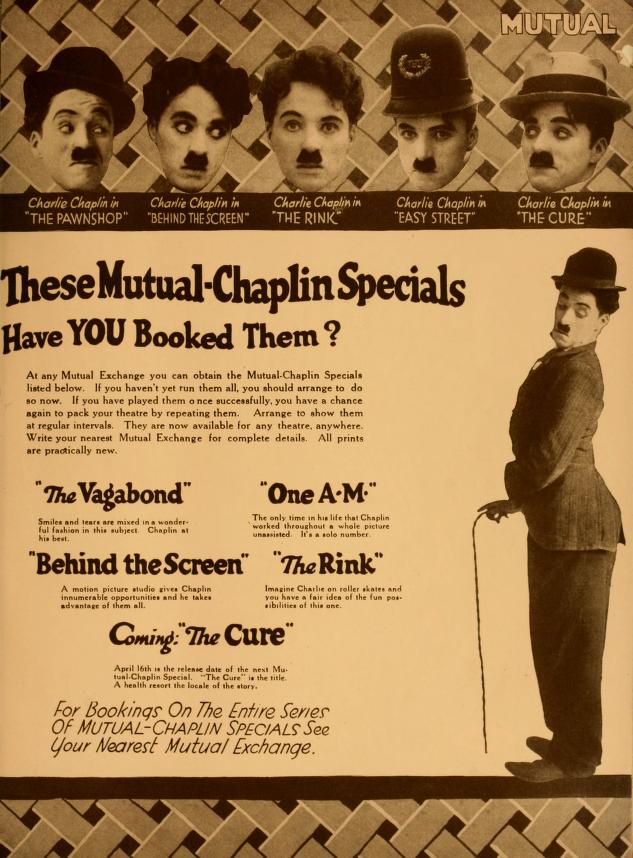
Today's selection ends with Behind the Screen (1916). A pure slapstick classic, this film shows Charlie at his best. The comedy also features a top-notch supporting cast of Chaplin regulars. The film's villain is played by Eric Campbell, a large and heavy man, Campbell dwarfed the already fairly small Charlie Chaplin. This made him an imposing villain, who automatically made our sympathies with Chaplin. He played the villain in multiple Chaplin films and was probably Charlie's best on screen villain. In 1917, Chaplin had loaned Campbell to appear in a dramatic role in a Mary Pickford movie, Amarilly of Clothes-Line Alley (1918). Three days into the shooting of that film Campbel was driving home from a party after having too much to drink. He was driving 60 mph on the wrong side of the road and ended in a collision that ultimately killed him. He was only 38 years old. He appeared in 11 classic Chaplin comedies. Charlie's romantic interest was played by Edna Purviance, who played his love interest in most Chaplin films made during this period. Chaplin later directed her in a dramatic role in the feature film A Woman of Paris (1923). She would remain on Chaplin's payroll long after she stopped appearing in his films. Also featured in this film are Frank J. Coleman, Henry Bergman, Charlotte Mineau, Albert Austin and John Rand. All of these actors were Chaplin regulars. Coleman would even play multiple roles in some Chaplin films such as The Vagabond (1916) and The Count (1916). As well as appearing many Chaplin films Bergman also is credited as assistant director in what many consider the filmmaker's masterpiece City Lights (1931). After working in some of Charlie's many comedy shorts, John Rand would disappear from Chaplin's filmography for a while. However, he would later reappear in some of Chaplin's best feature films such as The Circus (1928), City Lights and Modern Times (1936). Albert Austin had worked with Chaplin before Charlie ever made a film as they were both worked for English Music Hall impresario Fred Karno (Stan Laurel was Chaplin's understudy during these years). Like Bergman, Austin would also receive an assistant director credit on City Lights. Austin also has a major role Mary Pickford movie, Suds (1920). 


Thanks for joining me. Stay around for more Chaplin and classic films in general. 

Resources Used


The Chaplin Encyclopedia by Glenn Mitchell.  

https://lantern.mediahist.org/


Wednesday, May 21, 2025

The Great Movie Comedians (1978)


Well written and well researched Leonard Maltin's 1978 book remains essential reading for all fans of classic movie comedy. 

The book starts with an introduction that discusses the work of silent film comedians that do not receive their own chapters later in this book. This introduction is just as much essential reading as what follows. Offering a brief history of some of these forgotten clowns and how they contributed to the broad history of screen comedy, while also explaining what keeps them from entering into the pantheon of "Great Movie Comedians" like those that receive their own chapters here makes for compelling reading. Quotes for those who worked with these comedians firsthand provide even greater insight to who these comedians were and what comedy filmmaking was like in the silent era. This is one of the rare books where I wish that the introduction had gone on longer. 

The actual chapters cover 22 of the best comedians (or comedy teams) to ever grace the silver screen. These are Charlie Chaplin, Mabel Normand, Roscoe "Fatty" Arbuckle, Buster Keaton, Harold Lloyd, Harry Langdon, Charley Chase, Raymond Griffith, Marie Dressler, Laurel and Hardy, Will Rogers, Joe E. Brown, The Marx Brothers, W.C. Feilds, Mae West, The Three Stooges, Abbott and Costello, Bob Hope, Danny Kaye, Red Skelton, Jerry Lewis and Woody Allen. Each of this chapters provides a brief history of the comic's career, some critical insight and a filmography. The critical insight truly shows Maltin's talent as a critic and a writer. He has great admiration for the talent of each of these performers, while also allowing himself to critique the flaws in some of their work. While I may not agree with all his critical opinions (I have a much higher opinion of Harry Langdon's self-directed efforts), they are all well written and insightful. Naturally the history may not be as in depth as what you might read in an entire book dedicated to one of these comics, but for the brevity of these chapters, they are surprisingly insightful. The quotes from those who worked with these comics are invaluable even to film buffs, who may know the majority of the information in this book. Though today, we may take the filmographies for granted it is important to remember how in the pre-internet days, how valuable a simple list of each of these performer's films was to any film buff. 

If I were to find fault with any of these chapters, it would be the one about Harry Langdon. This is the rare occurrence where Maltin gets his film history wrong. He gives too much credit to Frank Capra and too little to Langdon himself for the creation of Langdon's screen character. However, this is not completely Maltin's fault. One must remember that at the time this book was written there was still a lot of research to be done on Langdon, and his films were not easy to see. Because of this it is easy to have believed Frank Capra's claims to have been instrumental in the creation of Langdon's character. I can't say that I wouldn't have made the same mistake at the time. Today one can see that Langdon's character was already on his way to being formed by the time that Frank Capra began working on Langdon's films. Yet even with this, I am very grateful to Leonard for calling attention to Langdon at this time period. 

This is a truly excellent book.         


Tuesday, March 18, 2025

Charlie Chaplin Carnival #4

 Hello my friends. Once again it is time to celebrate my personal favorite filmmaker, Charlie Chaplin with a selection of his classic short films. 

Today's selection begins with Between Showers (1914). This marked the last of four Chaplin films directed by Henry Lehrman. Though Charlie never saw eye to eye with his early directors (before he began directing all his films himself), he and Lehrman never got along. Lehrman actually had a nickname in the movie industry and this was "Mr. Suicide." This was because he was well-known for having a very low regard for actors and their safety. Many extras actually refused to appear in his films for this reason. The storyline for Between Showers came from a recent series of rainstorms in Los Angeles. This short may be best known today as a Chaplin film but Ford Sterling is just as much the star of this film as Charlie. At the time Sterling was a major comedy star and one of the top draws at the Keystone studio. Some of Charlie's earliest films actually call for Charlie to essentially imamate Sterling's over the top bombastic style. Also featured in this film are Emma Clifton and Chester Conklin. The latter would after the Keystone days would reunite with Chaplin to play smaller roles in two of Charlie's feature films, Modern Times (1936) and The Great Dictator (1940). Conklin will also be a familiar face to fans of the Three Stooges as he appeared in such Stooge films as Flat Foot Stooges (1938), Dutiful but Dumb (1941), Three Little Twirps (1943), Phony Express (1943) and Micro-Phonies (1945). He may also be known for his dramatic role in Erich Von Stroheim's masterpiece Greed (1924).   


Next comes one of Chaplin's funniest short films, The Pawnshop (1916). This comedy is a pure masterpiece that provides one great laugh after another. The film features one of Chaplin's most celebrated sequences, a tour de force where he examines a watch. Though at the time he made this film, sentimentality and pathos were finding their way into much of his work, that is completely absent in this film. Instead, this short is a pure gag fast. 


For fans of silent comedy Tango Tangles (1914) is an all-star short. This film features Charlie Chaplin, Ford Sterlin, Roscoe "Fatty" Arbuckle, Chester Conklin and Minta Durfee (the first Mrs. Arbuckle). Tango Tangles is the final time that Charlie Chaplin and Ford Sterling would appear together. This is a rare film that features Charlie without an elaborate costume or makeup. Here you can see he was actually quite a handsome young man. Chaplin also gets to do his drunk act here. Before his movie career Charlie had often played a drunk on stage as part of the Fred Karno Troupe (including in the popular Mumming Birds sketch). Producer and director Mack Sennett sent these comics to the Venice Dance Hall on Abbott Kinney Pier and had them improvise the majority of the comedy (the patrons in the background are real life patrons, unaware that a movie is being made). The end result lasts around 10 minutes, making for a fast-paced fun little film that always puts a smile on my face.  


Cruel, Cruel Love (1914) is a perfect example of Chaplin playing a very different character than his typical Tramp character. In this short film, we get to see Charlie at his most over the top, hamming it up as much as Ford Sterling. This is one of the many shorts made for the Keystone studio during this period that was a parody of the types of films that D.W. Griffith made for the Biograph Studio. This film's storyline is especially similar to the Griffith short, Death’s Marathon (1913).


A Day's Pleasure (1919) is an often glanced over Chaplin film. Released around the time, Charlie was releasing some of his greatest masterpieces, this is rather a simple basic comedy. It was in fact a quickly made film made around the time Charlie was working on the first feature length movie he directed and starred in, The Kid (1921). The short even feature Jackie Coogan, who played the title character in The Kid.  The Kid was becoming a much more complicated and elaborate project than Charlie had planned. However, he still had a quota of short films he had to make for First National. So that he could devote more time to the feature, he made a quick and easy low-brow comedy. Coogan later remembered that during the making of A Day's Pleasure Charlie, "‘kind of sloughed that picture off. You’ll notice, if you see it, that it gets very jumpy. He lost interest in it." The result may not be up to par with other films, Chaplin was turning out at this time. However, for what it is this is a very fun little comedy with some funny gags. The following is a review from The New York Times (dated December 8, 1919), "Charlie Chaplin is screamingly funny in his latest picture, A Day’s Pleasure, at the Strand, when he tries in vain to solve the mysteries of a collapsible deck chair. He is also funny in many little bits of pantomime and burlesque, in which he is inimitable. But most of the time he depends for comedy upon seasickness, a Ford car, and biff-bang slap-stick, with which he is little, if any, funnier than many other screen comedians."


Thanks for joining me. Come back in the future for more Charlie Chaplin. 

Resources Used

The Chaplin Encyclopedia by Glenn Mitchell.  

Liner Notes for the Chaplin at Keystone DVD set by Jeffery Vance

https://chaplinfilmbyfilm.wordpress.com/2018/06/29/a-days-pleasure-15-december-1919/

https://chaplinfilmbyfilm.wordpress.com/2014/03/09/tango-tangles-9-march-1914/

https://www.jbkaufman.com/movie-of-the-month/cruel-cruel-love-1914


According to Al St. John

 If you are a fan of either silent comedy or B-westerns than you are probably familiar with Al St. John. As the nephew of Roscoe "Fatty" Arbuckle, he was a regular presence in the comic's classic comedy shorts, including those featuring Buster Keaton. In the talkie era, he would appear often in B-westerns as a comic-relief character named Fuzzy Q. Jones. As this character he would appear in films starring such B-western stars as Bob Livingston, Buster Crabbe, Bob Steele, Fred Scott, Jack Randall and Lash La Rue. 

The following is a 1920 article from Motion Picture Magazine about Al St. John. If you have trouble reading the following article, click on the pages and use your touch screen to zoom in. If you don't have a touch screen click here. 


Here is a classic short film featuring Roscoe "Fatty" Arbuckle, Buster Keaton and Al St. John, The Butcher Boy (1917)


Here is a classic B-western featuring Al St. John in the title role, Fuzzy Settles Down (1944), also starring Buster Crabbe. 


Monday, February 17, 2025

Bathing Beauties in Action

 Since this blog has been taking a look at the Mack Sennett Bathing Beauties, I felt that it is only right to have a post that is simply a collection of their films. 


I am a huge fan of silent film comedian Harry Langdon. So let's start off this post with two short films featuring both Harry and the Bathing Beauties. 


Mabel Normand and Roscoe "Fatty" Arbuckle take center stage in short, Mabel's New Hero (1913). This short film would later be rereleased under the title, Fatty and the Bathing Beauties. As well as the Bathing Beauties, this film also features the Keystone Kops. 


The Bathing Beauties found themselves in more comedies than just those that took place at the beach. The Ben Turpin comedy, A Harem Knight (1926) features our hero saving a harem girl. The harem naturally consists of the Bathing Beauties and a pool for them to swim in. Here are the scenes from that picture that involving the Bathing Beauties looking as beautiful as always. 


Now for a short film featuring Louise Fazenda, Ford Sterling, Phillis Haver and of course the Bathing Beauties, Hearts and Flowers (1919). 


Let us end this post with a video showing the Bathing Beauties at their sexiest. No drooling gentlemen. 


Sunday, May 5, 2024

Cowboy Church #174

 Hello my friends and welcome back to another service of Cowboy Church. 

Today's musical selection begins with Roy Rogers and Dale Evans with a wonderful version of the classic hymn, How Great Thou Art. In the book, Happy Trails: Our Life Story, Roy tells of a story that had to do with this song. "I'll tell you about one time we nearly got into a real war with the promoters: at the World Championship Rodeo at Madison Square Garden in 1952. During the first rehearsal I started to practice 'How Great Thou Art,' a religious song I wanted to make the centerpiece of our musical act. There's a line in that song that goes, 'Then sings my soul my Savior God to Thee...' Someone in the front office heard the rehearsal and came to me that night to tell me I wasn't allowed to mention Christ at the rodeo. 'It might work for the kids in Houston, Texas' he told me, 'But this is New York. You can't preach to kids here.' I told him I wasn't preaching but that the Savior was a part of the song and I fully intended to sing that song in New York or anywhere else we performed. They suggested that I could change the words of the song, so it didn't mention Him. I'm not one for grandstand plays but I told those fellas that if I couldn't sing 'How Great thou Art' just how it was written, Dale and I would pack up and leave town. The song stayed in the show. That year we did forty-three performances over twenty-six days and broke all Madison Square Garden attendance records."

Up next is Connie Smith with He Set Me Free. This song was written by Albert E. Brumley (I'll Fly Away, Turn Your Radio On) and first published in 1939. Many consider this song to be the inspiration for Hank William's I Saw the Light and anybody familiar with that song will surely notice the similarities. This recording of the song comes from Connie's 1966 gospel album, Connie Smith Sings Great Sacred Songs.

Afterwards is The Chuck Wagon Gang with their 1941 recording of I'll Be No Stranger There. 

Now for Anne Wilson with Southern Gospel. This recording comes from her 2023 album, Rebel.

This is followed by a very early recording for Bob Dylan. This is a 1960 recording of the Woody Guthrie song, Jesus Christ. As many of you know Woody Guthrie was one of Bob's heroes and his influence can be heard all over Bob Dylan's first few years as a singer. In this recording he is not only doing a Woody Guthrie song but is obviously trying to emulate the folk singers' singing and playing style. 

Then comes The Blue Sky Boys with their 1946 recording of When I Reach That City On The Hill.

Next comes George Jones singing Leaning on the Everlasting Arms. This hymn began with a man named Anthony Showalter. As a fan of gospel music and an elder in a Presbyterian church, he held many "singing schools" at various churches in the south. One day he received two letters from former students who were struggling after their wives had passed. To respond to these letters, Showalter consulted scripture. He came across Deuteronomy 33:27, "The eternal God is thy refuge, and underneath are the everlasting arms." After reading this verse lyrics for a song chorus went through his head and he wrote down, "“Leaning, leaning, safe and secure from all alarms; Leaning, leaning, leaning on the everlasting arms.” After using this in the letters to his former students he sent this chorus to his friend hymnist, Elisha Hoffman. In the letter he also wrote, “Here is the chorus for a good hymn from Deuteronomy 33:27, but I can’t come up with the verses.” Hoffman then wrote the rest of the lyrics to which Showalter put to music. The hymn was published in 1887.

Today's musical selection ends with The Sons of the Pioneers with The Boss is Hanging Out a Rainbow. This song comes from their new 2024 gospel album, Campfire Spirituals.  


Today's movie is the Buster Crabbe B-western, Fuzzy Settles Down (1944). Comedic sidekicks were a staple for B-westerns. Every kid who watched these films knew Smiley Burnette, Gabby Hayes, Snub Pollard and Pat Buttram just as well as they knew the stars of the movie. Fuzzy Settles Down is a rare occasion when the sidekick takes center stage. This sidekick is Al St. John as Fuzzy Q. Jones. This was a character he played that not only served as a sidekick to Buster Crabbe but also to such B western stars as Bob Steele, Fred Scott and George Houston (The Lone Rider). Al St. John is a name that should be familiar to my fellow silent comedy fans as well. He was the nephew of Roscoe "Fatty" Arbuckle and got his start appearing in many of his uncle's best short films. This includes the Arbuckle shorts which featured Buster Keaton (just starting his movie career). 


Now for a message from the Rev. Billy Graham.


 Fear not, for I am with you; be not dismayed, for I am your God; I will strengthen you, I will help you, I will uphold you with my righteous right hand. Isaiah 41:10

The Lord is my strength and my song, and he has become my salvation; this is my God, and I will praise him, my father's God, and I will exalt him. Exodus 15:2

Love is patient, love is kind. It does not envy, it does not boast, it is not proud. It does not dishonor others, it is not self-seeking, it is not easily angered, it keeps no record of wrongs. 1 Corinthians 13:4-5

And so we know and rely on the love God has for us. God is love. Whoever lives in love lives in God, and God in them. 1 John 4:16

And now these three remain: faith, hope and love. But the greatest of these is love. 1 Corinthians 13:13

Be very careful, then, how you live—not as unwise but as wise, making the most of every opportunity, because the days are evil. Ephesians 5:15-16

Whatever you do, work at it with all your heart, as working for the Lord, not for human masters, since you know that you will receive an inheritance from the Lord as a reward. It is the Lord Christ you are serving. Colossians 3:23-24

Do not conform to the pattern of this world but be transformed by the renewing of your mind. Then you will be able to test and approve what God’s will is—his good, pleasing and perfect will. Romans 12:2

Thanks for joining me. Come back next week for another service of Cowboy Church. Happy trails to you until we meet again. 


Wednesday, March 13, 2024

Charlie Chaplin Carnival #3

 Hello my friends. I think it is a good time to take another look at the short films of my personal favorite filmmaker Charlie Chaplin.

Let us start with one of Chaplin's most beautiful films, The Vagabond (1916). Around this time, Charlie had been working on combining his slapstick comedy with real drama and pathos. Though he had already made some good films in this vein, this short shows him taking it to a new level with incredible results. In reality the plot is something that had already been done many times in movies, but Charlie does it with such sincerity that it remains incredibly touching. There has long been a rumor that this film's (SPOILERS) happy ending had been added to appeal to a wider audience, who did not want a comedy with a sad ending. Supposedly the original ending would have had Charlie jump into the water after the girl leaves. To end with a joke, he would be rescued by a woman but discovering this woman is incredibly ugly he would have jumped back in. Chaplin supposedly filmed this scene and kept it for himself. However, this rumor has never been proven true. There is however a wonder outtake that was done as a practical joke with the girl walking in on her long-lost mother much too early during the art gallery scene. (END SPOILERS) This film also benefits from a fine supporting cast that includes Enda Purviance, Eric Campbell, Lloyd Bacon (who would go on to become a director of such movies as 42nd Street (1933), Footlight Parade (1933) and Marked Woman (1937)), Charlotte Mineau, Leo White (in a dual role as a gypsy woman and a Jewish customer) and Frank J. Coleman. The band of musicians outside the bar would be played by Chaplin regulars John Rand, Albert Austin and James T. Kelly. 


Moving Picture World, 1917

It is a shame that Charlie Chaplin and Roscoe "Fatty" Arbuckle didn't work together more. They simply made a perfect comedy team in today's next short, The Rounders (1914). While the story is slight and the gags are predictable, this film is a must watch for silent comedy fans simply for how well these two greats work together. Here the two feel like a well-established well into their teaming, rather than two comedians who were simply making a film together. Roscoe regretted that they did not make more films together and stated, "I have always regretted not having been his partner in a longer film than these one-reelers we made so rapidly. He is a complete comic genius, undoubtedly the only one of our times and he will be the only one who will still be talked about a century from now." Arbuckle's wife is played by his real-life wife Minta Durfee and Charlie's wife is played by Phyllis Allen. Al St. John platys a bellboy here. Al was Roscoe's nephew and would work in many films with his uncle. In a brief role as another dinner is a future great film comedian Charley Chase. 


By the Sea (1915) is a Chaplin short they I think deserves more attention. This film is often viewed as quick little one reel comedy that Charlie churned out while more attention was paid to his more ambitious films of the time. In some ones this might be true. The whole picture was shot simply in one day and stylistically this film resembles his earliest work at the Keystone Studio (this film was done for Essanay after he left Keystone). There is little to no story here but simply a bunch of slapstick gags revolving around a simple setting. Many of his early comedies for Keystone would simply be little slapstick gags around a bunch of characters with romantic misunderstandings in a park. Because of the similarity but different setting, this film has often times been called a park comedy without a park. As is common with nearly all Chaplin shorts, this film benefits from a wonderful supporting cast. The big burly man is played by Bud Jamison, who would later become a regular foil for The Three Stooges. Billy Armstrong played the man that Charlie is fighting with. He would also appear in other Chaplin Essanay films including The Tramp, Work, A Woman, The Bank and Shanghaied (all 1915). Billy's wife is played by Margie Reiger and Bud Jamison's wife would be played by Charlie's main leading lady at this time, Edna Purviance. Snub Pollard can be seen briefly as the ice cream vendor, though he is nearly unrecognizable due to not having his famous moustache. Snub would go on to have his own series of short comedies in the 1920's at Hal Roach Studios. Also at Hal Roach, he had been a regular presence in Harold Lloyd's short comedies. Snub would much later appear as one of the street musicians in Chaplin's talkie feature, Limelight (1952). This picture was shot along Ocean Front Walk and Abbott Kinney Pier in Venice, California.  


Moving Picture World, 1920

Laughing Gas (1914) is another pure knockabout Chaplin comedy. Like many of Charlie's early films for Keystone, there is no effort to make his character, the slightest bit likable here. In fact, many of the gags make him seem pretty much sadistic. However, since the whole film is played for laughs this is not a problem at all. It has been said that this comedy is based off the Fred Karno sketch (Charlie worked as part of Karno's traveling troupe), The Dentist. Whether or not this is true, this comedy features some truly funny moments as Charlie pretends to be a dentist. 


In my opinion Police (1916) is the best film Charlie made for Essanay. Not only is this short often very funny, but it also does an incredible job of combining slapstick comedy and real drama. This film very much looks forward to the mature films, he would later make for Mutual as well as his great feature length movies. This film seems to be a perfect combination of everything that Chaplin learned during his first couple years of movie making. Once again, the cast is full of Chaplin regulars like Edna Purviance, Wesley Ruggles, James T. Kelly, John Rand, Leo White, Bud Jamison and Fred Goodwins. Once again, they all add a lot to this film. 


Thanks for joining me. Be sure to come back in the future for more Charlie Chaplin Carnivals. 

Resources Used

The Chaplin Encyclopedia by Glenn Mitchell

Liner notes for the DVD/Blu-Ray set Chaplin's Essanay Comedies by Jeffery Vance

Liner Notes for the DVD set Chaplin at Keystone by Jeffery Vance

https://lantern.mediahist.org/


Saturday, December 10, 2022

Christmas in Starland

 Did you ever wonder how movie stars celebrated Christmas back in the 1910's? Well wonder no longer. The following is an article from a 1918 issue of Motion Picture Magazine that talks about how movie stars spent their Christmas. 


Tuesday, June 1, 2021

Silent Film of the Month: The Rounders (1914)


Runtime: 13 minutes. Studio: Keystone. Director: Charlie Chaplin. Main Cast: Charlie Chaplin, Roscoe "Fatty" Arbuckle, Phyllis Allen, Minta Durfee. Cinematographer: Frank D. Williams. 

Charlie Chaplin and Roscoe "Fatty" Arbuckle are two of the greats of movie comedy, and it is no surprise that the two paired together they make a really comedy team. While the two were in six other films together (A Film Johnnie (1914), Tango Tangles (1914), His Favorite Pastime (1914), The Knockout (1914),  The Masquerader (1914), His New Profession (1914)), they duo only worked as a true team in one short film, The Rounders, and what a delightful movie it is. The two comedians have incredible chemistry together and it looks like they are having a ball working with one another. In The Chaplin Encyclopedia, Glen Mitchell states, "In  The Rounders, the two comedians complement each other perfectly, even to the point where it is Arbuckle rather than Chaplin who uses a cane to steal a handbag." Roscoe would later say,  "I have always regretted having not been his partner in a longer film than these one reelers we made so rapidly. He is a complete comic genius, undoubtedly the only one of our time and he will be the only one who will still be talked about a century from now."

Like many of the best shorts from the Keystone Studio, this film has a very basic storyline that is simply an excuse for gags. Our heroes (Charlie Chaplin, Roscoe "Fatty" Arbuckle) come home drunk and after fights with their wives (Minta Durfee, Phyllis Allen), decide to sneak out and have a night on the town. The story and the gags look forward to the Chaplin short  A Night Out (1915) and the scenes with the tramp and the drunk in Charlie's feature-length City Lights (1931). 

Like many Keystone shorts of this time period, this film is full of rough and tumble slapstick. A review in Moving Picture World says it best,  ROUNDERS (Keystone), September 7.—A picture of a "glorious" drunk and of two wives who try to mend matters. There is plenty of funny action and, though it is of the kind that one can't help laughing at, one is. nevertheless, not flattered by it. It's a rough picture for rough people, that people, whether rough or gentle, will probably have to laugh over when it is on screen." I can not argue with this. There is nothing subtle or sophisticated about this movie and those who except the more polished films that the two main comedians would turn yet later will be in for a surprise. Yet there is something about the unpretentiousness and unapologetically slapstick feeling to this film that I can not resist and can not help but put a smile on my face. Much of the humor holds up very well and I have to admit I laughed quite a few times watching this.  


Moving Picture World, 1914


Picture Play, 1917


Charlie's role as a drunk here was a normal role for this time. Comic drunkenness had been a major part of Charlie's act before he entered the movies. When on stage as part of the Fred Karno Troupe, he played a drunk in the comedy sketch Mumming Birds (which Charlie would later make into the short film, A Night in the Show (1915)). Comic drunkenness would remain a major part of Charlie's act through his time at Keystone and then at Essanay (directly after). However his two best known drunk roles would come later with the short film One Am (1916) and certain scenes of the feature length City Lights (1931). He would approach alcoholism in a more serious matter in the feature length Limelight (1952). In real life, Charlie was not much of a drinker, something common with many of the great movie drunks. Though today Charlie Chaplin is not known as much for his drunk act as he was in the 1910's, watching films like this today make it clear that he is one of the greatest comic drunks to ever grace the movie screen.


Stars of the Photoplay, 1924

As well as the two great starring comedians, this film also sports a fine supporting cast. Roscoe's wife is played by Minta Durfee, who was in fact his first wife in real life. Charlie's wife is played by Phyllis Allen. She appeared in many Keystones around this time supporting both Roscoe and Charlie. Her work at Keystone also included multiple films with Charlie's half-brother Syd Chaplin and Mack Swain (who is best known today for his role in the Chaplin feature, The Gold Rush (1925)). She would later work with Charlie in the short, Pay Day (1922). In a brief role as a bellboy is Al St. John. Al was Roscoe's nephew and was a talented trick bicycle rider. His parents did not wish for Al to get into the movies, but Minta Durfee arranged for Keystone founder and producer, Mack Sennett to see Al's bicycle riding which got him a movie contract. He would continue working with his uncle in the short films Roscoe made after leaving the Keystone Studio. In the sound era, Al often played sidekicks in westerns under the name Fuzzy St. John. In westerns, he would appear with such B-Western stars as Bob Steele. Fred Scott and Buster Crabbe. His character would even be the title character of the Buster Crabbe western, Fuzzy Settles Down (1944). In a tiny appearance as one of the people dinning is future comedy star, Charley Chase, who would go on to star in a hilarious series of short comedies.  Another dinner (the one who our two heroes annoy) is Fritz Schade, who appeared in quite a few of the Chaplin Keystones. Glenn Mitchell states in his A-Z of Silent Film Comedy, "In recent times, opinions have started to differ concerning Schade's credits; there are claims that the roles ascribed to Schade are in fact variously the work of two actors, the other as of yet unidentified." He spent four years four years at Keystone, starting in 1913, and during that time had sometimes been referred to as "Keystone Fritz." He had even played the chief of the Keystone Cops in the short, For Better- But Worse (1915). His career ended when a leg injury caused him to retire. He died at only 46 years old, when under going brain surgery on June 17, 1926. 


Variety, 1917

(Warning the Following Paragraph Contians Spoilers) The ending of this film features our two heroes sinking into the sea in a boat. It has been said that this came about because Charlie had an aversion to water and Roscoe wanted to play a practical joke on him. The story goes that Roscoe removed the bung without his friend excepting it. 

This film can be found on YouTube. 


Resources Used

The Chaplin Encyclopedia by Glenn Mitchell. 

A-Z of Silent Film Comedy
 by Glen Mitchell

Chase! A Tribute to the Keystone Cops
 Complied and Edited by Lon and Debra Davis.    

https://chaplinfilmbyfilm.wordpress.com/2014/09/07/the-rounders-7-september-1914/