Showing posts with label Leo McCarey. Show all posts

Tuesday, November 25, 2025

Cary Grant: A Brilliant Disguise (2020)


Scott Eyman is becoming one of my favorite film historians. After reading his biography of Cary Grant, I am even more of a fan. This biography is a gripping read that I always hated to put down. It is incredibly well-written, very informative and always fair when examining its subject. 

One of the main points this book makes is that the persona of Cary Grant was a creation of Grant himself. While it did not fully resemble the man who was born Archie Leach and would later bear the name of Cary Grant, it was the creation of the star not the studio. As well as digging into Cary Grant and his movie career, this book also greatly discusses who Archie Leach was. Probably the highlight of this book is the early chapters discussing Archie's life before becoming Cary Grant. As most writings about the Hollywood star tend to focus on his movie career, this is where I learned the most about the man born as Archie Leach. These early chapters are not only very well researched and informative but also where Scott Eyman's writing is at its best. We feel completely engrossed in this bygone world of English Music Halls and American vaudeville. The picture painted of a very vivid picture of this world, and it is easy to understand how it shaped Archie Leach, well into the years he would be known as Cary Grant. 

As well as starting strong, this book also finishes very strong. Most movie star biographies tend to wind down when the reach the years when the star retired. That is far from the case here. Eyman digs heavily into these years painting a very vivid picture of an older man, who finally find much of the peace and joy that he looked for through much of his life (especially due to the love he felt for his daughter Jennifer). These chapters give us probably our greatest understanding of who the man is. 

Though the middle section may not be as strong as the start or finish, it is still quite well worth the read. This is especially true because of the chapters when it talks about Grant's working and personal relationships with his three favorite and possibly best directors, Alfred Hitchcock, Howard Hawks and Leo McCarey. The book provides a very well-researched look into the making of his best work. It also provides a very smart and well-written critical examination of his filmography as a whole. Eyman argues that Grant's reluctance to take risks with many of his roles, hurt his career at times causing him to make inferior films while passing up movies that would have been perfect for him. At the same time Eyman is not short in his praise of Grant's best work, acknowledging that his best films are true cinematic masterpieces of the highest order.  

This book is highly sympathetic to Grant and often times paints a positive picture of the man. However, this does not mean that it overlooks or excuses Grant's worst flaws. Still for every story about his ego or selfish behavior, there are two more about how he took chances with newcomers he believed in or how much he truly loved his daughter. 

This is a must-read biography.    

Monday, April 1, 2024

Silent Film of the Month: The Second Hundred Years (1927)


Run Time: 20 minutes. Studio: Hal Roach Studios. Director: Fred Guiol. Writer: Leo McCarey. Titles: H.M. Walker.  Producer: Hal Roach. Main Cast: Stan Laurel, Oliver Hardy, James Finlayson, Tiny Sandford. Cinematographer: George Stevens. Editor: Richard C. Currier.

As Flicker Alley's recent Blu-Ray set Laurel and Hardy: Year One proved Laurel and Hardy's first year as a team is simply full of many delights. Though their characters were not fully developed in many of these films, there is a lot to enjoy about them. There are many great gags throughout these shorts and even if they are not the Stan and Ollie we know, Laurel and Hardy prove themselves to be top notch performers who work perfectly together. Though not the best known of these early shorts, The Second Hundred Years is a delightful silent comedy. 

Like many of the best silent comedies this film has an extremely simple storyline. Stan and Ollie are in jail sharing a prison cell. Together they plan an escape. However, it does not go as easy as they would hope. 

This is simply a wonderful little comedy. While the Stan and Ollie characters we know and love are far from fully formed here, the chemistry between the two actors is already extremely apparent. Watching this film, it is very easy to see why these two went on to become one of the most popular comedy teams of all time. This comedy also gets a lot of milage out of its simple premise. There are a lot of wonderful gags here and some great comedy set pieces. The boys disguising themselves as painters and them being mistaken for dinner guests are two delightful set pieces that should put on smile on any classic comedy fan's face. As is true of most any silent comedy from the Hal Roach Studio, many good laughs come from H.M. Walker's intertitles.  

The publicity for this film stated, "new staring team uncorks riotous performance in first picture as a comedy duo." While this is not the first film in which the two worked as a team (they had worked as a team previously in Duck Soup, Do Detectives Think and Hats Off (all 1927)), from this point on the two would always work together as a team. Though the studio caught on to how well these two worked together, they would often time in their first year appear as two actors in the same film rather than a traditional comedy team, but from The Second Hundred Years on this would no longer be the case. 

The person most often given credit for the teaming of Laurel and Hardy is Leo McCarey. About the origin of the two teaming, McCarey stated, "When I contributed -as I always did - to the gag and story sessions of the comedy All-Stars, I commented from time to time on the particular suitability of Hardy as Stan's comic foil. They seemed to fit so well together I said - not only because they were such contrasting figures, but also because they seemed to have this solid instinct that only top-flight comedians have of the reality underlying a gag." He would also state, "gradually their parts grew longer, and the parts of the other players grew smaller." Hal Roach would take some credit for himself as well. Roach would state, "I would say McCarey was 50% of it. I mean I was the boss, I was the guy that told McCarey to do it. I think Leo set a standard for their kind of humor that was followed after that." Naturally Hal Roach played a role in the teaming of Laurel and Hardy and it wouldn't have happened without him. However, one can debate about the percentage given here. Leo McCarey would go on to become a major Hollywood director. His movies would include Duck Soup (1933), Six of a Kind (1934), Ruggles of Red Gap (1935), The Milky Way (1936), Make Way for Tomorrow (1937), The Awful Truth (1937), Going My Way (1944), The Bells of St. Mary's (1945) and An Affair to Remember (1957).

Stan Laurel and Oliver Hardy had different reactions to the idea of being teamed. Stan did not want to be the part of a comedy duo. The reason for this had nothing to do with any feelings toward Oliver Hardy. Rather Stan wanted to work behind the camera as a director and writer, rather than being tied to working as an actor. Oliver Hardy on the other hand looked forward to being part of a comedy team. He had previously spent much of his career playing supporting roles and found moving into larger roles a very attractive idea. 

Since this was a prison picture, Stan Laurel and Oliver Hardy had their heads shaved for this film. When the team appeared in supporting roles in the Max Davidson short, Call of the Cuckoos (1927), their hair had not grown back yet, and they appear with their shaved heads. When Stan's hair grew back after the making of this film, it grew back very messily. It grew straight up and looked quite unkempt. When Stan noticed that this was getting laughs, he kept it this way and it became a staple of his screen character. 


Exhibitors Herald and Moving Picture World, 1928


Exhibitors Herald World, 1928


Motion Picture News, 1928


The script for this film was only four pages long. The filmmakers at the studio already knew how great these two were at improvising and wanted to give them plenty of room to do just that. The script does however begin with an elaborate comedy set piece that did not make it into the final film. This sequence would involve a scene involving a dummy and a prison guard. Randy Strekvedt in his book The Laurel and Hardy Movie Scripts states that this was probably going to be the same guard who is played by Tiny Sanford in the final film. The largest scene this guard gets in the final film is in the wonderful marching comedy set piece. This set piece was barely hinted at in the script, yet this mostly improvised sketch remains one of the highlights of the final film. Improvised sketches that are not in the script, would remain a normal part of the Laurel and Hardy films for Hal Roach for more than a decade after this short.   

Tiny Sandford appeared in 23 Laurel and Hardy films. In multiple of these films, he would play an officer of the law similar to his role here. These include Big Business (1929), Double Whoopee (1929), The Hoose-Gow (1929) and Pardon Us (1931). His other Laurel and Hardy films include Below Zero (1930), The Chimp (1932) and Our Relations (1936). However, comedy fans might know him best for his roles in the Charlie Chaplin features, The Circus (1927), City Lights (1931) and Modern Times (1936).  

Director Fred Guiol, only directed 10 Laurel and Hardy films. However, he did have a strong and varied career. He had worked as a cameraman on some of Harold Lloyd's short films and had a small acting role in the Harold Lloyd feature A Sailor Made Man (1921). Even before this he had been a prop boy on D.W. Griffith's Hearts of the World (1918). Movie buffs might know him best for his collaborations with the legendary director George Stevens (who had also worked at the Hal Roach Studio as both a cameraman and director). He would work on some of Stevens' most loved films. He would be a writer on Gunga Din (1939) and Giant (1956). He would be a producer on Talk of the Town (1942) and as an associate director on Shane (1953). Fred Guiol would direct some of the streamliners (films that were between the length of the average short and the average feature) for Hal Roach and the Wheeler and Woolsey movie, Silly Billies (1936). 

This film is readily available to watch on YouTube (as you can do below). However, I very much recommend getting Flicker Alley's Laurel and Hardy: Year One Blu-Ray set (which not only has a better-quality version but a lot more treats for Laurel and Hardy fans).  


Resources Used

Laurel and Hardy: The Magic Behind the Movies by Randy Skredvedt

The Laurel and Hardy Movie Scripts by Randy Skredvedt

Laurel and Hardy Year One Blu-Ray set liner notes by Randy Skredvedt

https://mediahistoryproject.org/


Saturday, April 1, 2023

Silent Film of the Month: Putting Pants on Phillip (1927)


Run Time: 20 minutes. Studio: Hal Roach Studios. Director: Clyde Bruckman. Supervising Director: Leo McCarey. Titles: H.M. Walker. Producer: Hal Roach. Main Cast: Stan Laurel, Oliver Hardy, Harvey Clark, Dorothy Coburn, Sam Lufkin, Chester A. Bachman, Ed Brandenburg. Cinematographer: George Stevens. Editor: Richard Currier.


For Laurel and Hardy fans, Putting Pants on Phillip is a fascinating film. Though it stars Stan Laurel and Oliver Hardy and they do work as a team, it is quite different from what Laurel and Hardy would become. They play quite different characters here and they aren't even using their own names. This is especially interesting as the two had already played characters much closer to their famous screen personas in such films as Duck Soup (1927) and Do Detectives Think? (1927). In hindsight it would seem to us that after the Hal Roach Studio found those almost there, characterizations in those movies, that the filmmakers would realize that they were hitting upon something great. But often times watching the early part of their career as a team today, it seems like the filmmakers couldn't see the great characters that were right in front of them. Yet if  you try to look at these films from the perceptive of when they were made it becomes clear that the filmmakers were simply trying to find the right identity for this new comedy team and were trying everything to see if it would work. Often times these early "out of character" films are dismissed by comedy fans. However Putting Pants on Phillip has more to offer a modern-day audience then simply being curio in movie history, as it is also a really funny film, that never fails to make me laugh.

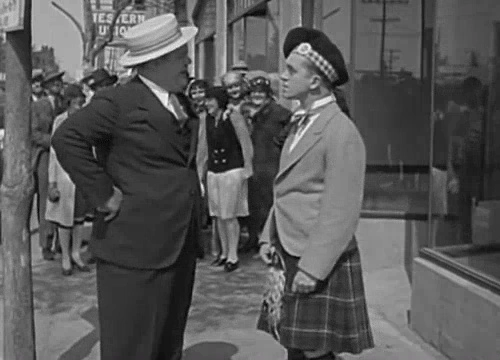
Like many of the best silent comedies, the storyline is very simplistic. Piedmont Mumblethunder (Oliver Hardy) is waiting to meet his Scottish nephew Phillip (Stan Laurel). Embarrassed by his nephew's kilt and how it keeps blowing upwards, Piedmont decides he has to get Phillip a pair of pants. Yet this might not be as easy as he would think.  

This is a truly wonderful silent comedy. It takes a very simple premise and gets a huge amount of great gags from it. There is a rapid succession of gags here and nearly every one of them works perfectly. What also makes the comedy so great here is that it relies heavily on variations on various reoccurring gags, such as Phillip chasing attractive women and crowds gathering around him. Each time on of these gag ideas reappears it simply gets funnier. This is because the film builds on these gags and adds something new that makes each one funnier. Towards the end of the film, each one of these reoccurring gags receives a perfect payoff. The movie also, of course, benefits greatly from Stan Laurel and Oliver Hardy themselves. Though their characters are not at all the Stan and Ollie characters we know and love, they play these roles perfectly, showing how good of actors these two truly were. Stan Laurel is especially wonderful in the scene in the tailor shop. With a lesser actor such a scene might have come off as distasteful, but with Stan playing the character, it is downright hilarious. While Oliver Hardy's character is not quite as eccentric as Stan's, he does a wonderful job reacting to all that is going on around him. Often times his reactions are just as funny as any of the gags themselves. 

I am certainly not alone in my love for this film. Producer Hal Roach considered this one of his favorite movies he produced along with the Harold Lloyd feature, Grandma's Boy (1922) and the Cary Grant slapstick comedy, Topper (1937). 


The director of this film was Clyde Bruckman. Clyde Bruckman is a man who deserves to be acknowledged as a great when it comes to movie comedy. He in fact co-directed one of the most beloved feature length silent comedies, Buster Keaton's The General (1925). As well as this he also was a writer on many of Buster's great silent feature films including Our Hospitality (1923), Sherlock Jr. (1924), The Navigator (1924), Seven Chances (1925) and The Cameraman (1928). Besides just Buster Keaton and Harold Lloyd, Bruckman also worked with many other comedy greats. He directed W.C. Fields in the short film, The Fatal Glass of Beer (1933) and the feature film, Man on the Flying Trapeze (1935). He directed the Harold Lloyd talkie feature, Movie Crazy (1932) and co-directed the Harold Lloyd talkie features Welcome Danger (1929) and Feet First (1930). He wrote many episodes of the 2nd season of Abbott and Costello's TV Show. If you are a Three Stooges fan who pays attention to credits you already know Clyde Bruckman's name for writing many of the classic Three Stooges shorts both during the Curly and Shemp eras. Unfortunately Bruckman would have a tragic end. Like many comedy writers Bruckman would often borrow from his previous work. This included comedy bits and sequences from the Harold Lloyd films he worked on. Harold Lloyd would sue over the uses of this material in his work for The Three Stooges, Abbott and Costello and some B movies he worked on at Universal. Because of this he would be dropped from these studios as they did not want another lawsuit. Afterwards no one wished to hire Bruckman because of this. Quickly this great talent became broke and slid into alcoholism. In 1955 he borrowed a pistol from his friend Buster Keaton, saying he was going to do some hunting. Instead he used the pistol to commit suicide in the restroom of a restraunt in Santa Monica California. The newspaper, Ocala Star-Banner stated, "The body of Clyde Bruckman, 60, was found yesterday. Police said he left them a type written note asking them to deliver his body to the Los Angeles County Medical Assn. or a medical school for experimental purposes and stating that 'I have no money to pay for a funeral.' It also asked that his wife Gladys who lives here be notified." 

Sam Lufkin, who plays the ship's doctor, has appeared in many films with Laurel and Hardy most famously as the cop in the duo's most famous short film, The Music Box (1932). He appeared in 39 films with the duo both shorts and features. His first film with the duo was Sugar Daddies (1927) and the last was Saps at Sea (1940). As well as working with Laurel and Hardy, he also appeared in 16 Three Stooges shorts and 11 Our Gang shorts. An attractive woman, who Stan chases in this film was played by Dorothy Corburn. She appeared in 12 films with Laurel and Hardy all of them either in 1927 or 1928. After her films with Laurel and Hardy, she would also be a stand in for Ginger Rogers and work as a stunt double on various westerns. 

This film was a pretty expensive picture for a comedy short, largely because of the location shooting and the sheer amount of extras involved. 


Motion Picture News, 1928

The following is a review from Movie Age Magazine. "Stan Laurel and Oliver Hardy supply the humor in this two reeler. Both gags and situations are dependable for laugh producing. The story concerns a young Scotsman who comes to America to visit his uncle. The Scot wears kilties through the streets of the American city which causes a great deal of excitement. The uncle can't keep him in check. Whenever the Scot gets lost, the uncle looks for a crowd and knows his nephew is in the center of it. A great deal of the comedy concerns the effort to put pants on the young fellow."

 The following is a review from The Film Daily, "A simple, but nonetheless effective idea, furnishes the comedy idea, which feature Stan Laurel and Oliver Hardy and which Leo McCarey directed. A young Scotsman, clad in kilts, arrives from the heatherland and his laughable appearance attracts crowd after crowd, causing much embarrassment to his unappreciative relative. Beautiful women are this strangers' weakness and this makes matters worse - and highly funny. Much of this film, which is generously loaded with laughs, shows the relative trying to put a pair of civilized pants on the Scotsman."

 The following is a review from The Motion Picture News. "This picture is much better than its title would indicate. Working greatly to the advantage of the film, and to the enjoyment of those who like laughs in their comedies, are Stan Laurel, a capital comedian, and Oliver Hardy, who knows many of the most effective tricks of screen fun making. Clyde Bruckman directed the piece. If he built up the story as well, he deserves credit for inventing some sure-fire gags. Along with that, he - if responsible he is - must take some criticism for playing too strongly on the incident of measuring Phillip for a pair of pants in the tailor shop. This is topped off with a bit of acting by Laurel which must be rated as excellent work from the acting standpoint. But it is comedy that seems just a bit too sophisticated for the average two reeler. The acting is an immensely clever burlesque, in a restrained fashion, of those scenes done by the ingenues who make their mistakes in the interests of screen and stage and story book plot. Phillip's flair for attracting crowds, because of the kilties and his admiration for the ladies, is the best bet of gags devised for this film. The story is about a Scot who comes to visit with his uncle in America. The uncle has his hands full trying to be inconspicuous in a town where men in kilts are a superlative novelty. The uncle can always locate Phillip by looking for a crowd - for he is certain to be the center of it, trying the explain to a cop just why he persists in some particularly comely young ladies. It is a diverting picture despite a rough spot here and there on its rather slick surface." 


Exhibitors Herald and Moving Picture World, 1928

If you are interested in seeing where this film was shot the following video does much better than I ever could.


And for anyone who is interested this film can be seen on YouTube below. 


Resources Used

Laurel and Hardy: The Magic Behind the Movies by Randy Skredvedt

https://mediahistoryproject.org/


Thursday, April 1, 2021

Silent Film of the Month: That's My Wife (1929)


Runtime: 20 Minutes. Studio: Hal Roach Studios. Director: Lloyd French. Story: Leo McCarey. Titles H.M. Walker. Main Cast: Stan Laurel, Oliver Hardy, Vivien Oakland,  William Courtright, Jimmy Aubrey. Cinematographer: George Stevens. Editor: Richard C. Currier. 

Since it is April Fools day, I can think of no better choice for a Silent Film of the Month than a Laurel and Hardy short. This month we are going to look at what is probably my favorite of the silent Laurel and Hardy films, That's My Wife

The premise of this film is very simple. Ollie (Oliver Hardy) will inherit a large amount of money from his uncle Bernal (William Courtright) if he is happily married. However his wife (Vivian Oakland) leaves him just before his uncle visits. There is of course only one way to still inherit the money. Stan (Stan Laurel) has to dress up as a woman and pretend to be Ollie's wife. Naturally this leads to many very funny comedic moments. 

The storyline and humor are pure Laurel and Hardy at their best and this stands up easily against any of their great talking pictures. I have had the pleasure of seeing this in a theatre with an audience and their reaction was extremely enthusiastic. There are few comedies past or present in which an audience reacts to the same way they do to a Laurel and Hardy film and this one caused an even greater reaction than normal for Stan and Ollie. Some of the biggest laughs for me come from Stan's pretending to be a woman. This would not be the last time he would get comedy out of female impersonation (in fact this was used as late as the Fox movies), yet it is by far the funniest. It also leads to some surprisingly risqué jokes for a Laurel and Hardy film (though risqué bits did appear occasionally in their work, most famously in Liberty (1928)). One of the best of these jokes involves Ollie giving Stan "breasts" for his disguise, a fantastic gag that never fails to make me laugh. This short is also a perfect example of what sets Laurel and Hardy apart from many other comedy teams. This is that there is real heart behind the relationship between the two characters. Despite all the hardships they inflict on themselves and each other, their friendship is the one thing that remains constant. This is true here as no matter how much hard luck Ollie has in this short the one thing he never loses is his friendship with Stan. Unlike other comedians who would often go out of their way to incorporate sentiment or heart into their films, this was never needed in a Laurel and Hardy film. That is because the heart was automatically there in the characters. Because of this the films could have this warmth and heart without ever once having to stop the laughs. 


Motion Picture World, 1930


The following is a very revealing exhibitor's review from Exhibitors Herald World, " THAT'S MY WIFE: Laurel-Hardy—This evidently was another knockout before the censors got in their work. Two reels.—S. B. Kennedy, Central Theater, Selkirk, Man. -General patronage." The following is another exhibitor's review from Exhibitor's Herald World, " 'That's My Wife.' Plenty of laughs, but not quite as many as in most of their previous ones. (C. A. Swircinsky, Majestic theatre, Washington, Kan, General Patronage." 

Jimmy Aubrey, who plays the drunk in this film had at one time been a part of Fred Karno's comedic theater group. Two other members had been Charlie Chaplin and Stan Laurel (who had been Chaplin's understudy). In 1917 Aubrey had starred in a series of short comedies directed by silent comedian Larry Semon (both Stan Laurel and Oliver Hardy had appeared in Larry Semon films before teaming (though never together)). Later in 1917 Aubrey moved to the Smallwood Film Company to star in a series of short comedies directed by C. Jay Williams and William A. Seiter (who would direct the Laurel and Hardy feature Sons of the Desert (1933)). In late 1918 he would begin to make another series of short comedies for Vitaphone. From 1919-1921, he would appear in multiple films with Oliver Hardy. When he made a series of shorts for Joe Rock beginning in 1924, he often worked with Laurel and Hardy regular, Anita Garvin. Anita would later state that some of Aubrey's films there were directed by Stan Laurel. Though he only appeared in two actual Laurel and Hardy films (this one and Their Purple Moment (1928)), as you can see much of his career had Laurel and Hardy connections. Former Ziegfeld girl Vivian Oakland had appeared in the Oliver Hardy solo film, Along Came Auntie (1926). Her other appearances with Laurel and Hardy include the pre-teaming shorts, Forty-Five Minutes From Hollywood (1926) and Love 'Em and Weep (1927), the talkie short, Scram! (1932) and the feature length, Way Out West (1937). Short comedy fans might also know her for appearing in the infamous short, Keystone Hotel (1935). Director Lloyd French worked almost exclusively in short subjects. He directed the fan favorite Laurel and Hardy short, Busy Bodies as well as shorts with The Boy Friends, Edgar Kennedy and Leon Errol. Writer Leo McCarey is often given credit for officially teaming Laurel and Hardy. McCarey would become one of Hollywood's best directors directing such features as Duck Soup (1933), Make Way For Tomorrow (1937), The Awful Truth (1937), Going My Way (1944) and An Affair to Remember (1957). Another great director who worked on this short was George Stevens (here the cinematographer) who would later direct such feature films as Swing Time (1936), Gunga Din (1939), Woman of the Year (1942), Shane (1953), Giant (1956) and The Dairy of Anne Frank (1959). 

1929 was a big year for Laurel and Hardy. This was the year they had made their last silent, Angora Love, their first talkie, Unaccustomed as We Are, and their first appearance in a feature film, Hollywood Revue of 1929 (unfortunately they received very little screen time here). It is also the year of some of the team's best short comedies including this short, Liberty, Wrong Again, Big Business, Men O' War and Perfect Day


Variety, 1929

You can watch this short on YouTube below.


Resources Used

https://laurel-and-hardy-blog.com/2019/02/09/30-thats-my-wife-1929/

A-Z of Silent Film Comedy by Glen Mitchell


Wednesday, May 20, 2020

My Top Classic Comfort Movies

Hello my friends, The Classic Movie Blog Association is having a blogathon in which various bloggers are posting their top 5 classic comfort movies. I personally would like to weigh in on my personal comfort movies. Three things first. Since this is about classic movies, I will include nothing after the 1950’s here. Also since cartoons and two reel comedies are such easy go-to films for comfort movies and would take up too much of this list, I will be limiting this list to only feature films. Last since this is my blog and I can do whatever I want I will be making a top ten list instead of a top five. Keep in mind that these are comfort movies. They are not what I consider the best films ever made and how though provoking or how impressive the filmmaking techniques are will have nothing to do with this list. These are simply movies, I watch when I feeling down and want a quick simple lift me up.

10. The Yodeling Kid From Pine Ridge (1937)

This movie is everything you could want from a Gene Autry film and in my opinion is one of his finest works. The story is rather slight but of course all we want from a film like this is fast paced action and good old fashioned country music. This movie gives us both of those in spades. Gene Autry gets to show just why he was known as the singing cowboy, perfectly crooning these old school country songs, and the band The Tennessee Ramblers also delight with their few performances in this movie. Comic relief and singer, Smiley Burnette gets one of his finest roles here as well.

9. My Pal Trigger (1946)

Being a lover of both horses and old B westerns, a Roy Rogers movie where Trigger in in the titular role of course has great appeal to me. It doesn't hurt that this is one of Roy's best films with fast paced action, great songs and more heart than you'd find in any other Roy Rogers movie. This is a treat.

8.  Buck Privates (1941)

Abbott and Costello Meet Frankenstein, Hold That Ghost and The Time of Their Lives are in my opinion Abbott and Costello's finest films, but Buck Privates holds a special place in my heart that those don't. It was the movie that turned me on to classic film comedy. I was a small kid and watching Abbott and Costello perform some of their great routines with such great youthful energy was the funniest thing I had ever seen. If I hadn't fallen in love with this movie perhaps I wouldn't have discovered Laurel and Hardy, Buster Keaton, The Marx Brothers, Harold Lloyd, Charlie Chaplin, Harry Langdon and so many more. The Andrew Sisters' musical numbers also taught me how great music was around before rock and roll. Whenever I watch this film, it brings me back to childhood and discovering my love of classic film comedy.

7. Sherlock Jr. (1924)

If The General is Buster Keaton's best made film, than Sherlock Jr. is his funniest. This barely feature length movie moves at a brisk pace and brings us gag after gag. What is incredible with this break neck pace and never stopping gags is that all of them work. This is the definition of a laugh out loud funny comedy and it has me doing that for its whole length.

6. The Gay Divorcee (1934)

Fred Astaire and Ginger Rogers never fail to brighten my mood. Their art is pure escapism at its finest and all of their movies put a smile on my face. These films exist in a world completely separate from ours. They do for urban life what Roy Rogers and Gene Autry movies did for western life. They romanticize it to a point where the films exist in their own reality that all of us wish we could live in and for the length of their movies we do live in it. It is hard to pick for a favorite among these movies, but The Gay Divorcee might be mine.  

5. Duck Soup (1933)

What do you get when you combine one of the great film directors (Leo McCarey) and one of the great comedy teams (The Marx Brothers)? One of the all time classic comedies. If there is a movie I can quote from beginning to end and do so often, it is Duck Soup. The Marx Brothers are at their best here and I laugh through the entire film each time I watch it. This movie will pick me up every time I feel even slightly down.

4. A Chump at Oxford (1944)

There is something initially heartwarming about Laurel and Hardy films. The friendship between these two characters is honestly quite lovely and because of this their movies never need to try for pathos or touching moments because it is already there in the relationship. This movie highlights the friendship between the two and the ending always makes me feel all warm inside. Despite this the rest of the film is completely made of classic slapstick comedy of the highest order. This feature has Stan and Ollie at their funniest and is one of my favorite features from the duo.

3. Dumbo (1941)
This is by far my favorite Disney animated feature film. As a huge cartoon fan I love that this movie is completely and unashamedly a cartoon. This is like a feature length Silly Symphony and I love every second of it. The world is so bright and colorful, the gags and musical numbers are so much fun and the emotional moments are so incredible effective. This is perfect filmmaking (animated or otherwise) at its finest.

2. For Heaven's Sake (1926)
Out of all of the Harold Lloyd films, this is the one I have watched more than any other. Yet I never get tired of it. This to me is one of the finest feature length silent comedies ever made. The jokes come fast and furious and all of them hit home perfectly. This movie has so many perfect silent comedy moments, such as how Harold gets all the drunks into the church building and the fantastic race to the chapel at the end. This is a film that once you see you will never forget. 

1. Show People (1928)

One of my favorite movies and a perfect mixture of comedy and romance. Marion Davies and William Haines receive their best roles in this movie and have perfect chemistry together. King Vidor is one of the all time best movie directors and gets to perfectly show why here. The humor here is absolutely perfect and I laugh out loud often whenever I watch it. Scenes such as Peggy trying to cry as well as her showing her range of acting emotions are as funny as anything done in any of the great silent comedies. As well as one of the all time great romantic comedies this is also a lovely tribute to silent film, not long before the silent era would be over. As a silent movie fan there is so much in this film from the cameos to the view of the classic studios to the excellent tributes to Mack Sennett and Keystone. A movie as delightful and fun as this is something that should be celebrated and no matter how many times I watch this film, I am never going to get tired of it.


-Michael J. Ruhland 

Thursday, September 12, 2019

A 4 Page Advertisement For "Going My Way" (1944)


Possibly my favorite director is Leo McCarey. I know this may not be a common choice for a favorite movie director, but looking at the man's output, I have no doubt he was one of the finest directors to ever come out of Hollywood. He could direct pure slapstick with Laurel and Hardy or The Marx Brothers, but could also turn out a film as touching and beautiful as any movie Hollywood ever put out, Make Way For Tomorrow (1937, a film which sadly never gets the attention and praise it fully deserves). I am also a huge fan of Bing Crosby, both as an actor and a singer. With this in mind it should come as no shocker that I absolutely love the movie, Going My Way (1944). This is a feel good movie that never fails to put a smile on my face. I am not alone in loving this movie, it was a huge hit upon its release and even won a Best Picture Oscar. Upon its release in 1944, the Motion Picture Herald ran a four page advertisement for the film which you can see below. Again if you have any problem reading any of these pages just click on them and use your touch screen to zoom in.


Now enjoy one of the classic songs from this movie, Swinging on A Star. Unfortunately I could not find the movie version on You Tube.


The song would later be used in a Little Lulu cartoon, A Bout With a Trout (1937). Obviously Paramount couldn't limit a song this good to just one film.


-Michael J. Ruhland


Wednesday, July 10, 2019

Michael's Christmas Movie Guide: Love Affair (1939)


Leo McCarey was one of the all time great American filmmakers (and my personal favorite director). He is often given credit for coming up with the idea to team Stan Laurel and Oliver Hardy. He directed the Marx Brothers in Duck Soup, and Harold Lloyd in The Milky Way. He also directed such classics as The Awful Truth, Going My Way, Make Way For Tomorrow, and The Bells of Saint Mary. I personally amazed Leo's name is rarely mentioned among such other greats of comedy direction during the 1930's and 40's such as Frank Capra and Preston Sturges. Leo is definitely one of the greats of screwball comedy.  With a director this good it is no wonder this film is so great.

Almost unbelievable for a film this great there was never a complete script. Pages of the script were changed almost daily. The actors never memorized the lines, because they felt they could easily be changed the next day. The rewrites were done for a reason. The first part of this film was more light-hearted and the second half was more dramatic. One suggestion was by Charles Boyer himself. He suggested a scene involving his character's grandmother (played by Maria Ouspenskaya) would play a bigger role in the story.

The story involves a man named Michel (played by Charles Boyer) and a woman named Terry (played by Irene Dunne). They meet on a boat and fall deeply in love with each other, despite the fact that both are engaged. They arrange to meet on the Empire State building. Unfortunately on her way there, Terry is hit by a car and becomes temporarily paralyzed. Terry doesn't want Michel to know she is paralyzed, so she can run to him when she is better. Michel is hurt by this as he doesn't know what happened. They meet again on Christmas, before Terry becomes better and she is afraid to admit it to him. However this meeting will change both their lives.

This movie is incredible. Everything in it is as good as it can be. The acting is great, the writing is fantastic, and the direction is as good as can be. The characters are more than just romantic comedy stereotypes and are very well thought out characters. On top of the comedy and romance, this movie features some fairly profound moments as well like those involving the grandmother. I couldn't recommend this movie more. By the way I am not the only one who holds this film in such a high regard. The film's stars Charles Boyer and Irene Dunne called this their personal favorite film they worked on.

Leo McCarey himself remade the film in 1957 as An Affair to Remember.

Below is an advertisement for the film in Boxoffice Magazine.The following is an exhibitor's review from The Motion Picture Herald (dated August 5, 1939)

"Love Affair: Irene Dunne, Charles Boyer - Very much enjoyed by my patrons. A refreshing story and the kids were great. Can recomend this one. Running Time 80 minutes. Played July 6 - A.L. Dove, Bengough Theatre, Bengough, Saskatchewan, Canada. Rural and small town panronage."

The following is another exhibitor's review from The Motion Picture Herald (dated May 27, 1939).

"Love Affair:  Irene Dunne, Charles Boyer - Although this did not draw as we expected it to, it certianly did please.Running time 89 minutes. Played April 25-26. - A.N. Miles, Eminice Theatre, Eminience, Ky. Small Town and rural pantroange."

Here is another exhibitor's review from The Motion Picture Herlad (dated October 28, 1939).

"Love Affair: Irene Dunne, Charles Boyer - Irene Dunne was born just a few miles from here and the local folks just lay a little claim to her because she is a Hoosier. She is always a good draw no matter how often played. 'Love Affair' is one of her best so they all said and that is good enough for me. Running Time 89 minutes. Played October 4-5. - Jim Haney, Milan Theatre, Milan, Ind. General pantroange."

-Michael J. Ruhland

Resources Used
http://www.tcm.com/tcmdb/title/3938/Love-Affair/articles.html

Tuesday, January 1, 2019

Old Town Music Hall New Years Eve Show


I have talked quite a bit on this blog about the Old Town Musical Hall in El Segundo, California.  This is one of the best places to see old movies and I think that all my fellow movie lovers should go there when they are in Southern California. Last night was their special New Years Eve show. Each year this show runs from 8:30pm to midnight and what is shown is always a complete surprise.

Like always before the films there was some live musical entertainment. This entertainment was on the Mighty Wurlitzer Organ, a huge 1925 pipe organ created to accompany silent movies. First was the talented young Edward Torres doing a highly entertaining duet with a player piano. He then followed this with a great performance of The Lady is a Tramp. After this the one and only Bill Field took over the organ and played a large selection of songs dating from the early 20th century to the late 1940's. After this there was a delightful sing along which included such old standards as Down By the Old Mill Stream, When the Red Robin Comes Bob Bob Bobbing Along, My Bonnie Lies Over the Ocean, Smiles and Let's All Sing Like the Birdies Do.

After this we started the films. First up was The Battle of the Century (1927) with Laurel and Hardy. This is one of the greatest Laurel and Hardy shorts and one of the best silent comedies ever created. This film is famous for having the largest and funniest pie fight ever created for films. This film shows what Laurel and Hardy do best. It takes a simple and small little idea and gradually brings it to something unbelievably over the top and massive. No short shows this better than this. The lengths this pie fight goes to is truly a sight to behold. I have seen and loved this film plenty of times before but I had never seen it before with a live audience. This made the film feel so fresh and new, as well as even funnier than ever before. For those of you who have never watched a Laurel and Hardy film in this context, there is probably no better audience pleasers than Laurel and Hardy. You rarely hear an audience laugh the way at any comedy (old or new) as they do at Laurel and Hardy. Because this was a silent film, it was accompanied live by Bill Field on the Mighty Wurlitzer organ. To see a silent film with live musical accompaniment is something I believe everybody should do in their lives, it is like no other experience in the world. This was followed by a cartoon, Betty Boop's Penthouse (1933). This is a typically great Betty Boop cartoon of this era. Like all the best Betty Boop cartoons, the best word to describe this film is imaginative. There is so much clever imagination and surreal humor in this cartoon that I and the rest of the audience found irresistible. After this came an enjoyable Charley Chase short, Arabian Tights (1933). Charley is one of the great screen comedians of his day, but rarely gets the appreciation he deserves. To be honest this is not his best short film, but it is highly entertaining regardless. It also is a great showcase for Chase's singing talents.

After an intermission filled with free cookies and hot apple cider, we got our feature film of the night. This was The Man on the Flying Trapeze (1935), staring the one and only W. C. Fields. This is a hilarious feature film and the perfect way to finish our watching. There is not much of a story in this movie, but that is not important. What is important is just how funny this film is. This movie features Fields in one of his put upon man roles. This means he plays a character who is good hearted but keeps finding himself in more trouble. The crazy extant these troubles go to is hilarious and a sight to behold. Just when you think things can't get worse for him or funnier for us they do. This all leads up to an extremely satisficing ending, that is impossible not to like.

After the feature it was exactly a minute to midnight. We all had our countdown with an animated ball dropping on the screen. Then we all sang Auld Lang Syne together. What better way to ring in the new year can there be.

This is done each year (except with different films) and if you are able to go next year, I could not recommend it more. Also just drop into the Old Town Music Hall for any show (there is one almost every week). To look at a schedule click here. 

Happy New Year and God Bless.

-Michael J. Ruhland            

Saturday, December 15, 2018

Celebrating Christmas With Laurel and Hardy at the Old Town Music Hall

This weekend is the annual Christmas festival at the Old Town Music Hall in El Segundo, California. I was able to see last night's show and loved it. This festival is always a treat and this year was no exception. As I have mentioned many times, the Old Town Music Hall is one of my favorite places to see old movies and a place that I recommend all my fellow film lovers go to when they are in Southern California. If you are interested in going (and why wouldn't you be) you can see the schedule and what movies are coming up here.

There was a Laurel and Hardy theme this year, which was no problem with me or anyone else there. The films this year included both a silent Laurel and Hardy short and a sound feature, both Christmas themed.

The silent short was Big Business (1929). This may be the duo's best silent comedy and maybe one of the laugh out loud funniest silent comedies. In this film Stan and Ollie are selling Christmas trees in California. They aren't very good at this and fail to sell one to their first two customers. Their third customer though is when their real problems begin. This customer is the one and only James Finlayson (one of the best supporting comic actors in the history of the movies and one that has proved on various occasions to be the perfect foil for Laurel and Hardy). At first this is just another customer who doesn't want a Christmas tree. However when he closes the door and the Christmas tree gets caught in it, this ends up causing one of the biggest slapstick fights in silent comedy history. Supposedly this film was originally going to revolve around Stan and Ollie trying to sell Christmas trees to each new customer, with the James Finlayson scenes playing a smaller role, but the crew found out that this was the funniest part of the movie and that most of the film should revolve around that.

This film perfectly shows what Laurel and Hardy do best. It follows their familiar, but surefire formula of tit for tat. Someone does something to Stan and Ollie, and they do something back to him. This continues until it reaches ridiculous extremes. This in the end represents another essential element of many of the duo's best movies taking a simple idea and pushing it to ridiculous extremes in a surprisingly believable way. This is one of the most pure and funniest examples of both these formulas and therefore one of the duo's laugh out loud funniest films, silent or sound. This is as good as it gets.

The great thing about the Old Town Music Hall is that I got to see this film the way it was intended to be seen. This is with an audience and with live musical accompaniment (by the very talented Bill Field on the Mighty Wurlitzer Organ (a vintage 1925 organ that was made to accompany silent movies)). If you have never been able to see a silent film this way you are missing out. This is a completely different experience than watching these film on TV or DVD and is something I think every film lover should do in their life. The film feels so new and fresh, even to someone who has seen it as many times as I have. This showing also proves that the film is still a crowd pleaser, as the audience was in hysterics. It is rare to see a movie audience enjoying themselves as much as one watching Laurel and Hardy, and with a film like Big Business, this is especially true.
 
After an intermission we watched the feature film, Babes in Toyland (1934, also with Laurel and Hardy). I have written about this film before on this blog as you can read here. Because of this I won't write much about the movie here, but what I will say is like Big Business this is a perfect crowd pleaser. The audience was howling with laughter at the funny scenes here and again seeing it with an audience again made it feel fresh and new even to someone who has seen this movie as many times as I have. If you have a chance to see this with an audience don't miss it for the world.

Like all shows at the Old Town Music Hall, the films were not the only part of the night. Before hand we got treated to some music on the Mighty Wurlitzer. First a very talented young man named Edward Torres played a medley of to two classic Christmas songs from the 1940's and then the incredibly talented Bill Field took over playing a medley of many great Christmas carols. This was followed by a sing-a-long where all the words appeared on the screen. These songs included White Christmas, Santa Claus is Coming to Town, Frosty the Snowman, Jingle Bells and Silver Bells.


I believe going to the movies should be an experience and a great night out and the Old Town Music Hall always provides just that. Again if you are ever in Southern California this place is a must go.


-Michael J. Ruhland     


Sunday, December 9, 2018

The Bells of St. Mary's (1945) at the Old Town Music Hall

Yesterday I had the great pleasure of seeing The Bells of St. Mary's at the Old Town Music Hall in El Segundo California.


Like always at the Old Town Music Hall, the feature film did not take up the whole show. Before this Bill Field played us a medley of Christmas carols on the Mighty Wurlitzer Organ (a pipe organ that dates back to 1925 and was designed to accompany silent movies), this was followed by a sing along of classic Christmas songs including Santa Claus is Coming To Town, Frosty the Snowman, Silent Night, Jingle Bells, and White Christmas.

 After this we were treated to a 1923 silent version of A Christmas Carol entitled Scrooge. This film was accompanied by Bill Field on the Mighty Wurlitzer Organ. Now if you have never seen a silent movie with live musical accompaniment I must urge you to do so. There is nothing quite like it and it is a completely different experience from watching these films on DVD or TCM. The short itself is a fascinating one. It is a short film that condenses the story to a 25 minute short. As such there is quite a bit of the story we all know not included here. For instance Bob Cratchit's family is never seen and this includes Tiny Tim. The ghosts all show Scrooge only one vision each and seem to disappear as quickly as they appear. Still it is quite a good film in its own right. Russell Thorndike is delightful as Scrooge giving a very human performance and the special effects are quite good and hold up very well.

After a brief intermission came our feature film and what a great movie it is. Leo McCarey is one of my all time favorite directors and this movie shows perfectly why. It blends gentle comedy, sentimentality, great characters and an excellent sense of atmosphere perfectly. Bing Crosby is excellent in the main role (who had earlier appeared in Going My Way (1944)) and shows that he was an incredible actor as well as a singer. Speaking about his singing, he sings some great songs here. Ingrid Bergman is also fantastic in her role. She has perfect chemistry with Bing and provides some of this films most charming moments. Though these two often get all the praise for the movie's great acting, but young Joan Carroll as Pasty is just as amazing here. Her performance is amazingly human and hits every mark from comedy to sentimentality perfectly.

This movie has a very light story, but this is a major part of this film's charm. The film isn't about some big storyline instead it is about these characters. The characters are so real and human. This is also an uplifting movie that can never fail to put a smile on my face. A cynic can argue that the things that happen in this movie could never happen in real life, but the rest of us will fall completely under its spell. This is a movie that shows there is good in all humanity, and all one needs to do is look for it to make it evident. If you can get rid of the cynic inside you for just a tiny bit, it is not hard to fall in love with this movie's sentimentality and believe in good once again (even if it is only for 2 hours and 6 minutes). McCarey was a devout Catholic and that leads this movie to have a charm many directors could not have brought to it, as it is a movie about the rewards of faith and patience showing this with an honesty and respect that few directors could have bought to the screen so effectively. As a Christian myself (though protestant) this message fully hit home with me.  

This is a movie of undeniably charm and it is full of fantastic little moments such as Pasty's report on the sixth sense, Sister Mary teaching a young boy how to box (despite knowing nothing about it herself) and the school Christmas pageant. These scenes are so charming they might even win over those cynics I mentioned earlier.


The Old Town Music Hall is one of my favorite places to watch old movies and if any of you go to (or live in) Southern California, I couldn't recommend it more. To look at their schedule click here. 

Merry Christmas and God bless.      
-Michael J. Ruhland 

Saturday, September 1, 2018

Silent Film of the Month: Isn't Life Terrrible (1925)

Run Time: 25 minutes. Studio: Hal Roach Studios. Director: Leo McCarey.  Main Cast: Charley Chase, Katherine Grant, Oliver Hardy, Lon Puff. Producer: Hal Roach. Cinematographers: Fred Jackman, Len Powers.


While Charley Chase may not be as well remembered as Charlie Chaplin, Buster Keaton, Harold Lloyd or Laurel and Hardy, he is certainty not without his fans today. There are quite a few of my fellow silent film fans, whose eyes light up when talking about Chase's films. One viewing of one of his classic short subject perfectly show why his fans today, though not as numerous as Chaplin or Keaton fans, love Charley so much. These are fast paced and extremely funny movies that never fail to make me laugh each time I see them. This is why this month we are going to look at one of Charley Chase's many great comedies, Isn't Life Terrible.

Like most of Charley Chase's best silent films this one was directed by Leo McCarey. McCarey may be one of the finest directors in the history of Hollywood. He showed his comedic talents not only with not only Charley Chase, but also Laurel and Hardy (directing some of that team's best shorts as well), The Marx Brothers (he directed the infamous Duck Soup) and Harold Lloyd (He directed The Milky Way, one of Lloyd's best talkies). However his filmography includes much more than just this. He also directed such widely hailed classics as Make Way For Tomorrow, The Awful Truth, Love Affair, Going My Way, The Bells of St. Mary and An Affair to Remember. His short comedies with Charley Chase alone, show why he was a master director. The humor in this shorts comes fast and often, yet never seems to miss the mark. Isn't Life Terrible is a fantastic example of just this.


In this film Charley plays a hard working man with a wife (Katherine Grant) and daughter (Nancy McKee) who is looking forward to a camping vacation. However his wife talks him into them all going on a cruise. This doesn't work put well as soon their luggage falls into the ocean and they wind up with the wrong child (Dorothy Morrison (Younger sister of Our Gang's Ernie Morrison)). Things get worse when Charley learns that the ship is falling apart and becomes a nervous wreck.

There is so much I enjoy about this short. I love Charley's reactions to the ship falling apart. I also really enjoy seeing a young Oliver Hardy (credited here as "Babe" Hardy (Babe being his real life nickname)) in a very different role as the extremely lazy brother in law, who does nothing but get Charley into trouble. He (as he does in many of his early films) shows that he is adept at playing characters quite different from Ollie in the Laurel and Hardy films. My favorite bit of humor is that when they wind up with the wrong child, at first this kid follows them around, but soon becomes as good as a member of the family. Most of all though this is just an extremely funny short showing Charley Chase and Leo McCarey at their best.

Around the time of this short, Charley's co-star Katherine Grant signed a 5 year contract with Hal Roach. To read an article from Moving Picture World about this film click here.


In 1932 one could rent a 16mm version of this film to play on a home projector for $2.50. To see the advertisement click here.  In 1936 it could be ordered for $2. To see that advertisement click here.

To see an original review of this film in Moving Picture World click here. Despite this film being a Hal Roach comedy, a review in Exhibitors World Herald refers to this as a Mack Sennett comedy, you can read this review by clicking here.

-Michael J. Ruhland 

Saturday, February 10, 2018

Highly Recomended Romantic Movies.

So with Valentines Day being close, I felt it was only natural that I share what I feel are some great romantic movies. This is not a list of the best romantic films ever made or my absolute favorites (I may have left one or two of my favorites out without even thinking about it). However what I am sharing is a list of some I highly recommend to my readers.


City Lights (1931) This is considered by many film buffs to be Chaplin's best film. I am not here to either confirm or argue with that, instead I am just going to say what a great movie this is. This film is the prefect blend of comedy and romance. The humor is absolutely hilarious and no matter how many times you see this movie it never gets old. The boxing match scene is about as great as a comedy set-piece can get. However none of this takes away from simply how touching the romance is. This romance is fully realized and perfectly developed. You believe the relationship between these two characters perfectly, and all this is done so subtly you don't even notice yourself become more attached to them. Also what can I say about the ending that hasn't already been said, it is powerful and unbelievable moving.

The Big Sick (2017) If this movie feels more real than most current romantic comedies that is because it is a true story, written by those who lived this story. Kumail Nanjiani (who is also the star of the movie) and Emily V. Gordon wrote this script based on their own lives and their own romances. It took them three years to write this script and the effort clearly shows on screen. Every second of this film is filled with a powerful sense of honesty. Even with all the great emotional moments of this film, the comedy is often times laugh out loud funny and the whole movie is a delight to watch.

Priceless (2006) This French romantic-comedy is completely and utterly delightful. One reason for this is that the main characters feel so real. Neither are simple and phoned in as too many characters in bad romantic comedies seem to be. They have various facets to their personalities. They don't always do the excepted, but everything they do feels completely natural and believable. This is because their personalities are much more than the one note characters we see too often in these type of movies. Adding to this is the fantastic performances by Audrey Tautou and Gad Emaleh, who bring so much conviction and likeability to their characters. Director, Pierre Salvadori and writer, Benoit Graffin also know how to balance the humor and sweetness needed for this picture. Nothing feels forced here and every element comes together to create a truly sweet and charming movie.

Sunrise: A Song of Two Humans (1927) F.W. Murnau's first American film is one of the finest romances ever put on film and one of the greatest dramatic films of the silent era. This movie is perfectly executed. Each shot looks absolutely incredible. Not only does it look great but as in many of the best silent movies, the look of the movie perfectly enhances the story, as it brings us further and further into the minds of these characters. There is not a wasted moment in this film as each moment brings us a touch of real raw humanity that even many of today's greatest filmmakers would envy. The scene where the main couple wanders into a church and sees a young couple stating their vows is one of the most powerful scenes in movie history. Adding to this is that George O'Brien and Janet Gaynor give some of the best performances of their careers.

Casablanca (1942) What can I simply say about this movie that hasn't all ready been said a thousand times. This is a movie that offers everything for everybody. There is action, drama, suspense, comedy and of course romance. Humphry Bogart and Ingrid Bergman light up the film, each time they appear together. Their chemistry is so powerful, that all they have to do is look at each other and we are already moved by their romance. One of the greatest movies of all time and a film that will never be overrated.

Flesh and the Devil (1926) There is no doubt about it this silent film is sexiness personified. The looks Greta Garbo and John Gilbert share are the sexiest moments ever put on film. Much more is accomplished with a look than can ever be seen in any nudity or graphic sex scenes seen in movies today. There has never nor will their ever be another screen couple like them. The chemistry is some of the finest ever seen in the movies. The story may be a little corny, but it too has a real charm to it. One of the must watch silent films.

Jules and Jim (1962) This is one of the finest films of the French New Wave movement and one of director François Truffaut's best. The power and beauty of this movie is unbelievable. Truffaut brings us one of the most lyrical films ever made. The intimacy felt between the characters is also fully felt by the audience watching. I don't want to go much more into this film because it is definitely that has to be watched to be experienced and any description will fail to do it justice. I will say though this movie is one you will do much more than watch you will experience it instead. The images and characters will live on in your mind long after watching.      

Lady and the Tramp (1955) This movie amounts to one of the finest animated features to come from the Disney studio after the 1940's. Everything just works in this classic film. The music is great. The characters are great. The animation is amazing and the whole film just has such a lovely perfect feeling to it. This is just such a great film to look at. The animation and backgrounds are just lovely all the way throughout. The romance is one of Disney's best, it is fully believable and perfectly handled. Of course the songs are also great, and they enhance every scene they are in.

The Awful Truth (1937) This is one of the most laugh out loud funny romantic comedies ever made. The humor is perfectly written and executed and there is never a moment in this film that does not entertain fully and completely. Leo McCarey is one of the finest American directors and this movie perfectly shows why. He not only makes an unbelievably funny screwball comedy here, but the romance is actually quite fun and engaging. Having Cary Grant and Irene Dunne does hurt the film at all and Ralph Bellamy is perfect in his supporting role. To say they don't make them like this any more is an understatement and how any one could resist this film's charm is beyond me.
Waking the Dead (2000) This is a real rarity. It is a film that is both extremely touching and intelligent. You never know where this movie's story is heading. Yet the film perfectly pulls you into the power and beauty of what you are seeing. This movie is told in a rather interesting way. Though it was shot in chorological order, the movie itself jumps back and forth from the past and the present. It was shot to make the relationship between the couple all the more real and natural. From looking at the movie this worked like a charm. What really makes this movie so powerful is that every scene these characters share is so real and believable. You feel the compassion between the two characters in a way you do in too few movie romances.This film also has an incredible look to it. On a fairly low budget the filmmakers created something that looks more powerful than many of the big budget CGI-heavy movies out there.  All in all this is a fantastic movie and simply a must watch. 

-Michael J. Ruhland